


.svg)
The Department has invested billions in systems, data platforms, and enterprise services. The infrastructure exists.
The challenge is consistency. Data moves across the organizations, environments, and classification levels, but it does not carry the same meaning everywhere it goes. Every new integration adds complexity. Every new system introduces another interpretation of the same data. Over time, the burden shifts from using data to reconciling it.
This is not a data problem. It is the reasoning problem Torch's AI infrastructure solves.
Torch provides government-owned reasoning infrastructure that operates across Defense Agency
environments and enterprise systems. It does not replace systems of record. It enables them to function as a coherent whole.
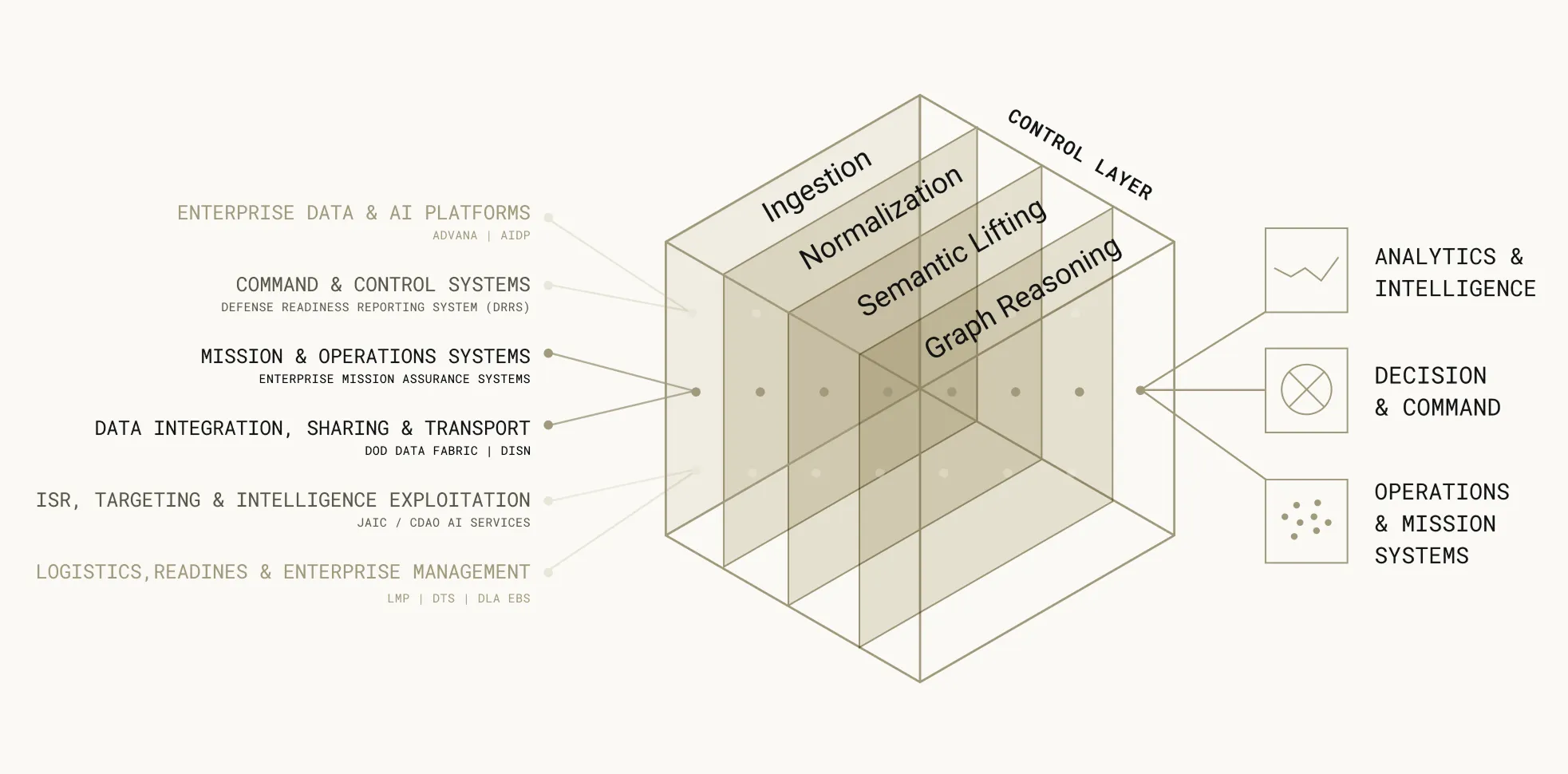
The control layer serves as a data integration and enhancement layer that sits across enterprise data platforms, oversight & planning systems, mission support systems, enterprise data fabrics, and enterprise operational systems.
It continuously aligns data across organizations, domains, and classification levels, preserving context and making it usable in real time. Instead of forcing programs to reconcile fragmented datasets, it ensures that data is already consistent when accessed.
This includes operating across environments supported by enterprise platforms and services
such as Advana, enterprise resource planning systems,financial management systems, cross-domain solutions, and shared data services.
Torch integrates the data and infrastructure layer, enabling these environments to operate on shared, aligned context rather than isolated data streams.

ORCUS ingests and synchronizes data across enterprise data platforms, oversight & planning systems, mission support systems, enterprise data fabrics, and enterprise operational systems. It handles high-volume data movement across organizations, domains, and classification levels, ensuring that data from different systems is continuously available and aligned.
It supports Department-wide data flows without requiring point-to-point integrations for each use case, enabling scalable interoperability across programs and agencies.

NEXUS transforms that data into high-fidelity semantic representations that encode meaning, time, and context together. Data from financial systems, logistics platforms, operational systems, and enterprise services becomes part of a unified structure that supports consistent interpretation.
This allows different organizations to operate on the same data with the same understanding, reducing ambiguity and eliminating repeated translation and reconciliation across systems.

HALO applies graph-based reasoning to map relationships between entities, transactions, systems, and events across the enterprise. It connects data directly to decision-making and analytical systems, supporting cross-mission insight and coordination. Relationships are continuously maintained, enabling agencies to understand how data and activities relate across organizational and system boundaries.
Together, ORCUS, NEXUS, and HALO allow Defense Agency systems to operate on coherent, continuously aligned data instead of fragmented inputs.
Within Defense Agencies, the reasoning infrastructure operates in environments where scale, reliability, and accountability are non-negotiable.
Torch reasoning infrastructure is being deployed in support of Department-wide financial data environments, processing more than one billion transactions annually and helping the DoW inspect and pass audits. In this context, it aligns high-volume, operational and transaction-based data across systems, ensuring consistency, auditability, and real-time usability at enterprise scale.
It enables alignment of data across enterprise systems, supporting consistent access and interpretation across programs and organizations. It supports shared services by ensuring that data provided to the Department carries consistent meaning and context, regardless of source.
It enables cross-domain and cross-mission interoperability by aligning data at the semantic level, reducing the need for custom integration and manual reconciliation.
These are not separate capabilities. They are applications of the same underlying infrastructure, adapted to operate at enterprise scale across the Department.
The reasoning infrastructure integrates across existing Defense Agency systems enterprise data platforms (such as Advana), oversight & planning systems, mission support systems, enterprise data fabrics, and enterprise operational systems.
Data from multiple organizations, environments, and classification levels flows into a shared structure where
it can be aligned, understood, and accessed consistently.
Outputs support enterprise services, mission applications, and decision systems across the Department, enabling reuse, interoperability, and scalable access.
Deployed across Department of War environments with ATOs across multiple classification enclaves and secure environments. Operates across enterprise infrastructure, cross-domain environments, and shared services architectures. Integrates with existing systems using standardized interfaces without requiring replacement.
Supports continuous software development and alignment with evolving enterprise standards, policies, and governance requirements.
Defense Agencies enable the Department to operate on shared understanding instead of fragmented data. Enterprise systems provide consistent, aligned data that can be used across missions without rework. Interoperability improves across organizations, reducing integration burden and increasing reuse.
Auditability and accountability are strengthened through consistent, aligned data across financial and operational systems. The Department gains a foundation for operating at scale with coherent, mission-ready data.
This is not another system.
It is the infrastructure that allows the enterprise to function as intended. See how this reasoning infrastructure deploys into existing Defense Agency environments.