


.svg)
Two analysts can review the same reporting and reach different conclusions. Not because one is wrong, but because the context is incomplete.
Intelligence is built from multiple sources,discipline and perspectives. That diversity is its strength, but also its challenge. Information does not arrive pre-aligned. Analysts must reconcile meaning, confidence, and context across sources before they can assess what is actually happening.
This is not a data problem. It is the reasoning problem Torch's AI infrastructure solves.
Torch provides a government-owned AI reasoning foundation that operates across existing intelligence systems. It does not replace systems of record. It enables them to function as a coherent analytic environment.
Torch's software infrastructure serves as a data integration and enhancement layer that sits between collection, processing, and analytic systems. It continuously aligns data across sources, disciplines, and classification boundaries, preserving provenance, context,and temporal relationships. Instead of forcing analysts to reconcile fragmented inputs, it ensures that information is already structured for understanding when it reaches them.
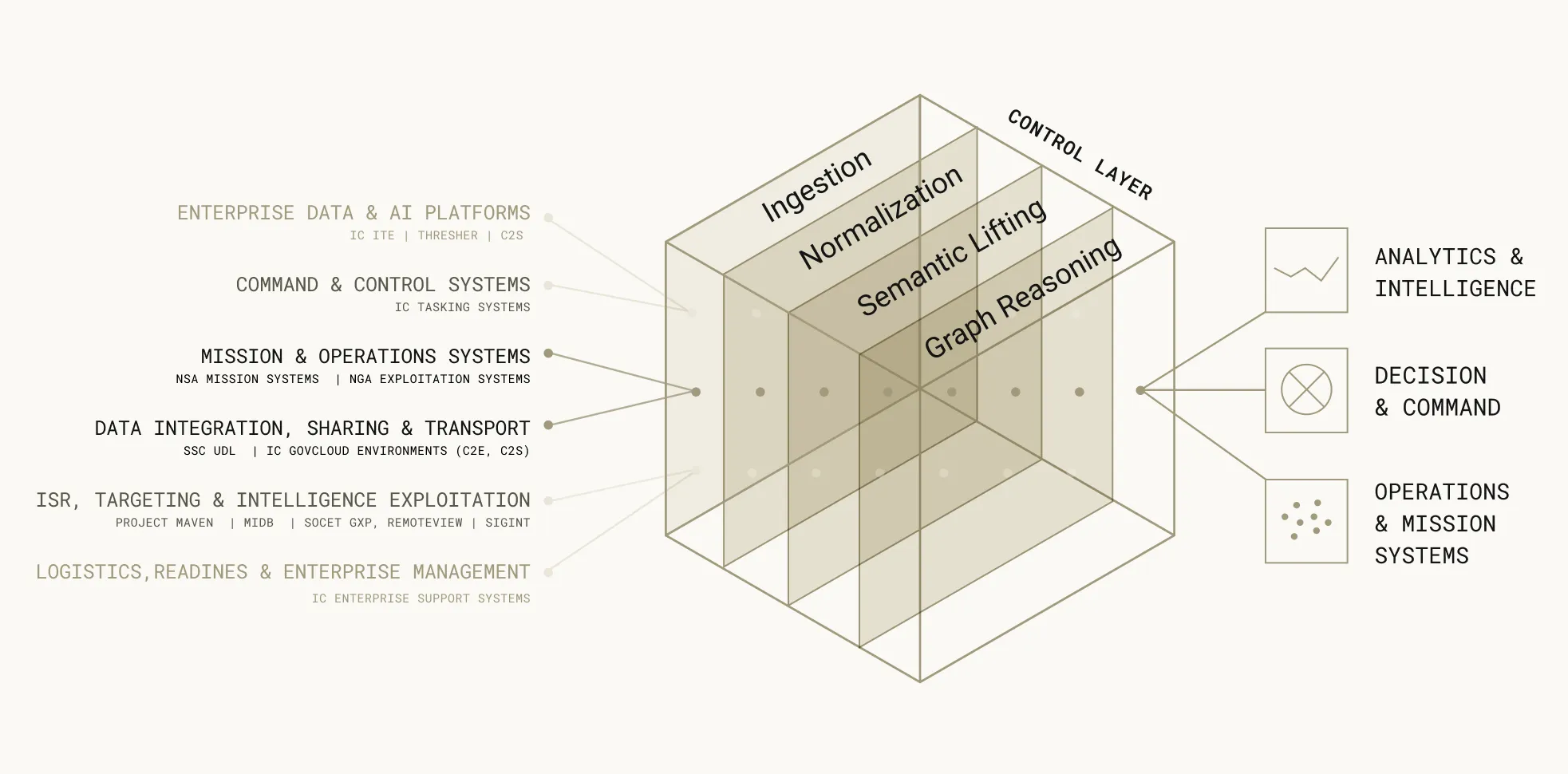
This includes operating within environments supported by data fabric and mesh implementations, data integration and transport layers, frameworks, ISR, targeting & intelligence exploitation systems, enterprise cyber platforms, and network operations systems.
Torch integrates the data and infrastructure layer, enabling these environments to operate on shared, aligned context rather than isolated data streams.

ORCUS ingests and synchronizes data across intelligence sources and systems. It handles inputs from HUMINT, SIGINT,GEOINT, OSINT, financial and economic, identity and biometrics, cyber and electromagnetic, and partner reporting, aligning them into a continuous, usable flow.
It preserves source integrity and provenance while enabling data from different disciplines to be used together without manual normalization. This supports multi-INT integration and reduces the burden of data preparation on analysts.

NEXUS encodes meaning, time, location, and context together. Instead of isolating reporting by discipline or format, information becomes part of a unified structure that supports correlation across sources.
This allows analysts to move beyond data aggregation to true understanding. Relationships between events, entities, and patterns emerge across disciplines, supporting deeper insight and more defensible analysis.

HALO applies graph-based reasoning to map relationships between entities, events, sources, and activities. It supports analytic workflows by connecting data directly to reasoning, enabling analysts to explore, test, and refine hypotheses with full context.
Relationships are continuously maintained and updated, allowing analytic conclusions to be traced, explained, and revisited as new information arrives.
Together, ORCUS, NEXUS, and HALO allow intelligence systems to operate on coherent, continuously aligned data instead of fragmented reporting.
Environments where rigor, provenance, and defensibility are essential. Torch enables alignment of data across disciplines, supporting true multi-INT analysis without forcing analysts to manually reconcile sources. It preserves source context and confidence, allowing analytic conclusions to be traced back to underlying reporting.
Instances support collaboration across organizations by ensuring that data carries consistent meaning and structure as it moves between agencies and mission areas.
Torch enables faster, more confident assessments by delivering context-rich information that can be evaluated immediately.
These are not separate capabilities. They are applications of the same underlying infrastructure, adapted to environments where accuracy, trust, and analytic integrity determine outcomes.
The reasoning infrastructure integrates across existing intelligence systems, including data fabric and mesh implementations, data integration and transport layers, frameworks, and cross-domain solutions, ISR, targeting & intelligence exploitation systems, and enterprise cyber platforms and network operations systems. Data from multiple sources, agencies, and classification levels flows into a shared structure where it can be aligned, understood, and analyzed consistently.
Outputs support analytic workflows, production environments, and decision support systems, enabling insight generation and dissemination across the community.
With ATOs across multiple classification enclaves and secure environments. Operates across enterprise and mission-specific environments, including cross-domain and compartmented conditions. Integrates with existing systems using standardized interfaces without requiring replacement.
Supports continuous software development and rapid adaptation to evolving operational requirements.
Analysts operate on shared understanding across sources and disciplines instead of
fragmented reporting. Time spent
reconciling data decreases. Time spent assessing meaning increases.
Analytic conclusions are more defensible, with clear traceability to underlying sources and context. Collaboration across
organizations improves, supported by
consistent data and shared structure.
Decision-makers receive insight that is timely, contextual,and grounded in integrated understanding.
This is not another system.
It is the infrastructure that allows intelligence to function as a coherent discipline. See how this reasoning infrastructure deploys
into existing intelligence environments.