


.svg)
Joint operations do not fail for lack of data. They fail when data cannot be reconciled across services, domains, and authorities fast enough to support a decision.
Each service brings its own systems, data standards, and operational context. Combatant Commands operate across all of them, while coordinating with coalition partners, national agencies, and mission-specific environments. Information exists everywhere, but it does not arrive aligned; it does not carry shared meaning. And it doesnot resolve differences in interpretation.
The result is friction. Time is lost reconciling data instead of acting on it. Decisions are delayed not because information is unavailable, but because it is not coherent across the joint force.
This is not a data problem. It is the reasoning problem Torch's AI infrastructure solves.
Torch provides a government-owned reasoning foundation that operates across existing Joint systems. It does not replace systems of record. It enables them to function together.
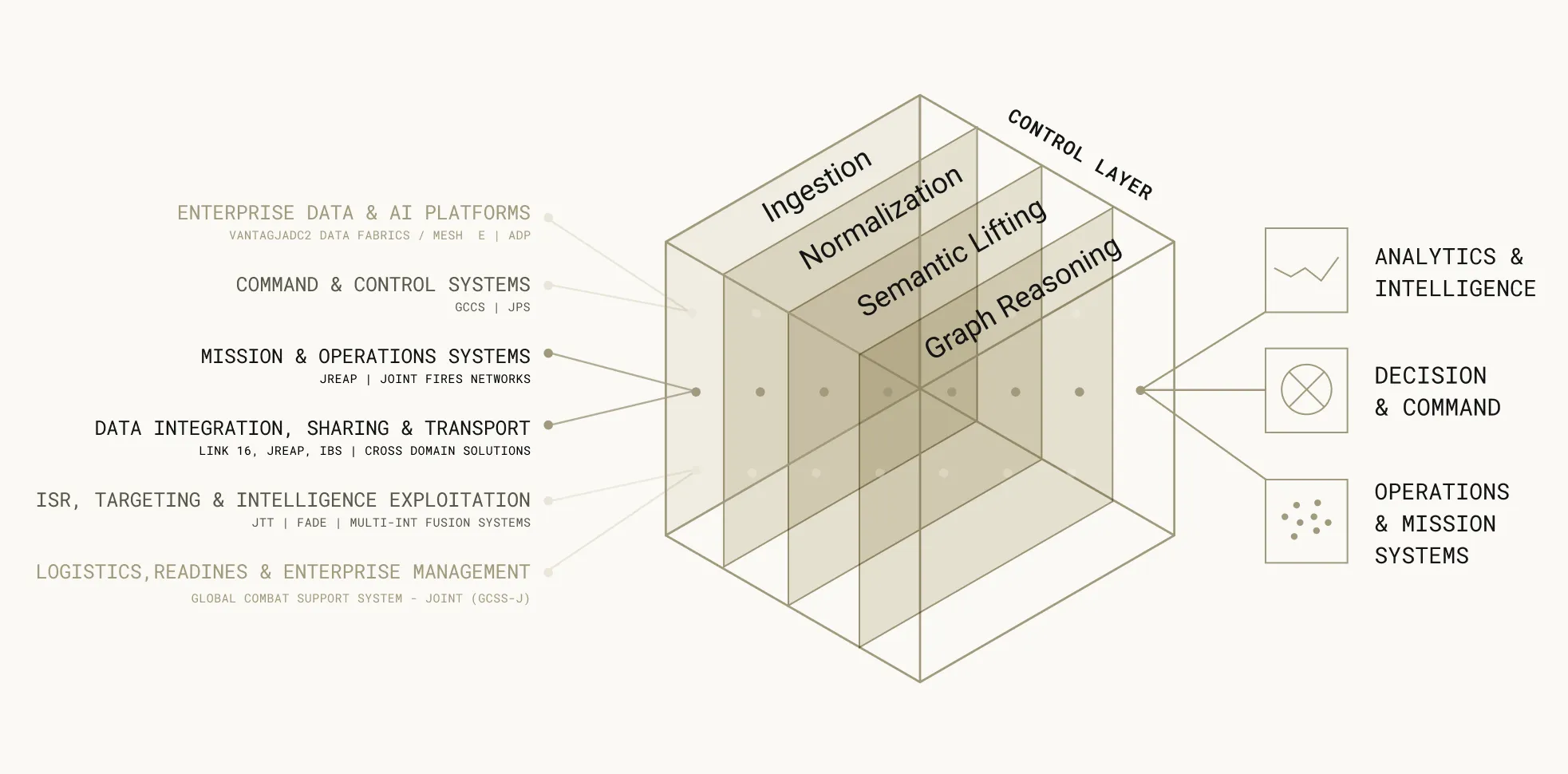
With Torch, the Joint Force gains a software infrastructure that serves as a data integration and enhancement layer that sits between service-level systems, including JADC2 data environments, joint C2 systems, joint mission systems and multi-domain operational platforms, tactical data links
and cross domain solutions, joint targeting and multi-INT fusion platforms, and joint logistics coordination systems. It continuously aligns data across domains, commands, and authorities, preserving context and making it usable in real time. Instead of forcing staffs to reconcile conflicting inputs from multiple sources, it ensures that information is already coherent when it reaches them.
This includes operating across environments supported by Joint command and control systems, service-specific platforms, coalition data sources, and national-level intelligence systems.
Torch integrates at the data and infrastructure layer, allowing these systems to operate on shared, mission-aligned context rather than disconnected data streams.

ORCUS ingests and synchronizes data across service systems, Joint command environments, and external partners. It handles continuous inputs from air, land, maritime, space, cyber, and intelligence systems, aligning them into a single operational flow.
It ensures that data from different services and domains can be used together without manual reconciliation. This supports joint planning, cross-domain operations, and real-time execution across combatant commands.

NEXUS transforms that data into high-fidelity semantic representations that encode meaning, time, and location together. Data from service systems, Joint platforms, and coalition inputs becomes part of a unified structure that supports correlation across domains.
It enables the joint force to move beyond data sharing toward shared understanding. Differences in format, terminology, and structure are resolved into a common semantic foundation that supports planning and execution.

HALO applies graph-based reasoning to map relationships between forces, assets, events, and operational conditions across the Joint environment. It connects data directly to decision-making systems, supporting Joint planning, targeting, and operational coordination. Relationships across services and domains are continuously updated, enabling staffs and commanders to maintain a coherent picture of the operational environment and act with greater speed and confidence.
Together, ORCUS, NEXUS, and HALO allow Joint systems to operate on coherent, continuously aligned data instead of fragmented inputs.
Within Joint organizations, the reasoning infrastructure supports environments where coordination, synchronization, and clarity of intent determine outcomes. It enables alignment of data across service systems, supporting joint planning processes and execution framework sto execute workflows such as rapid COA generation by grounding an agentic MDMP process in joint doctrine and real-time scenario data.
It supports Combatant Commands, Joint Staff, and Special Operations Forces by providing a coherent operational picture that reflects inputs from multiple services, domains, and partners. It enables coordination across authorities and echelons by ensuring that data carries consistent meaning and context as it moves between organizations.
These are not separate capabilities. They are applications of the same underlying infrastructure, adapted to the complexity of joint and combined operations.
The reasoning infrastructure integrates across existing Joint systems, including JADC2 data environments, Joint C2 systems, joint mission systems and multi-domain operational platforms, tactical data links and cross domain solutions, Joint targeting and multi-INT fusion platforms, and Joint logistics coordination systems. Data from all domains flows into a shared environment where it can be aligned, understood, andacted onimmediately.
Outputs feed directly into Joint command structures, combatant command headquarters,special operations units,planning staffs, and operational workflows, supporting both deliberate planning and real-time operations.
Deployed across Department of War environments with ATOs at multiple classification enclaves and secure environments. Operates across enterprise and forward-operating environments, including coalition and cross-domain conditions. Integrates with existing systems using standardized interfaces without requiring replacement.
Supports continuous software development and rapid adaptation to evolving operational requirements.
Joint Forces operate on shared understanding across services and domains instead of fragmented views. Staffs spend less time reconciling inputs and more time planning and executing.
Combatant Commands and Joint Staff gain a coherent operational picture that reflects the full joint force. Coordination across services, domains and partners improves, enabling faster and more confident decisions. Commanders gain the ability to align actions across the Joint Force with clarity and speed.
This is not another system.
It is the AI infrastructure that allows Joint operations to function as a coherent whole. See how this reasoning infrastructure deploys into existing Joint environments.