


.svg)
A ship, an uncrewed system, sailors, and a Marine unit can all be observing the same environment and still not share
the same understanding of it. Operations are distributed by design. Sensors, platforms, and expeditionary forces operate across distance and under contested conditions. Information moves between them, but context does not. The challenge is not seeing more. It is ensuring that
what is seen means the same thing everywhere it is used.
This is not a data problem. It is the reasoning problem Torch's AI software infrastructure solves.
Torch provides a government-owned AI reasoning foundation that operates across existing Navy and Marine Corps systems. It does not replace systems of record. It enables them to function together.
With Torch, the Navy gains software infrastructure which serves as a data integration and enhancement layer that sits between distributed data sources and operational systems, continuously aligning information across platforms, preserving context, and making it usable in real time. Instead of forcing operators to reconcile fragmented inputs across shipboard systems, ISR, targeting & intelligence feeds, and expeditionary networks,
it ensures that data is already coherent when it reaches them.
This includes operating across environments supported by Navy enterprise data platforms, maritime operations centers, Naval operational systems, maritime C2 and fleet battle management systems, tactical data links, autonomous platforms, maritime ISR & targeting systems, and Navy ERP environments.
Torch integrates at the data and infrastructure layer, enabling these systems to operate on shared, mission-aligned context rather than isolated data streams.

Within the Department of the Navy, ORCUS is deployed as UNACORN, the UNiversal AI CORe ENvironment. UNACORN ingests and synchronizes data across distributed maritime and expeditionary systems, processing data from shipboard sensors, uncrewed systems,tactical data links,ISR platforms, intelligence feeds, and targeting tracks. It enables real-time data movement and alignment across platforms operating at range, in contested environments,
and across intermittent communications.
UNACORN supports autonomy missions, distributed maritime operations, and long-range fires by ensuring that data from sensors, external sources, platforms, and operators is continuously available
and operationally aligned.

NEXUS transforms that data into high-fidelity semantic representations that encode meaning, time, and location together. Data from uncrewed systems, maritime sensors, ISR platforms, and operational reporting becomes part of
a unified structure that supports correlation, pattern detection, and rapid decision-making.
This enables capabilities such as rapid target pairing and dynamic mission alignment, where sensor inputs and data are continuously synchronized to support time-sensitive engagement decisions for distributed naval and expeditionary forces.

HALO applies graph-based reasoning to map relationships between targets, platforms, sensors, and operational conditions. It supports consequential targeting, autonomy coordination, and mission execution by connecting data directly to decision-making systems.
Relationships between assets, threats, and environments are continuously updated, enabling Naval and Marine Corps forces to operate with greater precision and speed across distributed and contested environments.
Together, ORCUS (UNACORN), NEXUS, and HALO allow Navy systems to operate on coherent, continuously aligned data instead of fragmented inputs.
Within the Department of the Navy, the reasoning infrastructure is deployed in mission-specific configurations aligned to distributed maritime and expeditionary operations.
UNACORN supports autonomy and uncrewed system missions, enabling coordination and data alignment across distributed drone operations operating at range and in contested environments.
It underpins long-range fires and advanced targeting workflows by ensuring that sensor data, targeting inputs, and operational context remain synchronized across platforms and decision systems.
It enables consequential targeting capabilities, including rapid target pairing analytics, where sensor data and target information are continuously aligned to support time-sensitive engagements.
Torch AI infrastructure has been selected under a competitive multi-award IDIQ supporting Marine Corps logistics planning, strategic mobility, and operational readiness. It aligns data across planning, policy, and operational systems so decisions about force posture, sustainment, and deployment are made on coherent, real-time context.
These are not separate capabilities. They are mission-specific applications of the same underlying infrastructure, adapted to operate across distributed maritime and expeditionary environments.
Torch AI reasoning infrastructure integrates data across existing Navy enterprise data platforms, maritime operations centers, Naval operational systems, maritime C2 and fleet battle management systems, tactical data links, autonomous platforms, maritime ISR & targeting systems, and Navy ERP environments. Data from shipboard sensors, logistics systems, uncrewed systems, airborne ISR, and external sources flows into a shared environment where it can be aligned, understood, and acted on immediately.
Outputs feed directly into combat systems, maritime operations centers, expeditionary command nodes, and logistics planning environments, supporting both deliberate operations and real-time engagements.
Deployed across Department of War environments with ATOs for multiple classification enclaves and secure environments. Operates across shipboard systems, expeditionary environments, and enterprise infrastructure, including degraded and intermittent communications conditions. Integrates with existing systems using standardized interfaces without requiring replacement or replatforming.
Supports continuous software development and rapid adaptation to evolving mission requirements.
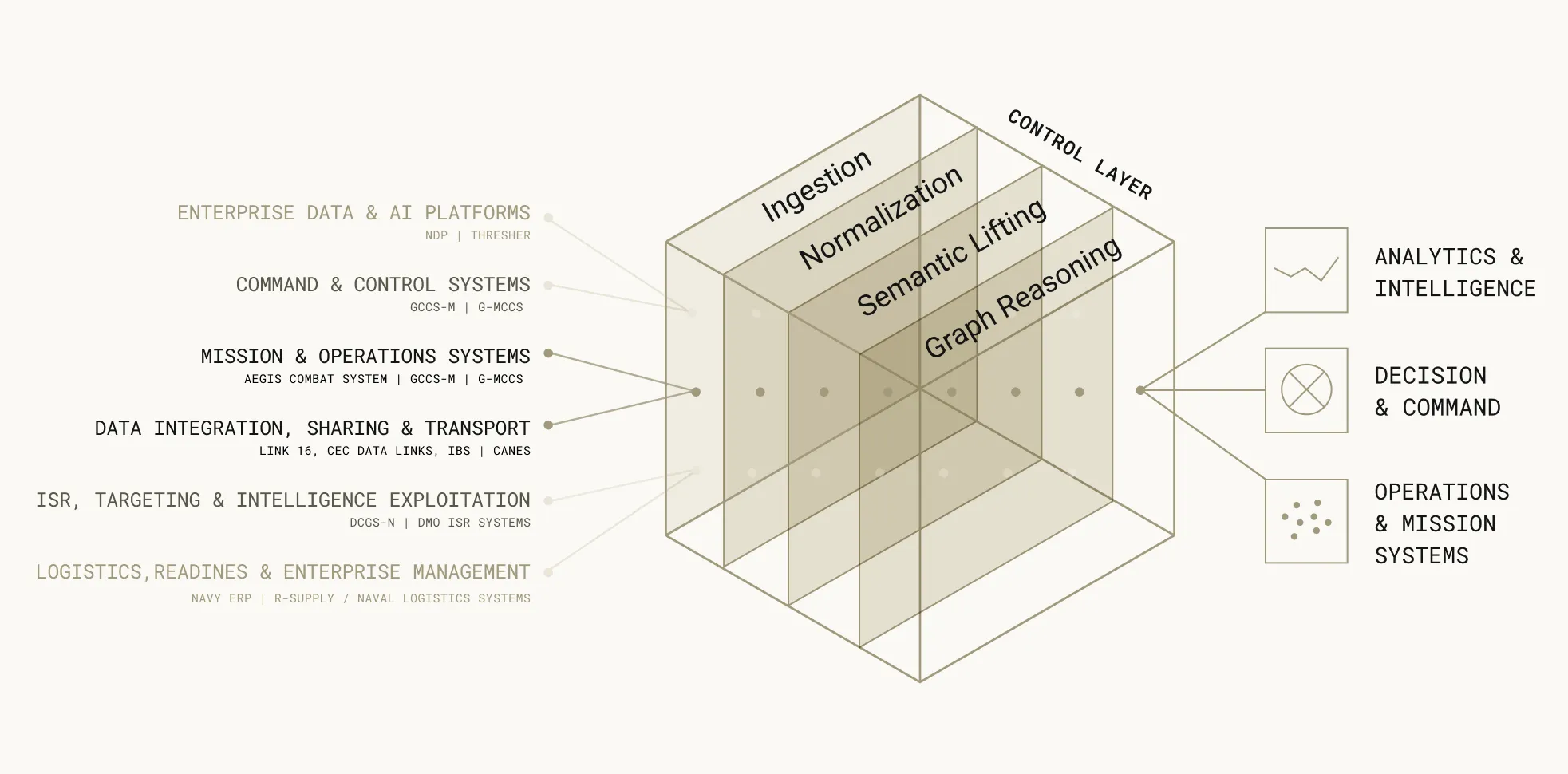
Naval and Marine Corps forces operate on shared understanding across distributed platforms instead of isolated views.
Autonomous systems, sensors, and operators act on aligned data, enabling coordinated operations at range. Targeting workflows accelerate, supporting time-sensitive engagements and long-range fires.
Logistics, mobility, and sustainment decisions are made on coherent, real-time context, strengthening readiness and force posture. Commanders gain the ability to sense, decide, and act across distance with greater speed and confidence.
This is not another system. It is the infrastructure that allows distributed maritime and expeditionary operations to function as a coherent whole. See how this reasoning infrastructure deploys into existing Navy and Marine Corps environments.