


.svg)
A track that cannot be trusted is as dangerous as one that does not exist. Air and space operations depend on knowing what is real, where it is, and how fast it is changing. Sensors generate continuous streams of data, but those streams are not naturally synchronized. Operators are left to reconcile timing, confidence, and correlation across systems while decision windows continue to shrink.
This is not a data problem. It is the reasoning problem Torch's AI infrastructure solves.
Torch provides a government-owned AI reasoning foundation that operates across existing Air Force and Space Force systems. It does not replace systems of record. It enables them to function as a unified decision environment.
The infrastructure serves as a data integration and enhancement layer that sits between sensors and operations, giving Commanders and decision-makers the information they need, when they need it. It continuously aligns data across domains, preserves temporal and spatial context, and delivers it in a form that can be used immediately. Instead of forcing operators to reconcile fragmented inputs, it ensures that information is already coherent when it reaches them.
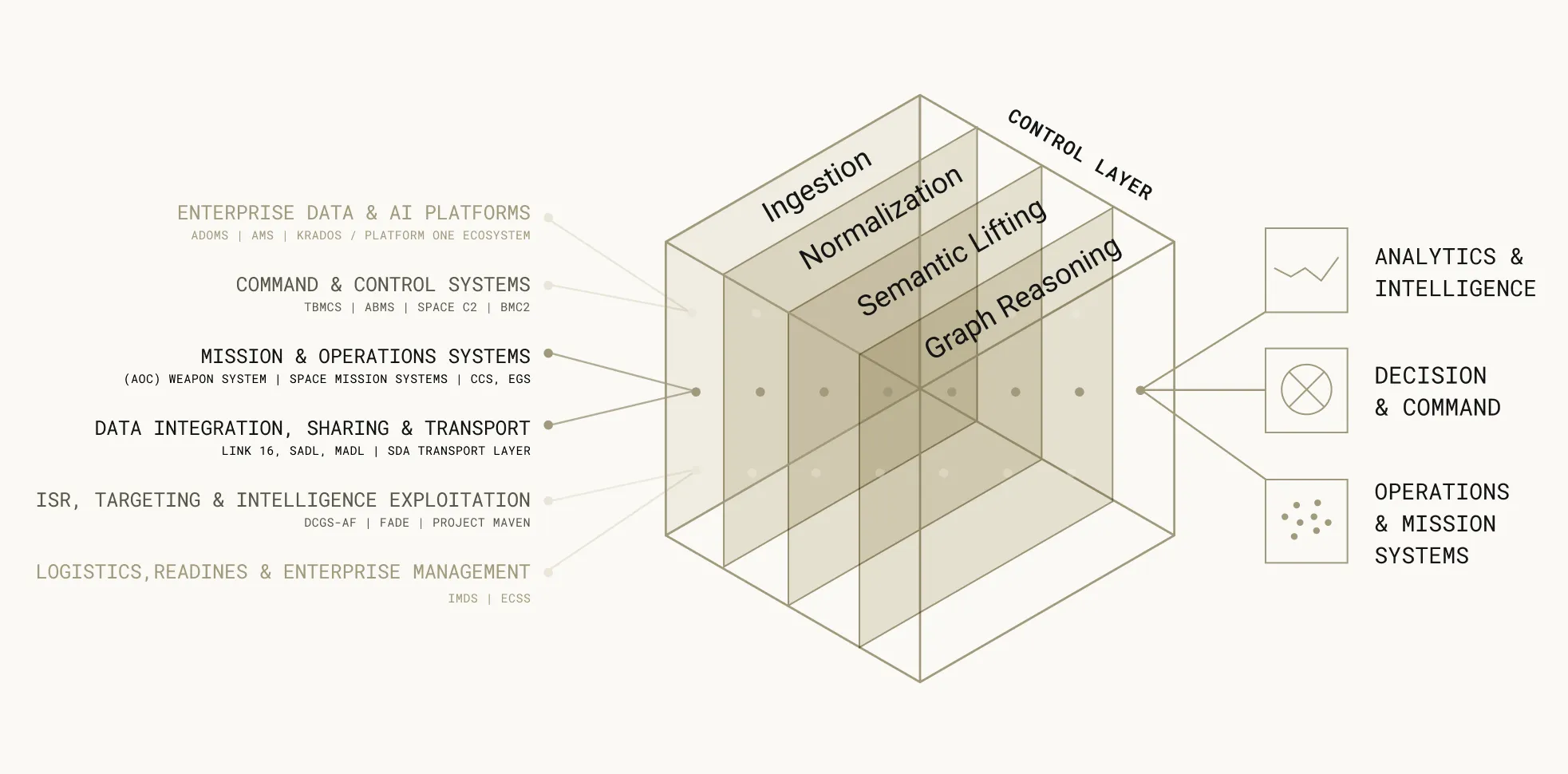
This includes operating across environments supported by Air Force & Space Force enterprise data platforms, command & control (C2) in support of Air Battle Management System (ABMS) and Space Battle Management System (SMBS), tactical data links, transport architectures, multi-modal communnications, ISR exploitation systems, and Air Force ERP and maintenance systems.
Torch integrates at the data and infrastructure layer, allowing these systems to operate on synchronized, mission-ready context rather than disconnected data streams.

ORCUS ingests and synchronizes data across airborne, space-based, and operational systems. It handles high-throughput sensor feeds, tracking data, and ISR inputs across enterprise and operational environments.
It aligns data across time and space so that inputs from multiple sensors can be used together without manual reconciliation.
This supports continuous tracking, sensor fusion, and real-time mission execution.

NEXUS transforms that data into high-fidelity semantic representations that encode meaning, time, and location together. Data from ISR, radar, and space sensors become part of a unified structure that supports correlation and temporal alignment.
Operators no longer manage disconnected data streams. They understand relationships between objects, events, and timelines. This enables continuity of tracks, anomaly detection, and predictive insight across air and space domains.

HALO applies graph-based reasoning to map relationships between tracks, objects, sensors, and operational conditions. It connects data directly to decision-making systems supporting tracking, targeting, and mission execution.
Relationships are continuously updated, allowing operators to maintain persistent awareness and act with greater speed and precision.
Together, ORCUS, NEXUS, and HALO allow systems to operate on coherent, continuously aligned data instead of fragmented inputs.
Within Air Force and Space Force operations, the reasoning infrastructure supports mission environments where timing, precision, and synchronization determine outcomes. It enables alignment of high-volume sensor data across ISR exploitation,air battle management,and space mission systems, supporting continuity of tracks and reducing ambiguity.
It supports mission execution by ensuring that sensor inputs, operational context, and mission data are synchronized across time and domain. It enables faster decisions by delivering coherent, aligned information to operators without requiring manual reconciliation.
These are not separate capabilities. They are applications of the same underlying infrastructure, adapted to environments where decision timelines are measured in seconds and minutes, not hours.
The reasoning infrastructure integrates across existing Air Force and Space Force systems Air Force & Space Force enterprise data platforms, command & control/Space C2 systems, air battle management systems and space mission systems, tactical data links and transport architectures, ISR exploitation systems, and Air Force ERP and maintenance systems. Data from airborne sensors, space-based systems, ground radar, and external sources flows into a shared environment where it can be aligned, understood, and acted on immediately.
Outputs feed directly into air operations centers, space command & control systems, and mission execution workflows, supporting both deliberate planning and real-time operations.
Deployed across Department of War environments with ATOs at multiple classification enclaves and secure environments. Operates across enterprise cloud infrastructure and low SWaP tactical environments, including disconnected and intermittent conditions. Integrates with existing systems using standardized interfaces without requiring replacement or migration.
Supports continuous software development and rapid adaptation to evolving operational requirements.
Air and Space forces operate on shared understanding across sensors and domains instead of fragmented views. Operators maintain continuity of tracks and awareness across time and space. Decision timelines compress, enabling faster and more confident action. Mission systems operate on aligned, coherent data, reducing reducing ambiguity and increasing precision. Commanders gain the ability to sense, decide, and act within the time constraints of modern air and space operations.
This is not another system.
It is this infrastructure that allows air and space operations to function as a coherent, time-synchronized whole. See how this reasoning infrastructure deploys into existing Air Force and Space Force environments.