


.svg)
An Army unit can track thousands of entities across a theater and still struggle to answer simple questions in time: what is actually happening right now, and what might happen next.
Data exists across sensors, reports, doctrine, and systems, but it does not arrive decision ready. Signals, imagery, and human reporting move through separate workflows, forcing staffs at echelon to reconcile context under pressure. As the pace of operations increases, the gap between collection and understanding becomes the limiting factor.
This is not a data problem. It is the reasoning problem Torch's AI infrastructure solves.
Torch provides a government-owned AI reasoning foundation that operates across existing Army systems. It does not replace systems of record. It enables them to function better together.
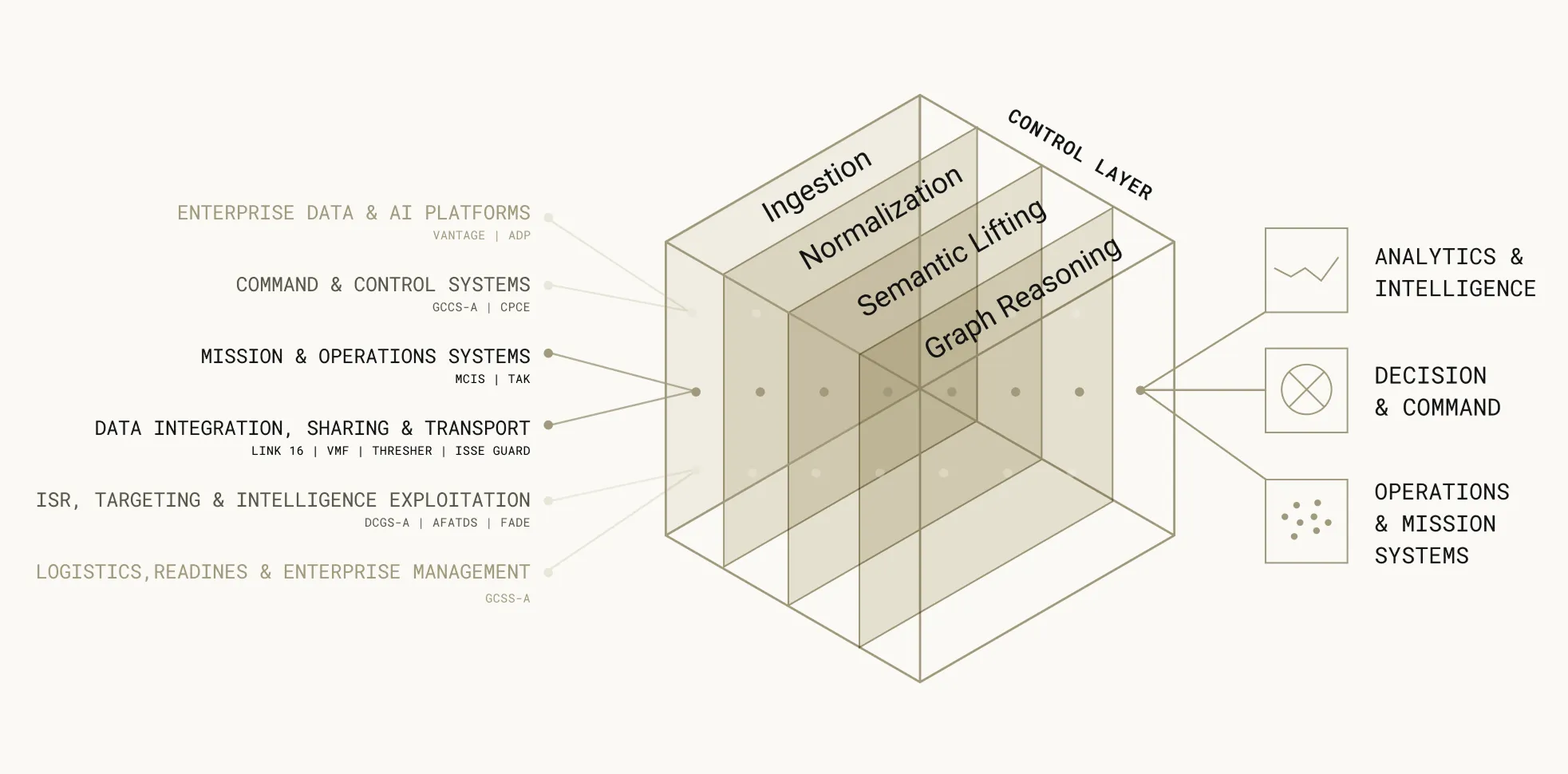
With Torch, the Army gains software infrastructure which serves as a data integration and enhancement stratum that sits between data sources and decision systems, continuously aligning data
across modalities, preserving context, and making it usable in real time. Instead of forcing users
to reconcile fragmented inputs, it ensures that information is already coherent when it reaches them.
This layer operates within environments supported by Army and Department of War, including enterprise data platforms (AIDP, Vantage, Maven, Advana), data integration & transport (SSC UDL, DCGS, Tactical Data Links), command & control (GCSS-A, JADC2), mission & operations systems (Army mission command), ISR, targeting & intelligence (DCGS-A, AFATDS-AXS),and logistics, readiness & enterprise management (AESIP). This layer is agnostic to the source and is supports Android Tactical Assault Kit (ATAK) with the ability to support next-generation platforms, such as Soldier Borne Mission Command (SBMC).
Torch integrates data and infrastructure, enabling these environments to operate on shared, aligned context rather than isolated data streams.

ORCUS ingests and synchronizes data across Army enterprise & AI platforms, as well as data integration & transport, command & control, ISR, targeting & intelligence, mission & operations,and logistics readiness & enterprise management systems. It handles continuous multi-INT feeds from ground, air, and space-based sources, operating across enterprise environments and tactical edge nodes.
Within the Army, ORCUS is already deployed in multiple mission contexts. HAVOC, the Army’s government-owned variant of ORCUS, supports institutional learning, experimentation, and concept development within the Combined Arms Command (CAC). In intelligence environments, it underpins processing, exploitation, and dissemination workflows and ISR multi-INT fusion, enabling real-time data alignment and analysis.
Data is available in real time, regardless of format or origin, without requiring replatforming.

NEXUS transforms that data into high-fidelity semantic representations that encode meaning, time, and location together. Instead of maintaining separate pipelines for signals, imagery, and reporting, data becomes part of a unified structure that supports correlation, pattern detection, and predictive analysis.
This allows the Army to move from manual data reconciliation to identifying patterns in enemy movement, activity, and intent across domains.

HALO applies graph-based reasoning to map relationships between units, assets, locations, and events. It supports indications and warnings, targeting workflows, and course-of-action development by connecting intelligence directly to decision-making systems.
Relationships that previously had to be constructed manually are continuously maintained and updated, enabling faster and more accurate operational understanding.
Together, ORCUS (HAVOC), NEXUS, and HALO allow Army systems to operate on coherent, continuously aligned data instead of fragmented inputs.
Within the Army, Torch's AI infrastructure is deployed in mission-specific configurations aligned to distinct operational and enterprise needs.
For institutional learning and doctrinal development, the infrastructure underpins capabilities such as VICTOR, the Army’s emerging AI-enabled network learning environment. In this context, it enables the aggregation, structuring, and continuous refinement of Army knowledge, supporting how doctrine is learned, applied, and evolves over time at the pace of the operational environment.
For training, experimentation, and concept development, ORCUS is deployed as HAVOC in support of the Combined Arms Command (CAC).
In this environment, the system enables large-scale aggregation and analysis of operational data to support learning at scale and the development of future concepts.
For the Army's intelligence enterprise, HAVOC is being deployed in support
of Army G2 workflows for processing, exploitation, and dissemination and ISR multi-INT fusion. In this role, it ingests and aligns data from distributed collection systems, enabling real-time correlation, predictive analysis,and targeting support across operational theaters.
These are not separate capabilities. They are mission-specific configurations of the same underlying infrastructure, adapted to different operational contexts while maintaining a consistent data and reasoning foundation.
The reasoning infrastructure integrates across existing Army environments, including enterprise data & AI platforms (AIDP, Vantage, Maven, Advana), data integration & transport (SSC UDL, DCGS, Tactical Data Links), command & control (GCCS-A, JADC2), mission & operations systems (Army mission command), ISR, targeting & intelligence (DCGS-A, targeting/fires integration), and logistics, readiness & enterprise management (GCSS-A). Data from these systems flows into a shared environment where it can be aligned, understood, and acted on immediately.
Outputs feed directly into command posts, targeting systems, and operational workflows, supporting both deliberate planning and dynamic execution.
Deployed across Department of War environments with ATOs across multiple classification levels and security enclaves. It operates across enterprise cloud infrastructure and denied, degrated, intermittent, and limited (DDIL) environments. It integrates with existing systems using standardized interfaces without requiring replacement or migration.
Supports continuous software development and rapid adaptation to evolving operational requirements.
Army formations operate on shared understanding instead of partial views.
The Army spends less time reconciling data and more time assessing it. Commanders receive timely, context-rich insight that supports faster, more confident decisions across multidomain operations.
At the enterprise level, capabilities like HAVOC and VICTOR extend this foundation into how the Army learns, transforming doctrine, training, and operational knowledge into a continuously evolving, machine-enabled system. This is not another system.
It is the infrastructure that allows existing systems, and the institution itself, to operate as intended. See how this reasoning infrastructure deploys into existing Army environments.