


.svg)
Learn
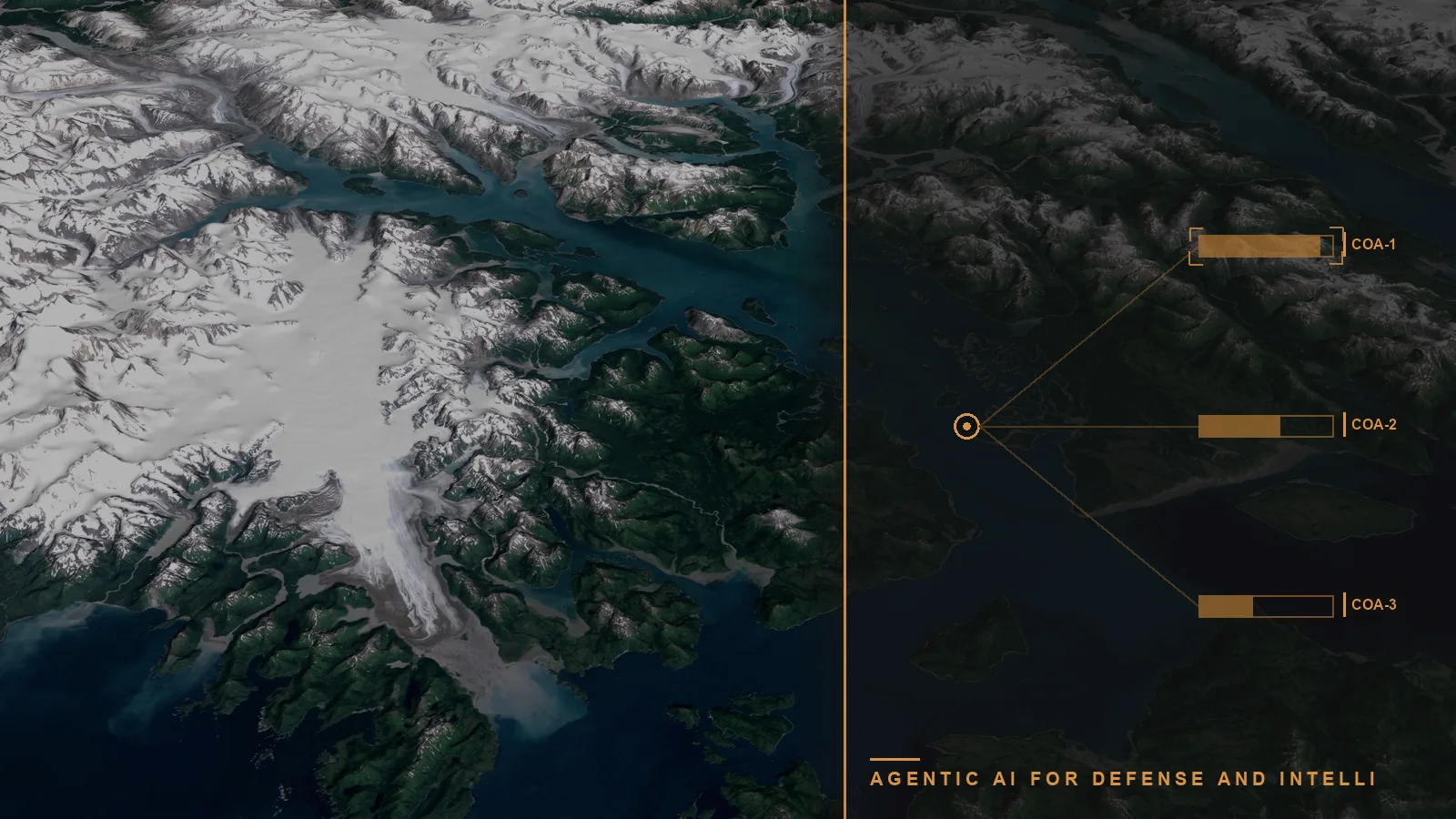
Agentic AI is artificial intelligence that pursues a goal across multiple steps on its own, planning, retrieving information, reasoning, and taking actions in sequence rather than answering a single prompt; in a defense and intelligence context it means autonomous analysis pipelines that work through a mission question under human oversight, not decisions taken without it.
Why it matters to your mission. Analysts spend hours running the same multi-step analysis by hand, and the backlog grows faster than the team. Agentic AI runs those pipelines end to end under human command, so people spend their judgment on decisions instead of the mechanics. The outcome is speed to decision and more mission covered with the same team, with a human in command of every consequential call.
Also called AI agents, agentic workflows, or autonomous AI analysis.
The appeal is obvious: analysts face more data than any team can read, and an agent that can work a mission question end to end, gathering, correlating, and drafting an assessment, turns weeks of manual correlation into minutes. The risk is equally obvious: an agent that acts over many steps can compound a hidden error, and if it cannot show its work, no one can catch the mistake or defend the conclusion.
That tension is why agentic AI for defense is not a model problem but a governance problem, and it sits on top of everything else in this hub: an agent is only as trustworthy as the resolved, fused data it reasons over and the auditable discipline that keeps every step traceable.
Key takeaways
The problem agentic AI addresses is the same one that runs through this hub from the other direction: there is far more data than analysts can process, and the gap is widening. Every pillar here, from entity resolution to order of battle, exists because manual correlation does not scale. An agent is the mechanism that applies those disciplines at machine speed and across many steps without a human performing each one by hand.
The government has moved in two directions at once, and agentic AI sits exactly between them. On one side, federal policy now directs agencies to accelerate the adoption of AI, explicitly to capture its benefits rather than stall on process (Office of Management and Budget, Accelerating Federal Use of AI through Innovation, Governance, and Public Trust, M-25-21, 2025). On the other, that same policy requires, for high-impact uses, minimum practices including pre-deployment testing, AI impact assessment, ongoing monitoring, and human oversight. The direction is clear: scale AI, but keep it governed and supervised. (National security systems are governed by parallel defense and intelligence-community policies, but the pattern, accelerate under oversight, is the same.)
The reason that balance is hard for agents specifically is that autonomy multiplies both value and risk. Standards guidance for generative AI flags exactly this: systems that act with less human intervention raise the stakes on traceability and control (National Institute of Standards and Technology, Artificial Intelligence Risk Management Framework: Generative AI Profile, NIST AI 600-1, 2024). An agent that takes ten steps can be wrong in a way a single answer cannot, because each step builds on the last.
For the mission the payoff, done right, is leverage without loss of control: an analyst sets the question and supervises an agent that does the gathering and correlation, then reviews an assessment in which every step is traceable to its source. The analyst stops performing the pipeline and starts commanding it.
An agent is defined by a loop, not a single call. In an intelligence setting the loop looks like this:
Two design choices separate a trustworthy agent from a dangerous one. First, every step carries provenance, so the chain of reasoning can be inspected after the fact, not just the final answer. Second, the agent has an abstain path: when confidence is low or the question exceeds its authority, it stops and routes to a human rather than guessing. An agent that always produces an answer is more dangerous than one that knows when to stop, which is the same deterministic, auditable discipline applied to a multi-step process.
Agentic AI is the capability; agentic workflows are what it runs. An agentic workflow is a specific multi-step analysis pipeline an agent executes toward a mission question: the sequence of plan, retrieve, reason, and act steps that turns a request like "assess this vessel's recent activity" into a sourced answer. Agentic AI is the general property of acting across many steps; an agentic workflow is a concrete, repeatable instance of it, built for a particular task and run on demand.
The distinction matters for a mission because a workflow is the unit a person actually governs. An analyst does not supervise "agentic AI" in the abstract; they compose, run, and inspect a specific agentic workflow, watch each step with its provenance, and keep or discard the result. Building agentic workflows as named, inspectable pipelines, rather than one open-ended agent told to figure it out, is what keeps oversight structural: each step is defined, logged, and traceable, and a human owns the judgment at the end.
A defense-grade agentic workflow carries the same requirements as the broader capability: it runs over resolved and fused data, keeps provenance on every step, has an abstain path to a human, and respects classification throughout. The agentic reasoning sandbox is where a mission owner composes and runs these workflows without writing code.
These terms are used loosely and often interchangeably. They are distinct. The table separates them.
| Term | What it is | Relationship to agentic AI |
|---|---|---|
| RAG / GraphRAG | Grounding an answer in retrieved data or a knowledge graph | A capability an agent uses at its retrieve step; see GraphRAG. RAG answers; an agent acts over many steps |
| Automation / RPA | Scripted execution of fixed, predefined steps | Deterministic and rigid; an agent plans its own steps toward a goal rather than following a fixed script |
| Copilot / assistant | An AI that suggests or drafts in response to a user prompt | Single-turn and human-driven; an agent pursues a goal across multiple steps with less step-by-step prompting |
| Autonomous weapon system | A system that can select and engage targets without human intervention | A different and heavily governed category; the agentic analysis described here supports human judgment and does not decide or act on the use of force |
The central objection to agentic AI in a mission context is not capability; it is accountability. An agent that works ten steps and returns a confident assessment is useless, or worse, if no one can see how it got there. The governance requirements the government applies to high-impact AI, pre-deployment testing, impact assessment, ongoing monitoring, and human oversight, are precisely the ones an opaque agent fails. The failure modes are specific:
The answer is not to avoid agents; it is to build them so that oversight is structural rather than optional: every step logged with provenance, confidence surfaced, an abstain path to a human, and no consequential action without approval. That is what turns an agent from an accountability risk into a governed capability.
Agentic AI raises the ownership question from this hub's other pages to a higher power, because an agent does more than hold the data; it acts on it. If the agent, its reasoning logic, and the data it works over live in a vendor's proprietary environment, the government has outsourced not just storage but judgment-shaped automation it cannot fully inspect. The table contrasts the models against what a mission requires.
| Consideration | Typical commercial agent platform | Government-owned reasoning infrastructure |
|---|---|---|
| Control of the agent and its logic | Held in the vendor's environment | Customer controls the agent, its steps, and its data |
| Provenance of each step | Varies; often opaque | Every step logged and traceable to source |
| Human oversight | Vendor-defined | Oversight and abstain built into the workflow by the customer |
| Where it runs | Frequently cloud-only | Enterprise to classified and disconnected environments |
| Data the agent reasons over | Often tuned for clean commercial data | All-source, multi-INT, resolved and fused |
| Auditability for governance | Limited | Supports the testing, monitoring, and oversight policy requires |
Government-owned does not mean the government builds every agent itself or owns a vendor's underlying intellectual property. It means the customer controls the agents, their reasoning, and the data they act on, and can inspect, govern, and supervise them, rather than running judgment-shaped automation inside a model it cannot see. Whether a specific deployment is government-owned (GOTS) or commercial (COTS) depends on the system the customer installs and purchases; for automation that acts on mission data under a governance mandate, the government-owned model is the one to evaluate.
"Human in the loop" understates what agentic AI requires; the standard is a human in command of the loop. The distinction matters: an agent can run many steps autonomously and still be fully supervised if a human sets the goal, can see every step with its provenance, is required to approve any consequential action, and receives an honest abstain when the agent is uncertain or out of its lane. Oversight is not a person watching a progress bar; it is a structural property of how the workflow is built. This is the same principle the auditable, deterministic pillar insists on, extended to automation that acts: the machine assembles and proposes at machine speed, and a human owns every judgment that carries weight. An agent that cannot be supervised is not ready for a mission, however capable it is.
The sections above explain why oversight, provenance, and ownership matter; the checklist is what to require in an evaluation.
Evaluating a capability? The seven requirements above are the backbone of an agentic-AI evaluation you can score vendors against. Bring them to a scoping call and we will walk each one against your environment: request a technical walkthrough.
For the customer, the outcome is throughput and speed: routine multi-step analysis runs on its own under human command, so analysts reach decisions faster and cover more of the mission. Here is how Torch.AI delivers it.
Torch.AI builds reasoning infrastructure the customer can own and govern, offered as a government-owned (GOTS) deployment when a mission requires it, with agentic workflows built for oversight rather than around it. ORCUS readies the data and NEXUS reads and enriches the unstructured reporting; HALO resolves and fuses the entities the agents reason over and serves graph retrieval at each step; and a deterministic doctrine layer provides the guardrail, returning a clear, bounded verdict rather than letting an agent improvise past its authority. The agentic workflows that run these analysis pipelines are composed and executed in the Workbench, the government-owned, no-code environment where mission owners build the data flows and agentic workflows themselves, so the people accountable for the mission shape the automation rather than inheriting a vendor's. You can see how this is packaged as a capability on the Torch.AI software page.
Because every step runs over resolved, fused data with provenance preserved and an abstain path built in, the agent is supervisable by design: an analyst sets the question, watches each step with its evidence, and owns the conclusion. This is the systems of record versus systems of reason distinction at the center of Torch.AI's approach, carried into automation: the agents act as a system of reason on top of the authoritative systems of record, which stay intact, so the force gains leverage without surrendering command of the loop.
Torch.AI's approach is built for the conditions this page describes: all-source data; provenance on every step; an abstain path and human approval for consequential actions; classification-aware operation from the enterprise to the disconnected edge; and agents the customer owns and governs.
For evaluators scoping a capability, see how Torch.AI delivers government-owned, auditable agentic reasoning over resolved and fused data on the software page, or request a technical walkthrough and we will run it against a representative mission question, with every step traced to source.
What is agentic AI in simple terms? It is AI that pursues a goal across multiple steps on its own, planning, retrieving information, reasoning, and acting in sequence, rather than answering a single prompt. In defense it means autonomous analysis pipelines that run under human oversight, not decisions made without it.
How is an AI agent different from a chatbot or copilot? A copilot responds to a prompt in a single turn; an agent pursues a goal across many steps with less step-by-step prompting, planning and acting on its own. The agent does more autonomously, which is exactly why oversight and provenance matter more.
Is agentic AI the same as autonomous weapons? No. Autonomous weapon systems are a separate, heavily governed category. The agentic analysis described here supports human judgment, assembling and proposing under oversight; it does not decide or act on the use of force, and a human approves any consequential action.
What does the government require for AI like this? Federal policy directs agencies to accelerate AI adoption while requiring, for high-impact uses, pre-deployment testing, impact assessment, ongoing monitoring, and human oversight (OMB M-25-21). An agent has to be built so those practices are possible, which means traceable steps and real oversight.
Why does agentic AI need provenance and an abstain path? Because an agent acts over many steps, a hidden error at one step corrupts everything after it. Provenance lets a human trace and challenge the chain; an abstain path stops the agent from answering questions it should escalate. Together they turn an opaque agent into a governed one.
Why should agentic AI for defense be government-owned? Because an agent acts on mission data, not just stores it. A government-owned (GOTS) deployment keeps the agents, their logic, and the data under the customer's control, inspectable and governable in classified and disconnected environments. The same capability can also be delivered commercially (COTS); which applies depends on the system the customer installs and purchases.
What are agentic workflows? An agentic workflow is a single multi-step analysis pipeline an agent runs toward a mission question, the defined sequence of plan, retrieve, reason, and act steps that produces a sourced answer. Agentic AI is the general capability of acting across many steps; an agentic workflow is a concrete, repeatable instance of it that a person composes, runs, and inspects. In defense, each workflow runs over resolved and fused data with provenance on every step and a human in command of the result.


Describe the problem.
Define the constraints. We will structure the session.
No demo.
No slide deck.
Real work.
Describe the problem.
Define the constraints. We will structure the session.
No demo.
No slide deck.
Real work.