What Is Multi-INT Fusion for Intelligence Analysis?
Multi-INT fusion for intelligence analysis is the process of correlating intelligence from many collection disciplines, such as signals (SIGINT), geospatial (GEOINT), human (HUMINT), measurement and signature (MASINT), and open-source (OSINT), into a single, entity-centric picture that preserves each source's provenance and confidence, so an analyst can assess a person, unit, vessel, or event with far higher confidence than any one discipline allows on its own.
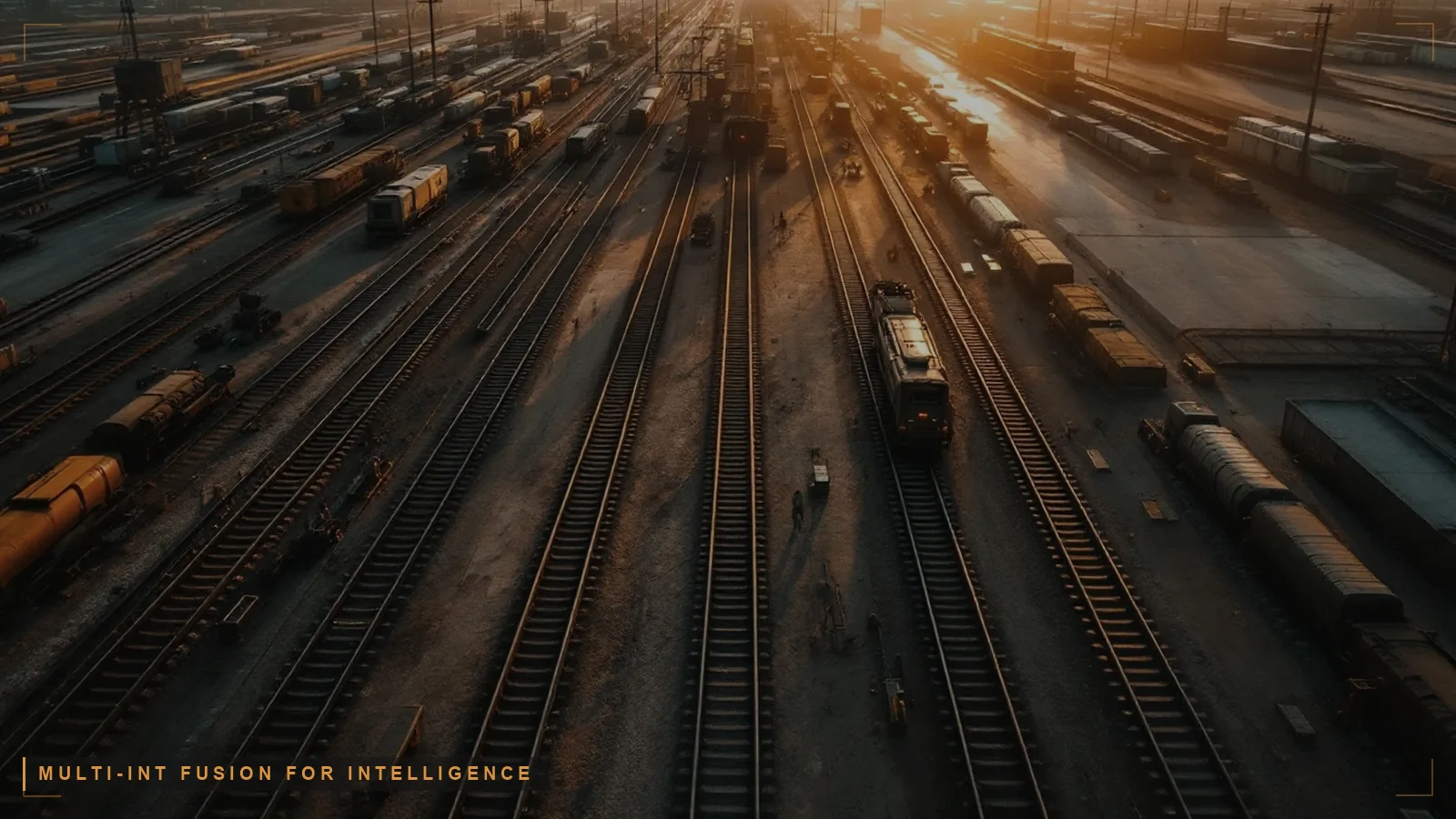
Multi-INT fusion is the process of combining intelligence from multiple collection disciplines — such as SIGINT, GEOINT, HUMINT, MASINT, and OSINT — into a single, correlated picture, so an analyst can assess an entity or event with far higher confidence than any one source allows on its own.
Instead of reading five separate reports about the same vessel, an analyst working from fused multi-INT sees one resolved entity, with each source's contribution, timing, and confidence attached.
What are the intelligence disciplines (the "INTs")?
Multi-INT fusion draws on the standard collection disciplines:
SIGINT — signals intelligence (communications and electronic emissions)
GEOINT — geospatial intelligence (imagery and mapping)
HUMINT — human intelligence (human sources)
MASINT — measurement and signature intelligence (radar, acoustic, and other sensor signatures)
OSINT — open-source intelligence (publicly available information)
Plus derived and technical sources (ELINT, FISINT, and others)
Each discipline sees a different slice of reality. Multi-INT fusion is how those slices become one operational picture.
Multi-INT fusion vs. all-source vs. sensor fusion vs. data fusion
These terms are often used interchangeably, but they are not the same thing:
Term
What it means
Multi-INT fusion
Correlating intelligence across multiple collection disciplines into a single, entity-centric picture.
All-source intelligence
The analytical discipline of assessing a question using all available INTs. Multi-INT fusion is the technical process that makes all-source analysis tractable.
Sensor fusion
Combining raw signals from physical sensors (radar, IMU, cameras) — typically a hardware/robotics term, one level below intelligence fusion.
Data fusion
The broad, generic category of merging data from many sources. Multi-INT fusion is data fusion applied to intelligence.
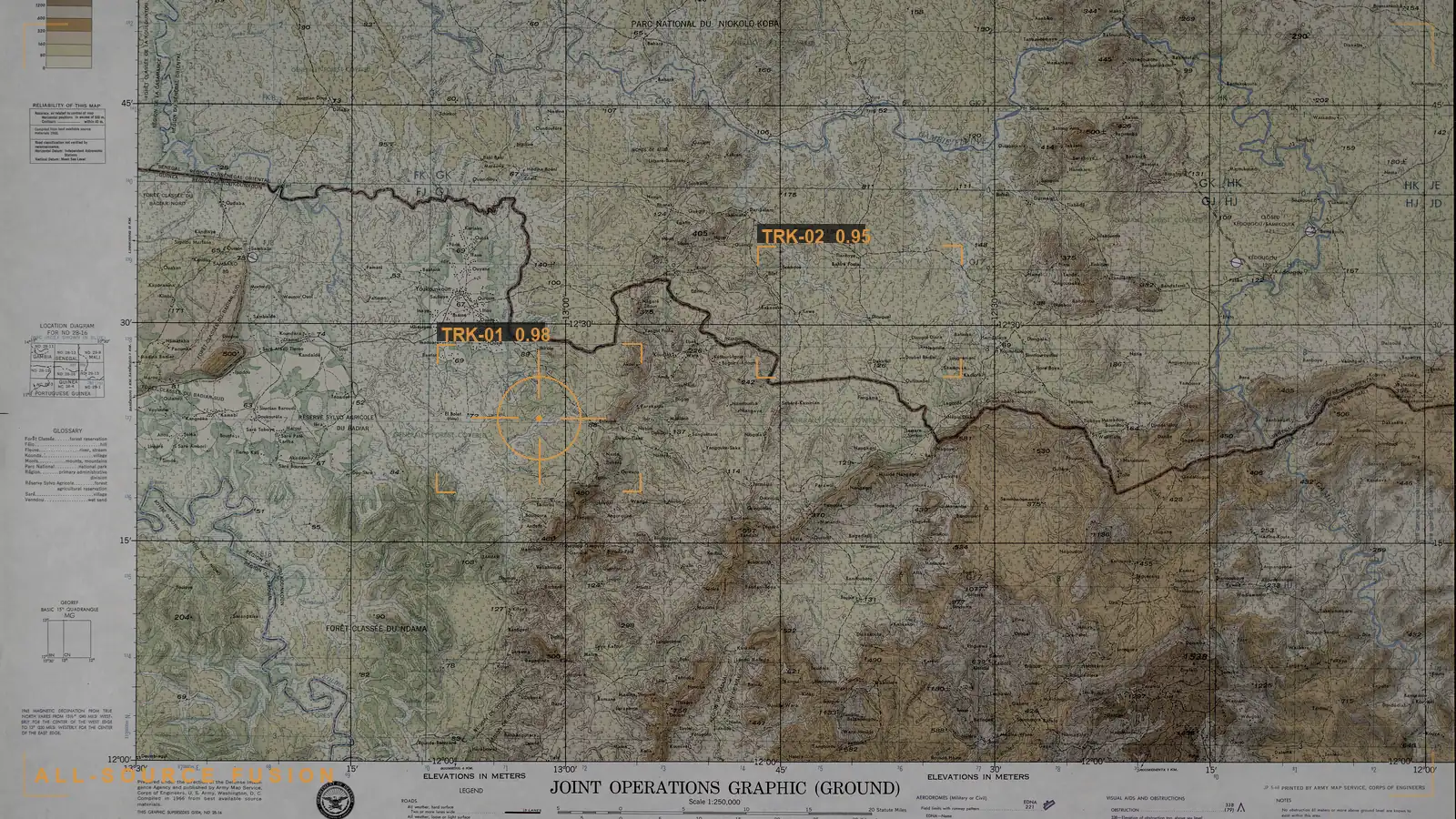
All-source intelligence fusion unifies SIGINT, GEOINT, HUMINT, and OSINT into one picture.
How does multi-INT fusion work?
Good multi-INT fusion is a pipeline, not a single algorithm:
Connect and normalize. Pull data from where it already lives — across formats, classifications, and systems — and normalize it so sources can be compared.
Resolve entities. Recognize that a track in SIGINT, a hull in GEOINT, and a name in OSINT are the same vessel. This is entity resolution, and it is the hard part.
Fuse relationships. Map how resolved entities relate — units, assets, locations, events — into an explicit knowledge graph, so patterns and networks become visible.
Preserve confidence and provenance. Keep each source's contribution, timing, and reliability attached, so the fused assessment is auditable rather than a black box.
Deliver into the workflow. Push the fused picture into the tools analysts and operators already use, at the speed the mission requires.
Why is multi-INT fusion hard?
Stovepiped systems. INTs live in separate systems that were never designed to talk to each other.
Identity resolution across sources. The same entity looks different in every discipline; getting the match right (and not wrong) is the central technical challenge.
Provenance and trust. Analysts must be able to trace and explain a fused conclusion, not just receive it.
Speed under constraint. Fusion has to happen fast, often at the edge, in disconnected or degraded conditions.
What to look for in a multi-INT fusion capability
When evaluating a fusion solution, ask:
Does it resolve entities well across disciplines, and can you inspect why it made a match?
Is the fused output auditable — can an analyst trace every conclusion back to source and confidence?
Do you own and control the fusion logic, or is your mission meaning locked inside a vendor's proprietary model?
Does it run across security levels and at the edge (IL5/IL6/IL7, disconnected/degraded environments)?
Does it keep a human in the loop on the assessment?
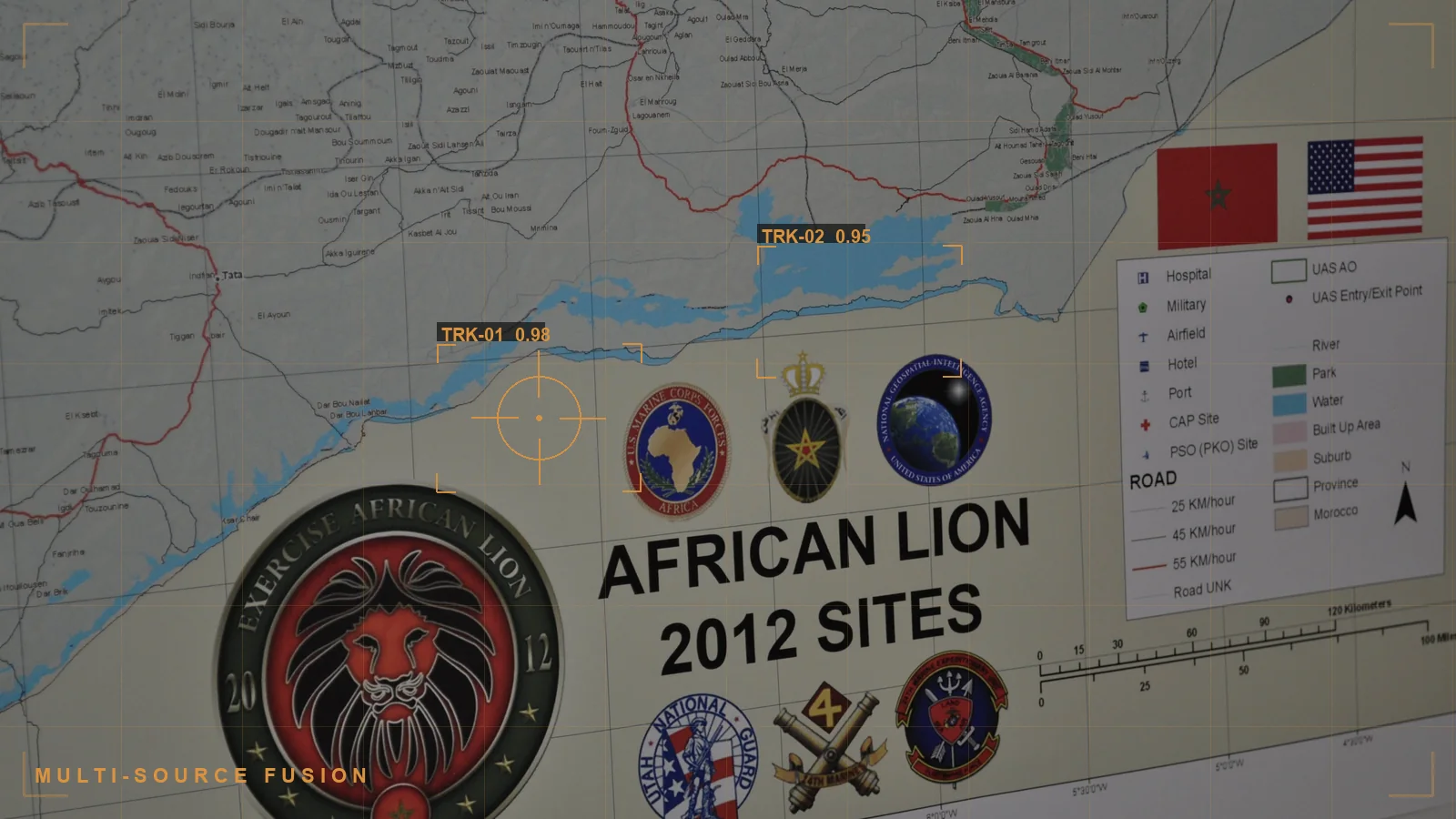
Multi-source intelligence fusion correlates many feeds into one assessed track.
How Torch.AI approaches multi-INT fusion
Torch.AI treats multi-INT fusion as a job for government-owned reasoning infrastructure, not a single black-box model. Across the reasoning infrastructure:
ORCUS connects to multi-source data where it lives and normalizes it — the "connect and normalize" step.
NEXUS builds high-fidelity semantic representations that preserve meaning, time, and location.
HALO applies graph-based reasoning to resolve entities and fuse the relationships between them into an explicit, inspectable graph.
Because the layer is government-owned and every stage has measurable, traceable behavior, the fused picture stays inspectable, governable, and connected to source authority — the opposite of concentrating mission meaning inside a proprietary semantic model.
What are the main intelligence disciplines? SIGINT (signals), GEOINT (geospatial), HUMINT (human), MASINT (measurement and signature), and OSINT (open-source), plus derived technical sources such as ELINT and FISINT. Multi-INT fusion correlates across these disciplines.
Is multi-INT fusion the same as all-source intelligence? No. All-source intelligence is the analytical discipline of assessing a question using every available INT; multi-INT fusion is the technical process that correlates those INTs into one picture so all-source analysis is possible at scale and speed.
What is the difference between sensor fusion and multi-INT fusion? Sensor fusion combines raw signals from physical sensors (radar, infrared, acoustic) into one physical estimate or track. Multi-INT fusion operates a level up, correlating that track with signals, human, open-source, and other intelligence into an entity-centric picture. See sensor fusion vs. data fusion.
Why is entity resolution central to multi-INT fusion? Because fusion is only as good as its ability to know that two records from different disciplines describe the same real-world entity. Resolve wrong and the fused picture is wrong. Entity resolution is the prerequisite step inside fusion; see entity resolution for intelligence analysis.
How does multi-INT fusion handle classification and releasability? A mission-grade capability respects classification levels, compartments, and coalition releasability during correlation, not only after it, so reporting that cannot be combined is not combined, and the fused output carries the correct markings.
How does multi-INT fusion work with an LLM? A large language model helps at the reading and correlation stages, extracting entities from free-text reporting and proposing links between differently worded references, but it does not replace the discipline. In an intelligence setting its proposals still have to carry a confidence score, preserve provenance back to every source, respect classification, and route ambiguous correlations to an analyst. The model is one input to a governed pipeline, not the fusion itself.
How is multi-INT fusion measured? Against a ground-truth set of known correct and incorrect correlations, using precision (of the links it made, how many were correct) and recall (of the true links, how many it found). The two trade off, and in a mission context the more important measure is whether every correlation is traceable and adjudicable, because an unexplained correlation cannot be defended in a briefing regardless of its score.
Does multi-INT fusion replace existing intelligence systems? It should not. Sound fusion reasons on top of the systems of record and preserves the original reporting with its classification and confidence, so any correlation can be inspected, explained, and reversed. It complements existing systems rather than replacing them.
Ben Brown
Mission Engagement Engineer
Start with the mission.
Describe the problem. Define the constraints. We will structure the session.
{"@context":"https://schema.org","@graph":[{"@type":"DefinedTerm","@id":"https://torch.ai/learn/multi-int-fusion#term","name":"What Is Multi-INT Fusion for Intelligence Analysis?","description":"Multi-INT fusion for intelligence analysis is the process of correlating intelligence from many collection disciplines, such as signals (SIGINT), geospatial (GEOINT), human (HUMINT), measurement and signature (MASINT), and open-source (OSINT), into a single, entity-centric picture that preserves each source's provenance and confidence, so an analyst can assess a person, unit, vessel, or event with far higher confidence than any one discipline allows on its own.","url":"https://torch.ai/learn/multi-int-fusion","inDefinedTermSet":{"@type":"DefinedTermSet","@id":"https://torch.ai/learn#termset","name":"Torch.AI Defense AI & Intelligence Glossary","url":"https://torch.ai/learn"}},{"@type":"Article","@id":"https://torch.ai/learn/multi-int-fusion#article","headline":"What Is Multi-INT Fusion for Intelligence Analysis?","description":"Multi-INT fusion for intelligence analysis is the process of correlating intelligence from many collection disciplines, such as signals (SIGINT), geospatial (GEOINT), human (HUMINT), measurement and signature (MASINT), and open-source (OSINT), into a single, entity-centric picture that preserves each source's provenance and confidence, so an analyst can assess a person, unit, vessel, or event with far higher confidence than any one discipline allows on its own.","url":"https://torch.ai/learn/multi-int-fusion","mainEntityOfPage":"https://torch.ai/learn/multi-int-fusion","author":{"@type":"Organization","@id":"https://torch.ai/#organization","name":"Torch.AI"},"publisher":{"@id":"https://torch.ai/#organization"},"isPartOf":{"@id":"https://torch.ai/learn#termset"},"inLanguage":"en-US"},{"@type":"BreadcrumbList","@id":"https://torch.ai/learn/multi-int-fusion#breadcrumb","itemListElement":[{"@type":"ListItem","position":1,"name":"Home","item":"https://torch.ai/"},{"@type":"ListItem","position":2,"name":"Learn","item":"https://torch.ai/learn"},{"@type":"ListItem","position":3,"name":"What Is Multi-INT Fusion for Intelligence Analysis?","item":"https://torch.ai/learn/multi-int-fusion"}]},{"@type":"FAQPage","mainEntity":[{"@type":"Question","name":"What are the main intelligence disciplines?","acceptedAnswer":{"@type":"Answer","text":"SIGINT (signals), GEOINT (geospatial), HUMINT (human), MASINT (measurement and signature), and OSINT (open-source), plus derived technical sources such as ELINT and FISINT. Multi-INT fusion correlates across these disciplines."}},{"@type":"Question","name":"Is multi-INT fusion the same as all-source intelligence?","acceptedAnswer":{"@type":"Answer","text":"No. All-source intelligence is the analytical discipline of assessing a question using every available INT; multi-INT fusion is the technical process that correlates those INTs into one picture so all-source analysis is possible at scale and speed."}},{"@type":"Question","name":"What is the difference between sensor fusion and multi-INT fusion?","acceptedAnswer":{"@type":"Answer","text":"Sensor fusion combines raw signals from physical sensors (radar, infrared, acoustic) into one physical estimate or track. Multi-INT fusion operates a level up, correlating that track with signals, human, open-source, and other intelligence into an entity-centric picture. See sensor fusion vs. data fusion."}},{"@type":"Question","name":"Why is entity resolution central to multi-INT fusion?","acceptedAnswer":{"@type":"Answer","text":"Because fusion is only as good as its ability to know that two records from different disciplines describe the same real-world entity. Resolve wrong and the fused picture is wrong. Entity resolution is the prerequisite step inside fusion; see entity resolution for intelligence analysis."}},{"@type":"Question","name":"How does multi-INT fusion handle classification and releasability?","acceptedAnswer":{"@type":"Answer","text":"A mission-grade capability respects classification levels, compartments, and coalition releasability during correlation, not only after it, so reporting that cannot be combined is not combined, and the fused output carries the correct markings."}},{"@type":"Question","name":"How does multi-INT fusion work with an LLM?","acceptedAnswer":{"@type":"Answer","text":"A large language model helps at the reading and correlation stages, extracting entities from free-text reporting and proposing links between differently worded references, but it does not replace the discipline. In an intelligence setting its proposals still have to carry a confidence score, preserve provenance back to every source, respect classification, and route ambiguous correlations to an analyst. The model is one input to a governed pipeline, not the fusion itself."}},{"@type":"Question","name":"How is multi-INT fusion measured?","acceptedAnswer":{"@type":"Answer","text":"Against a ground-truth set of known correct and incorrect correlations, using precision (of the links it made, how many were correct) and recall (of the true links, how many it found). The two trade off, and in a mission context the more important measure is whether every correlation is traceable and adjudicable, because an unexplained correlation cannot be defended in a briefing regardless of its score."}},{"@type":"Question","name":"Does multi-INT fusion replace existing intelligence systems?","acceptedAnswer":{"@type":"Answer","text":"It should not. Sound fusion reasons on top of the systems of record and preserves the original reporting with its classification and confidence, so any correlation can be inspected, explained, and reversed. It complements existing systems rather than replacing them."}}]}]}



.svg)