Learn
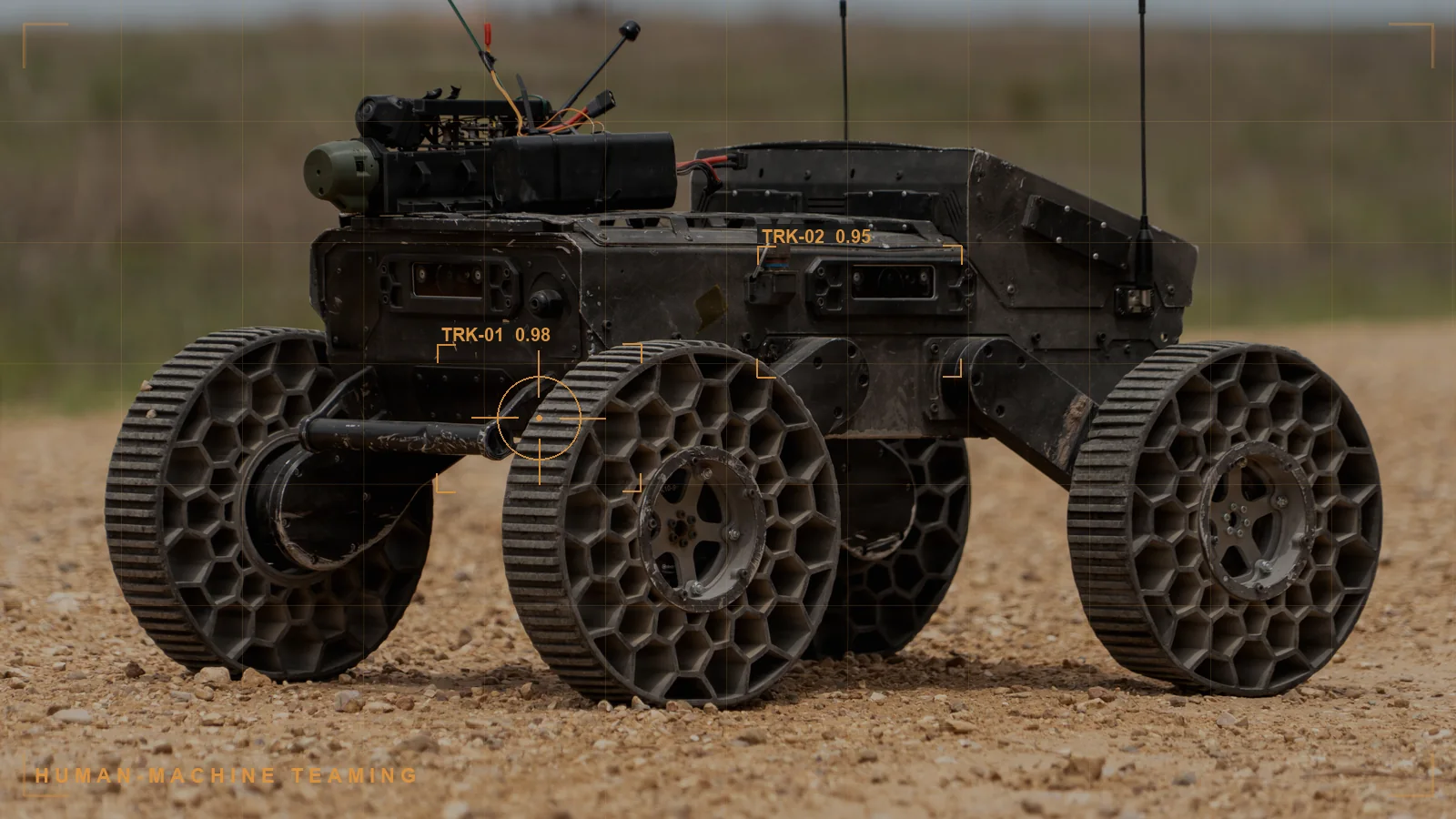
Human-machine teaming is an operating model in which people and AI systems work together as a single team on a shared mission task, with the machine handling scale, speed, and correlation, the person supplying judgment, context, and accountability, and the authority to decide kept with the human.
Last updated: October 19, 2026
Why it matters to your mission. Analysts and operators are drowning in more data than any team can read, while the decisions on top of it get faster and more consequential. Human-machine teaming is how a unit gets the scale and speed of AI without handing over the judgment that has to stay human. The outcome is a team that works through far more data in far less time, with a person still deciding what matters and answerable for the call.
Human-machine teaming is an operating model in which people and AI systems work together as a single team on a shared mission task, with the machine handling scale, speed, and correlation, the person supplying judgment, context, and accountability, and the authority to decide kept with the human. It is not automation that removes the person, and it is not a tool the person picks up and puts down. It is a working relationship in which each side does what it is better at and the division of labor is deliberate.
Key takeaways
Human-machine teaming describes people and AI systems operating as one team rather than as a user and a tool. The machine takes on the parts of the work it does better than any person can: reading everything, correlating records across sources, flagging what is anomalous, and doing it continuously and at volume. The person takes on the parts a machine cannot be trusted with: weighing context, applying intent, judging consequence, and standing behind the decision.
The word "team" is doing real work in the phrase. A tool waits to be used and has no stake in the outcome. A teammate carries part of the task, communicates what it is doing, and can be relied on, within limits the person understands. Good human-machine teaming makes those limits legible, so the person knows where the machine is strong, where it is weak, and when to override it. That mutual understanding, more than raw model accuracy, is what separates a team that performs from one that fails under pressure.
In an intelligence or operational setting, teaming shows up as an analyst working alongside a system that resolves entities across fragmented feeds, proposes the connections, and surfaces the handful worth attention, while the analyst adjudicates the ambiguous calls and decides what goes in the assessment. Neither side could do the job alone at the required speed and scale. That is the point of teaming.
The two are often confused, and the difference matters for how you design and govern the system. Automation assigns a task to a machine to perform on its own; the goal is to remove the person from that step. Human-machine teaming keeps the person in the task and divides the work, so the goal is to combine two different kinds of capability rather than replace one with the other. Automation is appropriate for steps that are well-bounded, low-consequence, and faster than a person could handle. Teaming is appropriate when the task needs both machine scale and human judgment at the same time.
A teamed workflow usually contains automated steps inside it. Normalizing incoming data can run fully automated; correlating and triaging it can run under supervision; the consequential judgment at the end stays with a person. The design question is not automation versus teaming but which steps to automate, which to team, and where the person's authority has to sit. The comparison below separates the two models so each can be evaluated on its own.
| Dimension | Automation | Human-machine teaming |
|---|---|---|
| Goal | Remove the person from a task | Combine human judgment with machine scale on a shared task |
| Role of the person | Out of the step once it runs | In the task, deciding and accountable |
| Role of the machine | Performs the task on its own | Does correlation, volume, and speed; proposes, does not decide |
| Best fit | Well-bounded, low-consequence, high-speed steps | Tasks needing both scale and judgment, higher consequence |
| What it demands | Reliable bounds and monitoring | Transparent behavior, calibrated trust, a usable override |
| Failure mode | Silent error outside its bounds | Over-reliance or under-reliance; person cannot see or stop it in time |
Teaming succeeds or fails on three conditions, none of which is about model accuracy alone.
These conditions are why teaming is a design problem, not a procurement checkbox. The same model can anchor a strong team or a dangerous one depending on whether the person can see it, calibrate to it, and stop it.
Human-machine teaming is the operating model; the level of human oversight is the control dial inside it. A teamed workflow still has to decide, action by action, whether a person approves each one before it happens or supervises while the system acts within bounds. That is the human in the loop vs human on the loop choice, and it is set by the consequence of being wrong and the time available to act. Lethal, legal, or irreversible actions pull toward a person in the loop; high-volume, low-consequence, faster-than-human steps pull toward a person on the loop. Teaming is the broader relationship; the loop model is how authority is placed within it.
The same relationship scales up into multi-step agentic AI for defense, where a system chains several reasoning steps together before a person signs off. The more a workflow can do on its own, the more the teaming conditions, transparency, calibrated trust, and a usable override, decide whether the autonomy is safe to field. Teaming is the frame that keeps agentic capability answerable to a person.
For the Department of War and the intelligence community, human-machine teaming is not only a way to move faster; it is how AI use stays accountable under policy. The Department of Defense has adopted five AI Ethical Principles, including that its AI be "responsible," with personnel exercising appropriate levels of judgment and remaining responsible for the development, deployment, and use of AI capabilities. The Government Accountability Office's review of how the department is implementing responsible AI, Artificial Intelligence: Actions and Opportunities to Implement Responsible Use in DOD, GAO-27-107837 (GAO, October 14, 2026), documents those principles and the governance the department is building around them, and notes work on assessing human-AI teaming technologies directly. Independent oversight flagging that this implementation is still maturing is exactly why a specified teaming design matters: the accountability has to be built into how the team works, not assumed.
That requirement runs through the wider federal framing of trustworthy AI. The National Institute of Standards and Technology's Artificial Intelligence Risk Management Framework (AI RMF 1.0) (NIST AI 100-1, 2023) states that risk management "should prioritize the minimization of potential negative impacts, and may need to include human intervention in cases where the AI system cannot detect or correct errors." That intervention capability is a teaming requirement: it only exists if the person can see the error and stop the system in time. Federal use policy reinforces the same logic. The Office of Management and Budget's memorandum M-25-21, Accelerating Federal Use of AI through Innovation, Governance, and Public Trust (OMB, April 3, 2025) directs agencies to "ensure human oversight, intervention, and accountability" for high-impact AI. The through-line is consistent: the more consequential the task, the more the human has to remain able to understand, challenge, and halt the machine, which is the definition of a working team rather than an unattended system.
A defensible teaming design is something you can specify and evaluate, not a slogan. Require the following:
Evaluating a teaming or decision-support capability? These seven requirements are a checklist you can score a design against. Bring them to a scoping call and we will walk each one against your workflow and its stakes: request a technical walkthrough.
Torch.AI builds government-owned reasoning infrastructure designed around the team, not around replacing the person. The reasoning layer does the machine's half of the work: it connects to mission data where it lives, resolves entities across fragmented multi-source systems, and fuses relationships into a picture, each element traced back to its source. It then hands that picture to a person with the authority and the context to decide, rather than acting on its own. HALO fuses relationships into a network an analyst can trust and challenge, NEXUS makes the underlying data meaningful so the machine's proposals rest on coherent representation, and the reasoning outputs are surfaced for non-technical users to interrogate rather than buried in a model. Because the infrastructure can be deployed government-owned, the customer keeps control of the teaming logic, the provenance, and the audit trail rather than renting them inside a vendor platform. You can see how this is packaged as a capability on the Torch.AI software page.
The division of labor is deliberate: the machine supplies scale, speed, and correlation; the person supplies judgment and accountability; and the system is built so the person can see what it did, calibrate how much to trust it, and override it when it is wrong. This is Torch.AI's systems of record versus systems of reason distinction in practice, with the reasoning layer acting on top of the customer's existing systems of record, adding understanding at machine speed while a person keeps authority over the judgments that carry consequences.
For evaluators scoping a human-machine teaming or decision-support capability, see how Torch.AI delivers reasoning over multi-source data with human judgment preserved on the software page, or request a technical walkthrough and we will run it against a sample of your mission data, with provenance traced end to end.
Human-machine teaming is an operating model in which people and AI systems work together as a single team on a shared mission task, with the machine handling scale, speed, and correlation, the person supplying judgment, context, and accountability, and the authority to decide kept with the human. Each side does what it is better at, and the division of labor is deliberate.
Automation assigns a task to a machine to perform on its own and removes the person from that step, while human-machine teaming keeps the person in the task and divides the work so human judgment and machine scale combine on the same problem. A teamed workflow often contains automated steps inside it; the design question is which steps to automate and where the person's authority has to sit.
Three conditions: transparency, so the person can see what the system is doing and why; calibrated trust, so the person relies on the system where it is reliable and doubts it where it is not; and authority with a usable override, so the person keeps control of consequential actions and can intervene or stop the system in time.
Human-machine teaming is the operating model, and the level of human oversight, human in the loop or human on the loop, is the control dial inside it. The loop model is chosen action by action based on consequence and available time, placing the person's authority where it matters within the broader team relationship.
It is how AI use stays accountable under policy. The Department of Defense's AI Ethical Principles require personnel to exercise appropriate judgment and remain responsible for AI capabilities, NIST's AI RMF notes human intervention may be needed where a system cannot correct its own errors, and OMB Memorandum M-25-21 directs agencies to ensure human oversight, intervention, and accountability for high-impact AI.


Describe the problem.
Define the constraints. We will structure the session.
No demo.
No slide deck.
Real work.
Describe the problem.
Define the constraints. We will structure the session.
No demo.
No slide deck.
Real work.