Learn
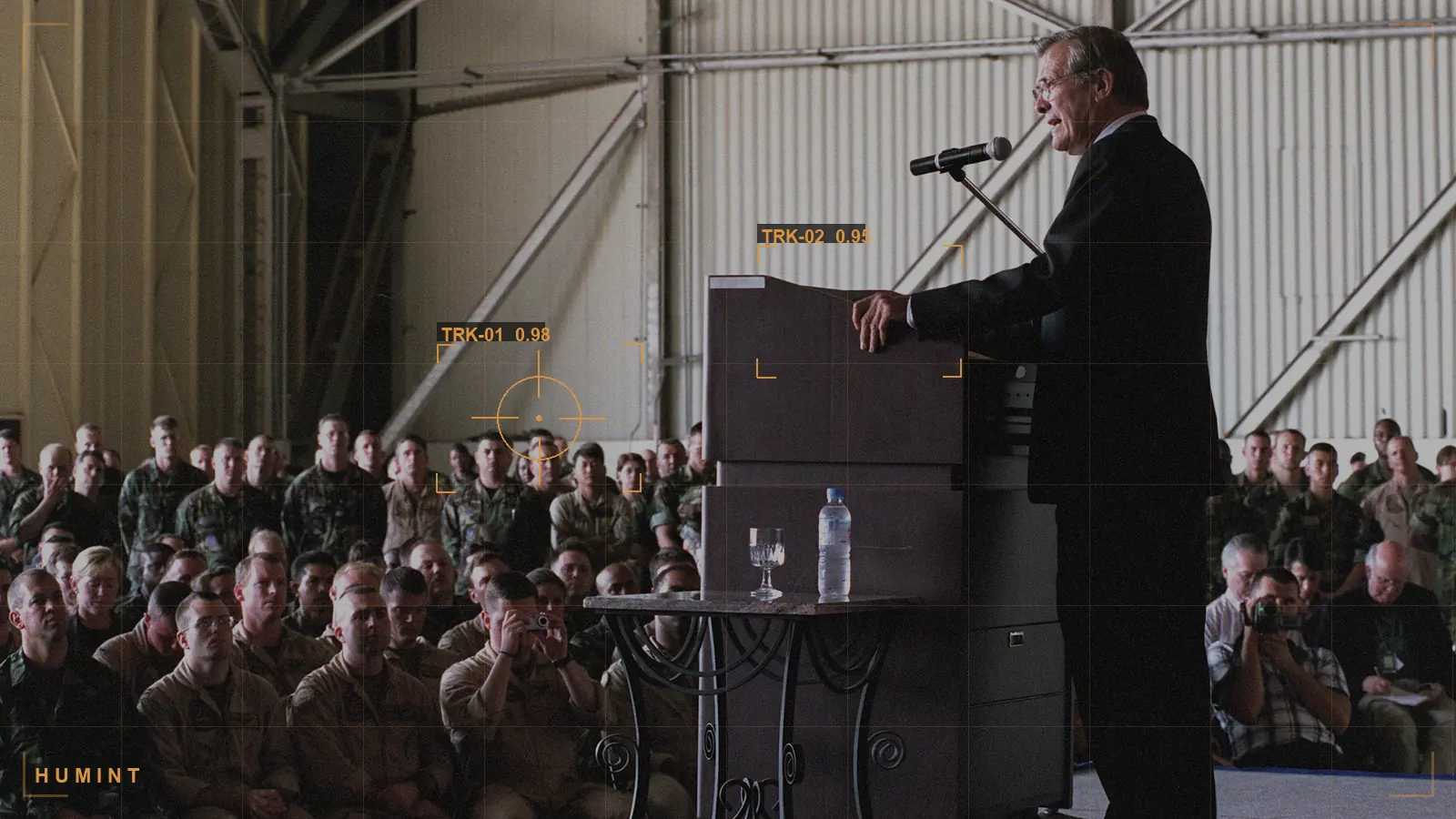
Human intelligence (HUMINT) is intelligence collected and derived from human sources, the oldest collection discipline, produced to answer specific intelligence requirements under legal and policy controls.
Last updated: October 19, 2026
Why it matters to your mission. A single source report can carry an adversary's intent that no sensor will ever see, yet it arrives as prose in a reporting system that was never built to line up with the signals, imagery, and open-source records around it. HUMINT is the discipline that turns information from human sources into sourced, requirement-driven intelligence. The outcome is that a reported intention is corroborated against the rest of the picture and reaches the decision in time to act on, with every assertion traceable back to the report it came from.
Human intelligence (HUMINT) is intelligence collected and derived from human sources, the oldest collection discipline, produced to answer specific intelligence requirements under legal and policy controls. It is a collection discipline defined by its source rather than its subject: the input is what a person knows, observes, or reveals, but the product is still intelligence, held to the same standards of sourcing, processing, and analysis as any other discipline.
The Office of the Director of National Intelligence describes human-source intelligence plainly as "information collected from human sources, the oldest method for collecting information" (see intelligence.gov, How the IC Works). Collection is only the first step. What makes a source report intelligence is what happens after: the reporting has to be evaluated for source reliability and content credibility, resolved to the entities it names, correlated with other reporting, and analyzed against a requirement before it answers anyone's question.
Key takeaways
HUMINT is defined by its source, the human being, and that source gives it reach into categories of information the technical disciplines struggle to reach. Four stand out:
Across all four, the report arrives as language, carrying a source's own words, biases, and gaps, with a reliability that has to be judged rather than assumed. That distinguishes HUMINT material from a sensor feed, and it makes exploiting it at scale a data problem as much as a tradecraft problem.
HUMINT runs on the same intelligence cycle as any other discipline, adapted to the fact that its raw material is what people report:
Two properties make or break the result. The first is that HUMINT is unstructured by nature: it arrives as narrative prose, in volume, across many reporting channels, so turning it into something an analyst can search and correlate is itself real work. The second is provenance: every assertion keeps a line back to its source report, with its reliability rating, its classification, and its confidence intact, so it can be inspected, corroborated, or challenged. A HUMINT-derived conclusion no one can trace is a liability, not a product.
HUMINT and SIGINT are the two disciplines most often contrasted, because they answer different kinds of question from opposite directions. SIGINT intercepts what an adversary transmits; HUMINT reports what a person knows. The difference shapes what each is good for and where each falls short.
| Dimension | HUMINT (human intelligence) | SIGINT (signals intelligence) |
|---|---|---|
| Source | Human beings who know, observe, or reveal information | Intercepted foreign communications and electronic signals |
| What it reveals best | Intent, plans, knowledge, and relationships | Activity, communications, locations, and technical capability |
| Form of the raw material | Unstructured narrative reporting in natural language | High-volume technical and text data from collection systems |
| Core evaluation | Source reliability and content credibility | Signal attribution and emitter or selector identification |
| Characteristic weakness | Source access, deception, and bias | Encryption, selector change, and volume outpacing exploitation |
| Characteristic strength | Reaches intentions no sensor can observe | Observes activity no source has access to |
Both are collection disciplines, and the point is not that one is better. It is that they are complementary: SIGINT can show that something is happening while HUMINT explains why, and a reported intention gains or loses weight depending on whether the signals and imagery corroborate it. Treating either as a standalone feed wastes the corroboration that comes from reading them together.
HUMINT is one of the recognized collection disciplines alongside signals intelligence (SIGINT), geospatial intelligence (GEOINT), open-source intelligence (OSINT), and measurement and signature intelligence (MASINT). Its distinctive role is to supply the intent and context the technical disciplines cannot observe directly, and to be corroborated by them in turn. A source report that an adversary plans to move a system is a lead; GEOINT that shows the system moving and SIGINT that shows the associated communications are what turn the lead into a confident assessment.
That cross-cueing is why HUMINT is a foundational input to multi-INT fusion: the human-source thread rarely stands on its own, but it supplies the intent or the relationship that gives the other threads meaning. The table below separates HUMINT from the disciplines it works alongside and from the fusion it feeds.
| Term | What it is | Relationship to HUMINT |
|---|---|---|
| HUMINT | Intelligence collected and derived from human sources | The discipline itself: collected, evaluated, and analyzed against a requirement |
| SIGINT | Intelligence from intercepted communications and electronic signals | A complementary discipline; corroborates or is corroborated by HUMINT reporting |
| GEOINT | Intelligence from imagery and geospatial data | A complementary discipline; often confirms activity a source reports |
| Multi-INT fusion | Combining intelligence from several disciplines into one correlated picture | HUMINT is a contributing discipline; fusion is where its reporting is correlated with SIGINT, GEOINT, OSINT, and MASINT |
A source report in isolation is a claim. Its value comes from what it corroborates and what corroborates it, and that connective work is exactly what falls apart when reporting is left to pile up in separate systems. A reported intention that no analyst has time to line up against the signals and imagery around it is warning that exists in the data but never reaches the decision. A source named one way in a HUMINT report and another way in open-source reporting stays two people until someone resolves them, and the network they belong to goes unseen.
The U.S. Government Accountability Office, in Defense Command and Control, GAO-25-106454 (2025), describes the shift the Department of War is trying to make away from analysts who "collect, assess, and package the data by manually entering and transferring them into yet another system" toward more automated, scalable decision-making. HUMINT reporting is a large share of the unstructured data caught in that manual movement. Collected with care but correlated by hand, it produces the familiar failure: the intent was in the reporting, but it reached no one in time. HUMINT becomes decision advantage only when its reporting is processed, resolved to entities, and fused with the other disciplines at machine speed.
The difficulty is partly tradecraft and partly data, and the data side is where infrastructure has to carry the load:
These are not reasons to discount HUMINT. They are why exploiting it demands reasoning infrastructure, not just collectors and analysts reading one report at a time.
Torch.AI builds government-owned reasoning infrastructure that turns fragmented, multi-source data, HUMINT reporting included, into coherent understanding at machine speed, while keeping every element traceable to its source. The infrastructure connects to reporting systems where they live and turns high-volume unstructured reporting into a representation an analyst can search and reason over, rather than leaving source reports as queues no one has time to read. You can see how this is packaged as a capability on the Torch.AI software page.
Three public products carry the relevant roles. NEXUS applies semantic representation and vectorization so unstructured HUMINT reporting and multilingual source material become something you can query and correlate. HALO resolves the people, organizations, and places a report names to entities and fuses them with other reporting into a graph an analyst can trust and trace, with each report's reliability and classification preserved. ORCUS is the data-availability layer that connects to the reporting sources and preserves provenance end to end. Because the reasoning layer runs as a system of reason on top of existing systems of record, the authoritative reporting stays intact and interoperable, and in a government-owned deployment the customer keeps control of the layer where source reporting becomes understanding.
This approach is built for the conditions this page describes: machine-speed processing of unstructured reporting, resolution of named sources and subjects to entities, classification-aware fusion of HUMINT with SIGINT, GEOINT, and OSINT, and every finding traceable to the report behind it. For evaluators, see the software page or request a technical walkthrough and we will run it against a sample of your HUMINT and multi-INT reporting.
Use this as the backbone of an evaluation you can score against:
Evaluating a capability? Bring these seven requirements to a scoping call and we will walk each one against your environment: request a technical walkthrough.
HUMINT collects information from human sources, with unique reach into categories technical collection cannot observe directly: an adversary's intentions and plans, knowledge of how programs and organizations work, relationships and networks, and local ground-truth observation. The report arrives as language and carries a source reliability that has to be judged.
HUMINT follows the intelligence cycle: plan against a requirement, collect from human sources, evaluate the source's reliability and the content's credibility, correlate and resolve the people and places a report names to real-world entities, analyze against the requirement, then produce and disseminate a sourced assessment with provenance preserved.
HUMINT is intelligence from human sources and reaches intent, plans, and relationships that no sensor can observe, arriving as unstructured reporting whose source reliability has to be judged. SIGINT is intelligence from intercepted communications and electronic signals and observes activity and capability no source has access to. They are complementary and most valuable used together.
HUMINT is one of the collection disciplines alongside SIGINT, GEOINT, OSINT, and MASINT. It supplies the intent and context the technical disciplines cannot observe directly and is corroborated by them in turn, which makes it a foundational input to multi-INT fusion.
A source report is the raw material; HUMINT is what you get after that report is evaluated for source reliability and content credibility, resolved to the entities it names, correlated against other reporting, and analyzed against a requirement. A report taken at face value is not yet intelligence.
Because a source report in isolation is a claim whose value comes from corroboration, HUMINT reporting correlated by hand produces intent that exists in the data but never reaches the decision in time. Machine-speed fusion with SIGINT, GEOINT, and OSINT is what corroborates the reporting and turns it into decision advantage.


Describe the problem.
Define the constraints. We will structure the session.
No demo.
No slide deck.
Real work.
Describe the problem.
Define the constraints. We will structure the session.
No demo.
No slide deck.
Real work.