Learn
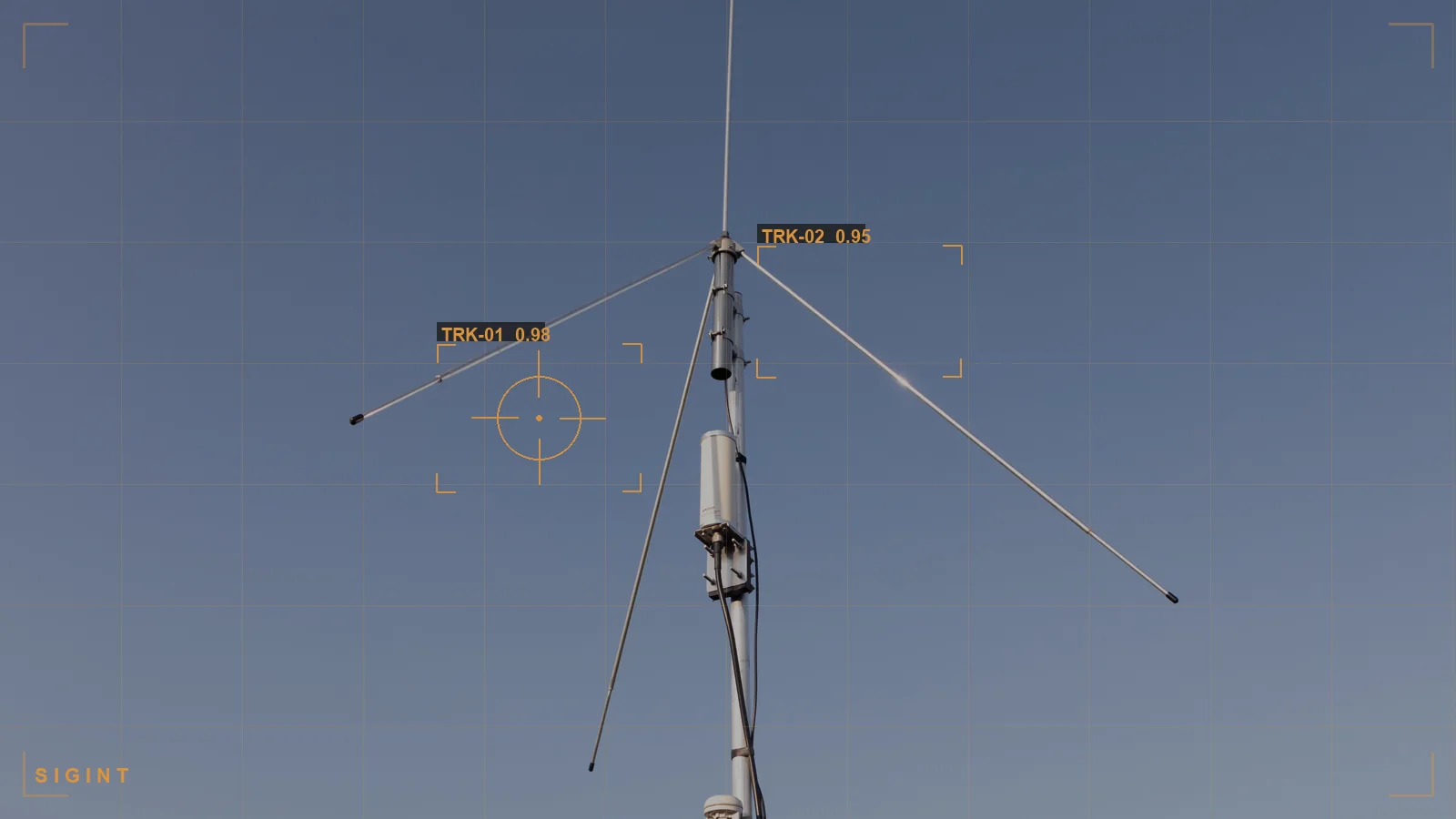
Signals intelligence (SIGINT) is intelligence derived from the interception, processing, and analysis of foreign communications and electronic signals, produced to answer specific intelligence requirements under legal and policy controls.
Last updated: October 19, 2026
Why it matters to your mission. Signals collection produces far more intercept than any analytic team can read, and the fragments that answer a commander's question are scattered across selectors, emitters, and reporting systems that were never built to line up. SIGINT is the discipline that turns intercepted communications and electronic signals into sourced, requirement-driven intelligence. The outcome is a faster, defensible track a decision can rest on, with every assertion traceable back to the collection it came from.
Signals intelligence (SIGINT) is intelligence derived from the interception, processing, and analysis of foreign communications and electronic signals, produced to answer specific intelligence requirements under legal and policy controls. It is a technical collection discipline: the inputs are intercepted signals, but the product is still intelligence, held to the same standards of sourcing, processing, and analysis as any other discipline.
The Office of the Director of National Intelligence describes SIGINT plainly as "the interception of signals, whether between people, between machines, or a combination of both" (see intelligence.gov, How the IC Works). That interception is only the first step. What makes it intelligence is what happens after: the signal has to be processed, exploited, correlated, and analyzed against a requirement before it answers anyone's question.
Key takeaways
SIGINT is an umbrella over three recognized subdisciplines, divided by the kind of signal each one targets:
The distinction matters operationally because each subdiscipline carries different collection, processing, and exploitation demands. COMINT turns on language and content; ELINT on technical parameters and emitter identification; FISINT on instrumentation signatures. A capability that handles one well does not handle the others, which is why SIGINT is a family rather than a single pipeline.
SIGINT runs on the same intelligence cycle as any other discipline, adapted to a high-volume technical environment:
Two properties make or break the result. The first is speed: intercept arrives faster than analysts can read it, so the exploitation that turns signals into facts has to happen at machine speed or the relevant material is never seen. The second is provenance: every assertion keeps a line back to its source intercept, with its classification and confidence intact, so it can be inspected, corroborated, or challenged. A SIGINT finding no one can trace is a liability, not a product.
COMINT and ELINT are the two SIGINT subdisciplines most often confused, because both intercept signals. The difference is what kind of signal, and therefore what the intelligence is about.
| Dimension | COMINT (communications intelligence) | ELINT (electronic intelligence) |
|---|---|---|
| Signal type | Foreign communications: message traffic between people or systems | Non-communications electronic emissions: radar and other sensor signals |
| What it reveals | Content, intent, relationships, and networks | Technical parameters, emitter identity, and system capability |
| Primary exploitation | Language, transcription, and content analysis | Signal parameter measurement and emitter signature matching |
| Typical question | Who is communicating with whom, and about what | What system is emitting, where, and with what capability |
| Common challenge | Encryption, language, and selector changes | Dense emitter environments and ambiguous signatures |
Both are SIGINT, and in practice they are used together: ELINT locates and characterizes a platform while COMINT reveals who is operating it and why. Treating them as one undifferentiated feed is a mistake; so is treating them as unrelated. The value is in correlating them.
SIGINT is one of the recognized collection disciplines alongside geospatial intelligence (GEOINT), human intelligence (HUMINT), open-source intelligence (OSINT), and measurement and signature intelligence (MASINT). Its distinctive role is twofold: it delivers unique value on its own, and it cues and corroborates the others. Joint doctrine gives the classic pairing of using SIGINT direction finding to focus collection by GEOINT systems, so a signal detected by one discipline points another at where to look (JP 2-0, Joint Intelligence).
That cross-cueing is why SIGINT is a foundational input to multi-INT fusion: the SIGINT thread rarely stands alone, but it often supplies the track or the confirmation that ties the other threads together. The table below separates SIGINT from the disciplines it works alongside and from the fusion it feeds.
| Term | What it is | Relationship to SIGINT |
|---|---|---|
| SIGINT | Intelligence from intercepted communications and electronic signals | The discipline itself: collected, processed, and analyzed against a requirement |
| GEOINT | Intelligence from imagery and geospatial data | A complementary discipline; SIGINT direction finding often cues GEOINT collection |
| HUMINT | Intelligence from human sources | A complementary discipline; corroborates or contextualizes SIGINT reporting |
| Multi-INT fusion | Combining intelligence from several disciplines into one correlated picture | SIGINT is a contributing discipline; fusion is where its output is correlated with GEOINT, HUMINT, OSINT, and MASINT |
The cost of unfused SIGINT is not hypothetical. Joint doctrine recounts the German "Operation Bodenplatte" air attack of 1945: the headquarters had received adequate signals intelligence and human intelligence reporting to have provided tactical warning, including compartmented SIGINT indicating the operation, but the reports were never fused. The SIGINT specialist had no further knowledge of the operation, and a corroborating prisoner-of-war report was filed elsewhere in the headquarters (JP 2-0, Joint Intelligence). The collection was good. The failure was that the pieces never came together.
The same failure mode persists in a modern form. The U.S. Government Accountability Office, in Defense Command and Control, GAO-25-106454 (2025), describes the shift the Department of War is trying to make away from manual, "swivel-chair" movement of data between systems toward integrated flows that turn vast amounts of data into actionable information. SIGINT is a large share of that data. Collected in volume but correlated by hand, it produces the Bodenplatte outcome at scale: warning that existed in the data but never reached the decision. SIGINT becomes decision advantage only when it is processed, resolved to entities, and fused at machine speed.
The technical environment is advantaged for collectors and adversaries alike, which is what makes it difficult:
These are not reasons to discount SIGINT. They are why it demands infrastructure, not just collection systems and analysts reading one intercept at a time.
Torch.AI builds government-owned reasoning infrastructure that turns fragmented, multi-source data, SIGINT reporting included, into coherent understanding at machine speed, while keeping every element traceable to its source. The infrastructure connects to collection and reporting systems where they live and turns high-volume technical and text data into a representation an analyst can search and reason over, rather than leaving intercept as queues no one has time to work. You can see how this is packaged as a capability on the Torch.AI software page.
Three public products carry the relevant roles. NEXUS applies semantic representation and vectorization so unstructured SIGINT reporting and multilingual communications content become something you can query and correlate. HALO resolves selectors and emitters to entities and fuses them with other reporting into a graph an analyst can trust and trace. ORCUS is the data-availability layer that connects to the sources and preserves provenance end to end. Because the reasoning layer runs as a system of reason on top of existing systems of record, the authoritative collection stays intact and interoperable, and in a government-owned deployment the customer keeps control of the layer where signals become understanding, free to inspect, govern, and evolve it.
This approach is built for the conditions this page describes: machine-speed processing of high-volume technical and text data, resolution of signals to the entities behind them, classification-aware fusion of SIGINT with GEOINT, HUMINT, and OSINT, and every finding traceable back to the intercept behind it. For evaluators, see the software page or request a technical walkthrough and we will run it against a sample of your SIGINT and multi-INT data, with provenance traced end to end.
Use this as the backbone of an evaluation you can score against:
Evaluating a capability? Bring these seven requirements to a scoping call and we will walk each one against your environment: request a technical walkthrough.
SIGINT has three recognized subdisciplines: communications intelligence (COMINT), from intercepted foreign communications; electronic intelligence (ELINT), from non-communications emissions such as radar signals; and foreign instrumentation signals intelligence (FISINT), from signals associated with foreign systems under test or in operation, such as telemetry.
SIGINT follows the intelligence cycle: plan against a requirement, intercept foreign communications and electronic signals, process and exploit the intercept into intelligible form, correlate selectors and emitters to entities, analyze against the requirement, then produce and disseminate a sourced assessment with provenance preserved.
COMINT is intelligence from intercepted foreign communications, the message traffic between people or systems, and reveals content, intent, and relationships. ELINT is intelligence from non-communications electronic emissions such as radar signals, and reveals technical parameters, emitter identity, and system capability. Both are SIGINT and are most valuable used together.
SIGINT is one of the collection disciplines alongside GEOINT, HUMINT, OSINT, and MASINT. It delivers unique value and also cues and corroborates the others, for example using SIGINT direction finding to focus GEOINT collection, and it is a foundational input to multi-INT fusion.
Intercepted signals are the raw material; SIGINT is what you get after that material is processed, exploited, correlated against a requirement, and analyzed into a sourced assessment. Raw intercept answers no one's question until the exploitation and analysis that make it intelligence are done.
Because SIGINT collected in volume but correlated by hand produces warning that exists in the data but never reaches the decision, the failure mode joint doctrine illustrates with the 1945 Operation Bodenplatte attack, where adequate SIGINT and HUMINT reporting existed but were never fused. Machine-speed fusion with the other disciplines is what turns SIGINT into decision advantage.


Describe the problem.
Define the constraints. We will structure the session.
No demo.
No slide deck.
Real work.
Describe the problem.
Define the constraints. We will structure the session.
No demo.
No slide deck.
Real work.