

.svg)
Learn
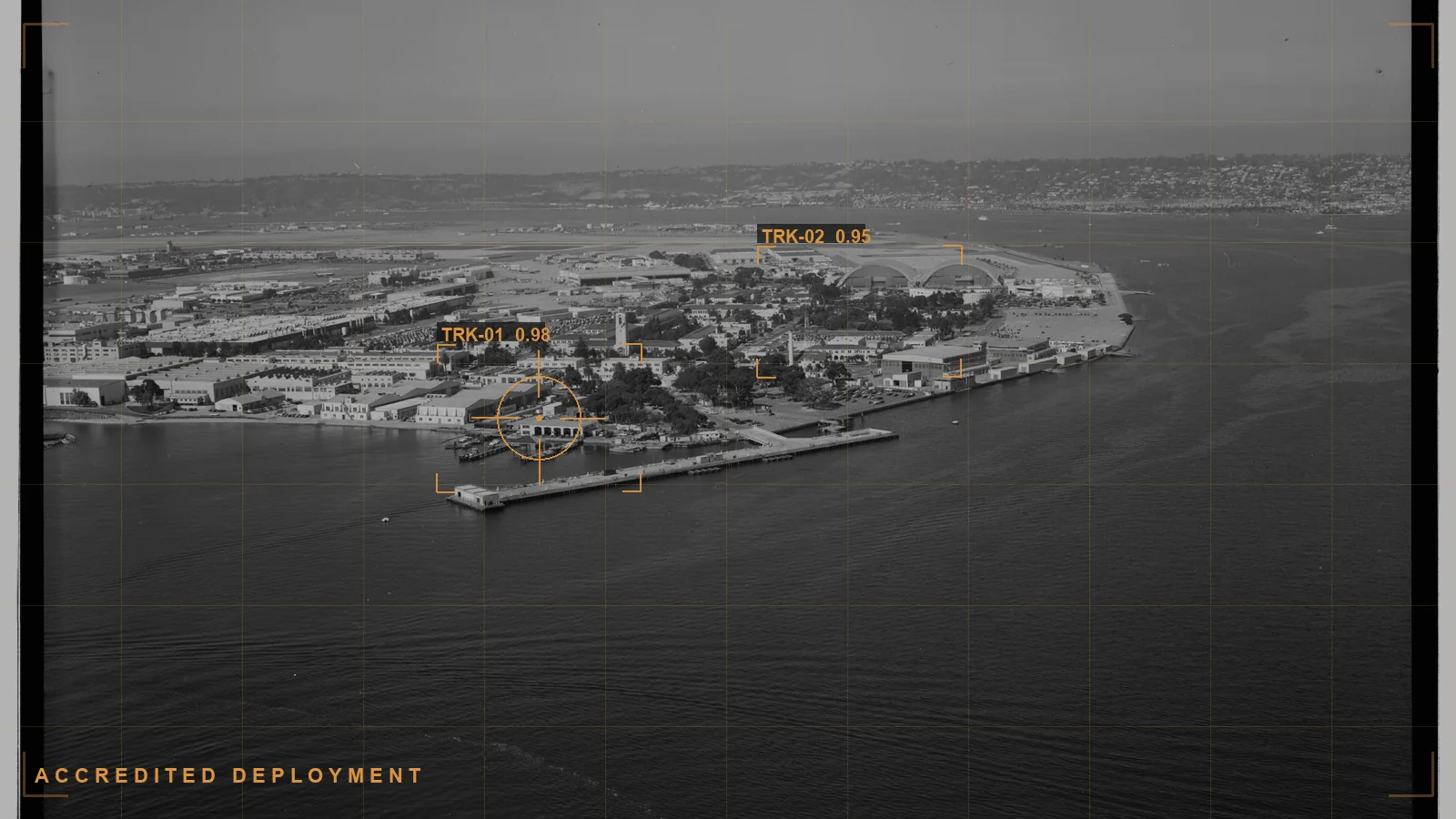
Accredited AI deployment is the process of fielding AI in U.S. government environments under the Risk Management Framework, so the system earns an authorization to operate at a specified DoD cloud impact level with documented, audit-ready controls.
Accredited AI deployment is the process of fielding AI in U.S. government environments under the Risk Management Framework, so the system earns an authorization to operate at a specified DoD cloud impact level with documented, audit-ready controls.
Accreditation is a process, not a product feature. AI that handles mission data must inherit the same authorization discipline as any other government system: assessed controls, a named authorizing official, and an authorization boundary. Fragmented data already increases decision risk; deploying unaccredited AI on top of it adds compliance risk and can block fielding outright. Treating accreditation as an engineering requirement from day one is what makes AI usable in the environments where the mission actually runs.
Impact levels classify the sensitivity of the data a system is authorized to host. Under the DISA Cloud Computing Security Requirements Guide (CC SRG), IL5 covers higher-sensitivity controlled unclassified information and unclassified National Security Systems. IL6 covers classified information up to SECRET and must run on dedicated, isolated infrastructure. TS/SCI data sits in a tier above IL6 and is not an official named impact level, so it should not be labeled "IL7."
A traditional authorization to operate is a point-in-time decision. Continuous ATO (cATO) replaces the periodic re-authorization cycle with ongoing monitoring, automated control checks, and a maintained security posture, so authorization keeps pace with code changes rather than lagging them. It depends on a mature DevSecOps pipeline and continuous visibility into the authorization boundary.
Zero trust assumes no implicit trust by network location and verifies every access request. The DoD Zero Trust Reference ArchitectureZT_RA_v2.0(U)_Sep22.pdf) describes a data-centric model where protection follows the data itself. For AI, that means enforcing authorization at the data layer, not just the perimeter, so a reasoning system only sees what a given user and mission are cleared to see.
Transfer between separate security domains is governed, not ad hoc. Per DoD Instruction 8540.01, any transfer between domains must use an accredited cross domain solution. AI deployment plans that span classification boundaries have to account for this control rather than assuming data can flow freely.
Torch.AI builds government-owned reasoning infrastructure designed to deploy and accredit in mission environments, and to complement existing systems of record rather than replace them. ORCUS is the government-owned data-availability layer that runs in accredited environments; NEXUS makes data meaningful; HALO makes relationships understandable; and every determination preserves an audit trail. Because the infrastructure is government-owned and auditable, the authorizing official retains ownership of the boundary and the evidence.
| Element | What it is | Why it matters for AI deployment |
|---|---|---|
| IL5 | Sensitive unclassified and unclassified NSS | Hosts most mission data outside the classified tier |
| IL6 | Classified up to SECRET, dedicated isolated infrastructure | Required to field AI against SECRET data |
| cATO | Continuous authorization via ongoing monitoring | Keeps authorization current as the system changes |
| RMF | Risk Management Framework control process | The path to an ATO; accreditation is this process |
| Zero trust | Data-centric, verify-every-request model | Enforces access at the data layer, not the perimeter |
| Cross domain solution | Accredited transfer between domains | Required to move data across classification boundaries |
STIG hardening and a DevSecOps software factory support this work by producing consistently configured, continuously scanned builds that feed the RMF evidence package. The result is AI that can be authorized, not just demonstrated.
Impact levels classify the sensitivity of the data a system is authorized to host. Under the DISA Cloud Computing Security Requirements Guide, IL5 covers higher-sensitivity controlled unclassified information and unclassified National Security Systems. IL6 covers classified information up to SECRET and must run on dedicated, isolated infrastructure. TS/SCI data sits in a tier above IL6 and is not an official named impact level.
A traditional authorization to operate is a point-in-time decision. Continuous ATO replaces the periodic re-authorization cycle with ongoing monitoring, automated control checks, and a maintained security posture, so authorization keeps pace with code changes. It depends on a mature DevSecOps pipeline and continuous visibility into the authorization boundary.
Zero trust assumes no implicit trust by network location and verifies every access request. The DoD Zero Trust Reference Architecture describes a data-centric model where protection follows the data itself. For AI, that means enforcing authorization at the data layer, not just the perimeter, so a reasoning system only sees what a given user and mission are cleared to see.
Transfer between separate security domains is governed, not ad hoc. Per DoD Instruction 8540.01, any transfer between domains must use an accredited cross domain solution. AI deployment plans that span classification boundaries have to account for this control rather than assuming data can flow freely.
Torch.AI builds government-owned reasoning infrastructure designed to deploy and accredit in mission environments and to complement existing systems of record. ORCUS is the government-owned data-availability layer that runs in accredited environments. Because the infrastructure is government-owned and auditable, the authorizing official retains ownership of the boundary and the evidence.


SHARE