


.svg)
Learn
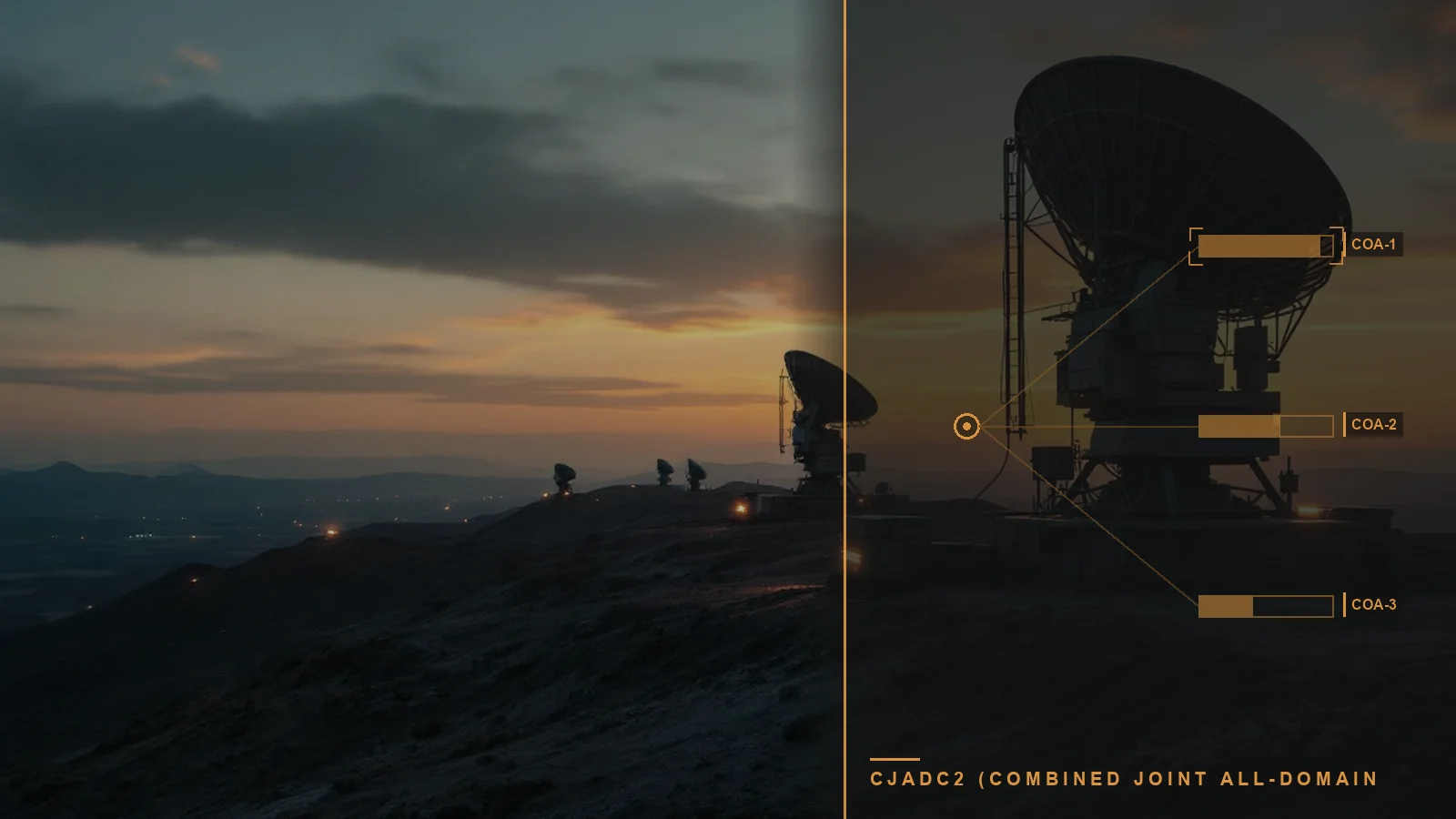
CJADC2, or Combined Joint All-Domain Command and Control, is the U.S. Department of Defense concept for connecting data, sensors, and decision-makers across every warfighting domain and with coalition partners, so that commanders can sense, make sense, and act at the speed of relevance; it is not a single system but a way of integrating data and analytics to make and communicate decisions.
Why it matters to your mission. CJADC2 only works if data from every domain reaches the decision in a form it can use, and today it usually does not. Integrating that data into one decision-ready picture is what turns the concept into tempo. The outcome is a shared, trustworthy operating picture and faster sensor-to-decision timelines across the joint force.
Also written JADC2 (Joint All-Domain Command and Control); the added C is for Combined, signaling coalition integration.
The slogan is connectivity; the substance is data. A sensor feed is worthless to a commander until it has been reconciled against everything else the force already knows, and that reconciliation is where most of the difficulty lives. CJADC2 is less a network to be built than a data-integration problem to be solved, repeatedly, under classification and at the edge.
That makes CJADC2 the mission context the rest of this hub ladders up to: you cannot integrate what you cannot first match (entity resolution), you cannot act on fragments you have not fused into one picture (multi-INT fusion), and the common picture is only decision-ready if it stays owned and traceable.
Key takeaways
The problem CJADC2 exists to solve is concrete and expensive. Today an analyst often receives inputs from one system and manually re-enters them into another, a pattern the U.S. Government Accountability Office calls "swivel-chair" analysis (GAO, Defense Command and Control, GAO-25-106454, 2025). Every manual hop costs time the mission does not have and introduces errors no one can audit. CJADC2 is the move from that model to one where the data is integrated once and reused everywhere.
The Department has made the need explicit. Its unclassified strategy frames CJADC2 as the capability to "sense, make sense, and act at all levels and phases of war, across all domains, and with partners, to deliver information advantage at the speed of relevance," organized around lines of effort that put the data enterprise first (DoD, Summary of the Joint All-Domain Command and Control (JADC2) Strategy, 2022). "Make sense" is the operative phrase: connectivity moves bits, but making sense of them is a reasoning problem over fragmented data.
The mechanism the Department has chosen for the data layer reinforces the point. The Chief Digital and Artificial Intelligence Office's Open DAGIR initiative (Open Data and Applications Government-owned Interoperable Repositories) is built to combine multi-source data while the government retains ownership and interoperability, rather than pooling everything into one proprietary platform (CDAO, Open DAGIR Fact Sheet, 2024). The architecture is deliberately federated: oversight notes that there will not be a single data repository across DoD, but a computing environment that connects existing federated data across systems.
For the mission the payoff is the same one every page in this hub returns to: fragmented, multi-domain data becomes one picture a commander can act on, assembled at machine speed, with a line back to every source so a coalition can share it and an inspector can defend it.
Bottom line: JADC2 is the all-domain command-and-control concept; CJADC2 adds the "Combined" C to make coalition data sharing a first-class requirement rather than an afterthought. The data-integration problem is the same; CJADC2 raises the bar on releasability and partner interoperability.
| Dimension | JADC2 | CJADC2 |
|---|---|---|
| Scope | Joint force across all U.S. domains | Joint force plus coalition and mission partners |
| What the extra "C" means | Not present | Combined: partner data sharing is a core requirement |
| Hardest added constraint | Cross-service data integration | Cross-service plus releasability and partner interoperability |
| Data-sharing challenge | Classification across services | Classification plus foreign-disclosure and releasability rules |
| Origin | DoD concept, strategy summarized 2022 | DoD effort established 2019 (per GAO); Combined adds coalition partners |
The takeaway is not that CJADC2 is a different program; it is the same all-domain concept with coalition sharing promoted to a requirement. That promotion makes classification-aware and releasability-aware data handling non-negotiable, because the picture now has to be shareable with partners who are allowed to see some of it and not the rest.
CJADC2 is a data flow, not a box. Following the strategy's own framing, the stages are:
The load-bearing stage is "make sense." Connectivity and a federated data layer get the bits into reach, but a commander needs a reconciled picture, not a bigger inbox. That is why CJADC2 depends on the same disciplines the rest of this hub covers: entity resolution decides which records are the same entity, multi-INT fusion links them into the common picture, and GraphRAG makes that picture answerable, each step preserving the line back to source.
These terms travel together in command-and-control discussions and are easy to conflate. They name different layers. The table separates them.
The vendor-lock-in concern is not a talking point; it is an oversight finding. When the layer that integrates a force's data is a vendor's proprietary environment, the government's own data and the logic that reconciles it live somewhere it cannot fully inspect or move. For CJADC2, where the whole point is interoperability across services and partners, that is a strategic risk. The table contrasts the two acquisition models against the considerations that decide the mission.
| Consideration | Typical commercial platform | Government-owned reasoning infrastructure |
|---|---|---|
| Control of the integration layer and logic | Held in the vendor's proprietary environment | Customer keeps control of the integration and reasoning layer |
| Interoperability | Often non-standard interfaces; risk of lock-in | Open, interoperable; complements existing systems |
| Relationship to existing systems | Often a new platform to migrate onto | Reasons over federated data in place; no rip-and-replace |
| Data ownership | May reside with the vendor | Government retains ownership of its data (the Open DAGIR model) |
| Classification and releasability | Varies | Classification- and releasability-aware by design |
| Where it can run | Frequently cloud-only | Enterprise to disconnected tactical edge |
Government-owned does not mean the government builds everything itself or owns a vendor's underlying intellectual property. It means the customer keeps control of the mission layer, the integration and reasoning over its own data, and can inspect, govern, and evolve it rather than renting it inside a proprietary platform. Whether a specific deployment is government-owned (GOTS) or commercial (COTS) depends on the system the customer installs and purchases; for a capability meant to integrate the whole force's data, the government-owned model is the one to evaluate when ownership and interoperability are the point.
The comparison explains why ownership and interoperability matter; the checklist is what to require in an evaluation.
Evaluating a capability? The seven requirements above are the backbone of a CJADC2 data-integration evaluation you can score vendors against. Bring them to a scoping call and we will walk each one against your environment: request a technical walkthrough.
For the customer, the outcome is tempo: data from every domain arrives in one decision-ready picture, shortening the path from sensor to decision across the joint force. Here is how Torch.AI delivers it.
Torch.AI builds reasoning infrastructure the customer can own and govern, offered as a government-owned (GOTS) deployment when a mission requires it, aligned with the Open DAGIR model of keeping data owned and interoperable. The reasoning layer connects to mission data where it lives across services and domains. ORCUS ingests and normalizes the fragmented, multi-source feeds, including unstructured text, without forcing them into one repository. NEXUS reads the unstructured sources for the entities and relationships buried in reporting. HALO resolves records that describe the same entity and fuses them into a common picture whose every element traces back to source, respecting classification and releasability throughout. You can see how this is packaged as a capability on the Torch.AI software page.
Because it reasons over federated data in place rather than replacing the systems that hold it, the authoritative sources stay intact and interoperable, not locked inside a proprietary model. This is the systems of record versus systems of reason distinction at the center of Torch.AI's approach: the reasoning layer acts as a system of reason on top of the force's existing systems of record, delivering the reconciled, shareable picture CJADC2 calls for without the vendor lock-in oversight has warned against.
Torch.AI's approach is built for the conditions this page describes: all-domain, multi-source data; classification- and releasability-aware integration; a common picture traceable to its sources; and operation from the enterprise to the disconnected tactical edge.
For evaluators scoping a capability, see how Torch.AI delivers resolution, fusion, and government-owned data integration on multi-domain data, deployable government-owned, on the software page, or request a technical walkthrough and we will run it against a sample of your own multi-domain data, with provenance traced end to end.
What is the difference between JADC2 and CJADC2? JADC2 is the all-domain command-and-control concept; CJADC2 adds the "Combined" C to make coalition and mission-partner data sharing a first-class requirement, which raises the bar on releasability and partner interoperability. The underlying data-integration problem is the same. See the JADC2 vs. CJADC2 table.
Is CJADC2 a system I can buy? No. Oversight is explicit that CJADC2 is not a single system but a way of using data and analytics to make and communicate decisions. What a program actually acquires is the data-integration and reasoning capability underneath it, which is why ownership, interoperability, and classification handling are the real evaluation criteria.
How does Open DAGIR relate to CJADC2? Open DAGIR is the data-layer mechanism: government-owned, interoperable repositories that let the force combine multi-source data while the government retains ownership. CJADC2 needs exactly that owned, federated integration to work, which is why the two are usually discussed together.
Why is data integration the hard part of CJADC2? Because the same entity arrives from many systems that were never built to agree, under classification rules that limit what can be combined. Connecting the systems is necessary but not sufficient; the force needs the data reconciled into one picture, which depends on entity resolution and fusion, not just a network.
Does CJADC2 require a single central database? No. DoD has stated there will not be a single data repository across the Department; the integration layer is federated, connecting existing data across systems. That is why a capability has to reason over data in place rather than demand a migration into one store.
Can CJADC2 data integration run on classified and disconnected networks? It has to. A mission-grade capability handles classification and releasability during integration and can operate government-owned in classified and disconnected or degraded environments, not only as a cloud service.
What does government-owned CJADC2 integration mean? It is a deployment and ownership model (GOTS) in which the customer keeps control of the integration layer, the reasoning logic, and the data, with open interfaces that avoid vendor lock-in, and can run them in classified or disconnected environments. The same capability can also be delivered commercially (COTS); which applies depends on the system the customer installs and purchases.


Describe the problem.
Define the constraints. We will structure the session.
No demo.
No slide deck.
Real work.
Describe the problem.
Define the constraints. We will structure the session.
No demo.
No slide deck.
Real work.