

.svg)
Learn

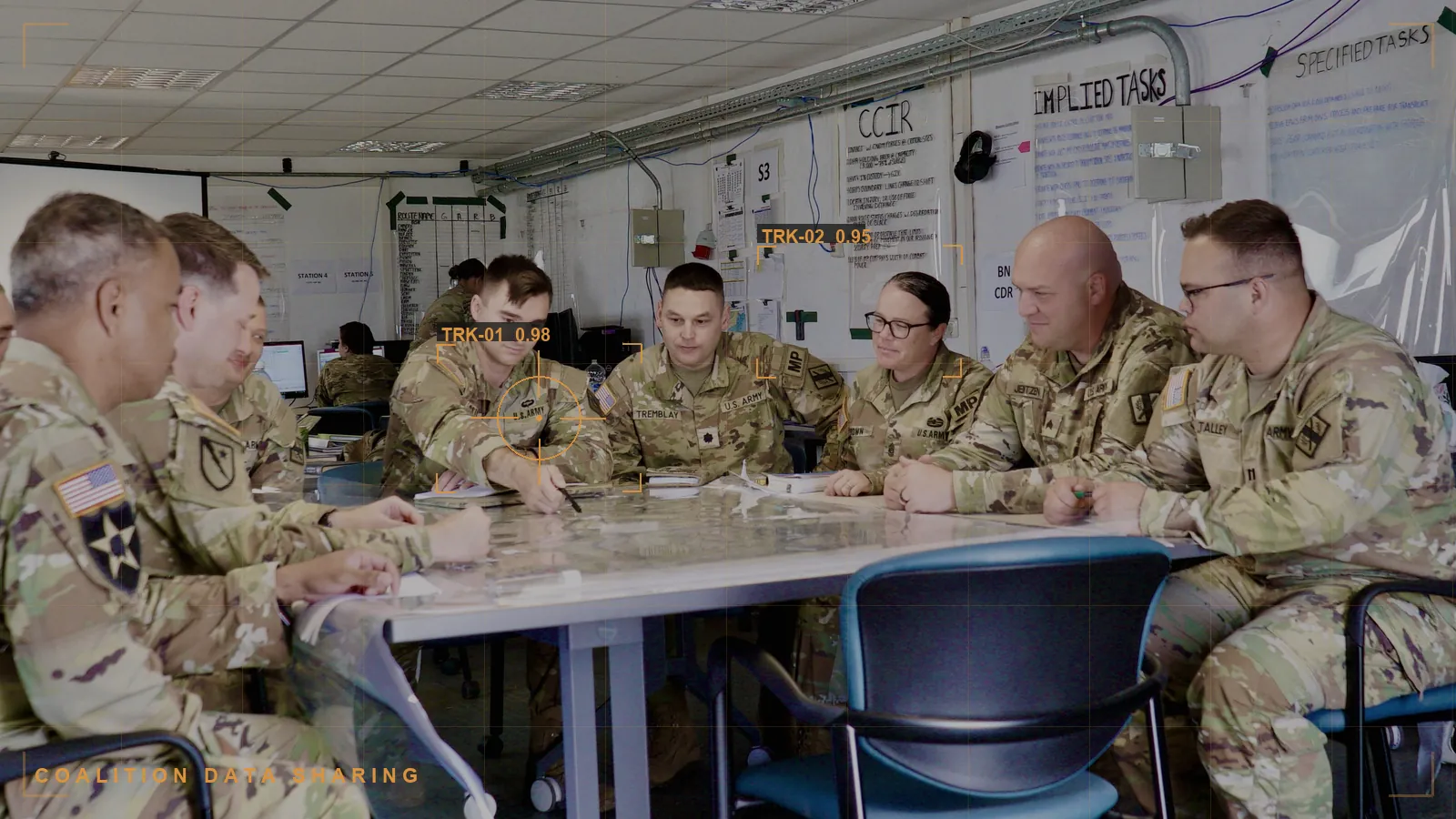
Coalition interoperability is the ability of allied and partner forces to share a common, decision-ready picture across national boundaries, which means sharing the data, terminology, and systems needed for combined operations while enforcing the releasability and foreign-disclosure rules that govern what each partner is allowed to see.
Why it matters to your mission. Coalitions lose time when data cannot move across partners at the speed operations demand, and releasability rules make manual sharing slow and risky. Interoperable, releasability-aware data flow lets partners act on a common picture. The outcome is faster coordinated decisions across the coalition, with sharing controlled rather than improvised.
Also called coalition data sharing, multinational interoperability, or releasability-aware data sharing.
Connectivity between partners is necessary but not sufficient. The real constraint is that data carries releasability: a given report may be shareable with one partner, a subset of partners, or none, and that rule lives at the level of the individual record, not the network. Sharing a coalition picture therefore means producing, from one body of data, many partner-specific views, each holding exactly what that partner is cleared to see and nothing more.
That makes coalition interoperability a classification-and-releasability problem layered on top of everything else in this hub: you cannot share a correct partner view of data you have not resolved, fused, and marked for releasability. It is the combined, partner-facing expression of the same integration that CJADC2 calls for inside a single force.
Key takeaways
Coalition interoperability exists because the United States rarely fights alone, and sharing with partners is both essential and constrained. Joint doctrine treats multinational operations as the norm rather than the exception and makes information sharing with partners a central problem of combined command, bounded by national disclosure policy and releasability (U.S. Joint Chiefs of Staff, Joint Publication 3-16, Multinational Operations, 2019). The coalition has to act on a shared understanding, but what can be shared is governed by rules that differ by partner and by piece of information.
The department has made closing that gap an active priority. Efforts to build mission partner networks and digital pathways for coalition data access are explicit about the goal: let partners exchange and act on data across national boundaries rather than through slow, manual, lowest-common-denominator channels (U.S. Department of Defense, Project Olympus Forges Critical Digital Pathways to Enable Interoperability). The demand is for coalition data sharing that is fast and automated, yet still bounded by what each partner is cleared to receive.
The reason it is hard is that releasability is granular and dynamic. A single fused picture contains records with different releasability: some marked for release to a specific partner, some to a coalition group, some not releasable at all. Producing a correct partner view means filtering that picture per partner, continuously, as new data arrives, without either leaking what is not releasable or starving a partner of what they are cleared to see. Done by hand, the choice collapses into releasing too little, and the coalition fights half-blind, or too much, and a disclosure rule is broken.
For the mission the payoff is partners who can actually operate as one force: each acting on a current, coherent view built from the shared data, holding exactly what they are cleared for, with every disclosure traceable and defensible rather than improvised under time pressure.
Bottom line: releasability is not one switch but a set of rules, enforced at the record level, about which foreign partners may receive which information. Understanding the vocabulary is the difference between sharing responsibly and either over-disclosing or paralyzing the coalition.
| Term | What it is | Role in coalition sharing |
|---|---|---|
| Releasability | Whether and to whom a specific piece of information may be released | The core attribute that decides what crosses a national boundary |
| Foreign disclosure | The governed process and decision to release information to a foreign partner | The human, policy-bound decision that authorizes a release |
| REL TO | A marking that information is releasable to named partners or coalition groups | How releasability is expressed on the record |
| NOFORN | A marking that information is not releasable to any foreign partner | The hard stop a partner view must enforce |
The takeaway is that releasability is an attribute of the data, decided and marked, not a property of the network. A coalition sharing capability has to read and enforce those markings at the point of sharing, and route the actual disclosure decision to the people and policy authorized to make it.
Coalition sharing done right produces partner-specific views from one shared picture. The pattern is:
The load-bearing idea is one picture, many views: a single resolved, fused, releasability-marked body of data from which each partner's view is derived, rather than many hand-maintained copies that drift apart and invite error. That is only possible if releasability is enforced at the data level, which is why coalition interoperability cannot be separated from classification-aware resolution and fusion.
These terms cluster around combined operations and are easy to blur. The table separates them.
| Term | What it is | Relationship to coalition interoperability |
|---|---|---|
| Mission partner environment (MPE) | The networks and services through which partners share information | The infrastructure coalition sharing runs on; interoperability is what makes the data usable across it |
| Foreign disclosure | The governed decision to release information to a partner | The authorizing decision releasability-aware sharing routes to a human |
| CJADC2 | Integrating data and decisions across domains and partners | The broader command-and-control effort; see CJADC2. Coalition interoperability is the partner-sharing, releasability-enforcing part of it |
| Interoperability (general) | Systems and forces working together | Coalition interoperability adds the releasability and foreign-disclosure constraint that combined operations impose |
The failure mode of coalition sharing is treating releasability as a step that happens after the picture is built, usually by a person manually sanitizing a product before passing it to a partner. That approach breaks in both directions. Sanitize by hand under time pressure and something not releasable slips through, a disclosure violation with real consequences; sanitize too cautiously and the partner receives a hollowed-out picture too late to use, and the coalition loses the speed that was the point of sharing. The only durable answer is to make releasability a property enforced at the data level, so every partner view is correct by construction rather than by a manual last pass. That is the same discipline the auditable and government-owned pillars insist on, applied to the boundary between allies: the rules travel with the data, and the disclosure decision stays with the authorized human.
Releasability is sovereign policy: who may see a nation's intelligence is a government decision, enforced under government authority. If the system that marks releasability, filters partner views, and logs disclosures lives in a vendor's proprietary environment, the government has put the enforcement of its own disclosure policy somewhere it cannot fully control or audit. The table contrasts the models against what coalition sharing requires.
| Consideration | Typical commercial platform | Government-owned reasoning infrastructure |
|---|---|---|
| Control of releasability enforcement | Held in the vendor's environment | Customer controls how releasability is enforced |
| The disclosure decision | Vendor-defined or automated | Routed to the authorized foreign-disclosure human |
| Marking and partner views | Varies | Releasability marked at the record level; views derived per partner |
| Auditability of a disclosure | Often limited | Every release logged and traceable to its basis |
| Terminology crosswalks | Generic translation | Partner terminology and language crosswalks |
| Where it can run | Frequently cloud-only | Enterprise, coalition networks, and disconnected environments |
Government-owned does not mean the government builds everything itself or owns a vendor's underlying intellectual property. It means the releasability enforcement, the partner-view logic, and the disclosure log stay under the customer's control and inspection rather than inside a proprietary model. Whether a specific deployment is government-owned (GOTS) or commercial (COTS) depends on the system the customer installs and purchases; for the enforcement of national disclosure policy, the government-owned model is the one to evaluate.
Releasing information to a foreign partner is a legal and policy judgment, so the system enforces the rules but a human owns the disclosure. The machine does the enforcement at scale: marking releasability, deriving each partner's view, keeping views current, and flagging where a release needs a decision, all faster and more consistently than manual sanitization. The foreign-disclosure authority weighs the cases that require judgment, approves or withholds, and owns the release. Two properties make that possible: every partner view and every proposed release carries the releasability basis behind it, so it can be inspected; and the system withholds by default when releasability is unclear rather than guessing toward disclosure. This is the same auditable discipline the rest of this hub requires, applied where a wrong release is a sovereign violation: the AI enforces and proposes; the authorized human discloses.
The sections above explain why record-level enforcement and human disclosure matter; the checklist is what to require in an evaluation.
Evaluating a capability? The seven requirements above are the backbone of a coalition-data-sharing evaluation you can score vendors against. Bring them to a scoping call and we will walk each one against your environment: request a technical walkthrough.
For the customer, the outcome is coordinated speed: partners act on a common, releasability-aware picture instead of waiting on manual data calls. Here is how Torch.AI delivers it.
Torch.AI builds reasoning infrastructure the customer can own and govern, offered as a government-owned (GOTS) deployment when a mission requires it. ORCUS ingests and normalizes multi-source data with classification and releasability preserved; NEXUS reads unstructured reporting and applies semantic labels, including releasability markings, at scale; and HALO resolves and fuses the data into one shared picture in which every entity and relationship carries its releasability, so a partner-specific view can be derived rather than hand-built. A deterministic doctrine layer applies the releasability rules, enforcing what is releasable to whom consistently and auditably, while releases that require a foreign-disclosure judgment are routed to the authorized human and every disclosure is logged. You can see how this is packaged as a capability on the Torch.AI software page.
Because releasability is enforced at the data level with provenance preserved, each partner view is correct by construction and defensible: a foreign-disclosure officer can see why a record is or is not releasable to a given partner and own the call. This is the systems of record versus systems of reason distinction at the center of Torch.AI's approach: the reasoning layer produces the shared picture and the partner views on top of the authoritative sources, which stay intact, so the coalition shares at machine speed without surrendering control of disclosure.
Torch.AI's approach is built for the conditions this page describes: multi-source data with classification and releasability; one shared picture yielding many partner views; human-owned foreign disclosure; partner terminology crosswalks; and auditable, government-owned operation across coalition and disconnected networks.
For evaluators scoping a capability, see how Torch.AI produces releasability-aware partner views from a shared picture on the software page, or request a technical walkthrough and we will run it against a representative coalition scenario, with provenance traced end to end.
What is coalition interoperability in simple terms? It is the ability of allied and partner forces to share one decision-ready picture across national boundaries while enforcing the rules about what each partner is allowed to see. The hard part is controlling what crosses the boundary, not the connection itself.
What is releasability? Releasability is whether, and to which partners, a specific piece of information may be released. It is marked on the record (for example, REL TO named partners, or NOFORN for no foreign release) and enforced when the data is shared, not decided by the network.
What is the difference between coalition interoperability and CJADC2? CJADC2 is the broad effort to integrate data and decisions across domains and partners; coalition interoperability is the partner-facing part that enforces releasability and foreign disclosure when sharing across national boundaries. One is the whole integration; the other is the releasability-governed sharing within it.
Can a shared coalition picture enforce what each partner sees? Yes, if releasability is enforced at the data level. One resolved, fused, releasability-marked picture can yield a correct partner-specific view for each partner, derived automatically rather than by hand-sanitizing a separate copy, which is slower and error-prone.
Does AI decide what to release to a partner? No. Releasing information to a foreign partner is a legal and policy judgment. The AI enforces releasability markings, derives partner views, and flags releases that need a decision; the authorized foreign-disclosure officer approves or withholds and owns the release, consistent with auditable AI principles.
How does AI help coalition data sharing? It marks releasability at scale, derives each partner's view from one shared picture, keeps the views current, and logs every disclosure, replacing slow manual sanitization that is the common source of both over- and under-disclosure. The human still owns the foreign-disclosure decision.


Describe the problem.
Define the constraints. We will structure the session.
No demo.
No slide deck.
Real work.
Describe the problem.
Define the constraints. We will structure the session.
No demo.
No slide deck.
Real work.