

Learn
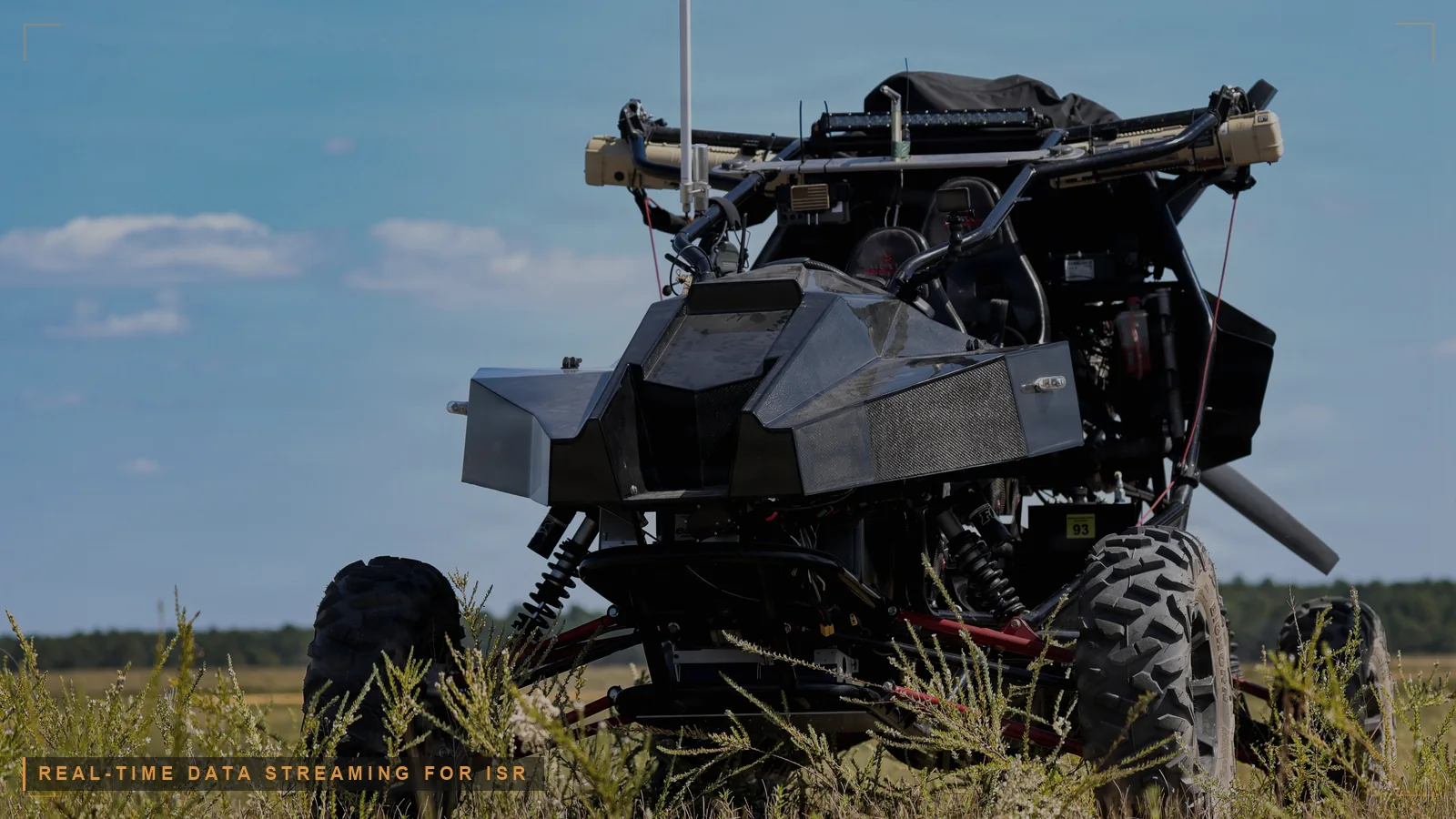
Real-time data streaming for ISR is the continuous ingestion, processing, and exploitation of high-volume sensor and unstructured intelligence feeds at machine speed, so an indication or track is usable in time to act.
Last updated: October 26, 2026
Why it matters to your mission. The hard problem in intelligence, surveillance, and reconnaissance is no longer storing the take. Storage is cheap and getting cheaper. The problem is that sensor and unstructured feeds now arrive faster and in greater volume than any team can exploit by hand, so the one track or indication that answers the commander's question sits unread while the window to act closes. Real-time data streaming for ISR is the discipline of processing those feeds as they arrive, at machine speed, so a finding reaches the decision-maker while it still matters. The outcome is a sensor-to-decision timeline measured against the adversary's tempo, not against how fast an analyst can open the next tab.
Real-time data streaming for ISR is the continuous ingestion, processing, and exploitation of high-volume sensor and unstructured intelligence feeds at machine speed, so an indication or track is usable in time to act. The emphasis is on in time: a correct assessment delivered after the decision window has closed is not decision advantage, it is a forensic record.
This reframes the mission the Department of War has set for itself. The U.S. Government Accountability Office, in Defense Command and Control, GAO-25-106454 (2025), documents a force that still depends on analysts who manually move data between systems and displays, and describes the goal as a transition "from swivel chair analysis to a model where all data is integrated" so warfighters can "handle increasing volumes of data and act faster than their adversaries." Streaming exploitation is how that integrated, faster model is actually achieved on the feeds.
Key takeaways
This is the distinction the term turns on, and most data-platform marketing blurs it.
Batch processing, sometimes called forensic exploitation, collects a body of data, lands it in a repository, and then runs processing against the stored set. It is how you reconstruct what happened after the fact, and it is the right tool for pattern-of-life analysis, post-mission review, and training data. Its defining property is that exploitation is decoupled from arrival: the data waits.
Streaming processing exploits each record as it arrives in the feed, maintaining a continuously updated picture rather than a periodically refreshed snapshot. Its defining property is that exploitation is coupled to arrival: the data does not wait. For an indication that is only actionable for minutes, that coupling is the whole point.
The failure mode is treating a batch architecture as if it were a streaming one. You can run a batch system often, but "run the overnight job every hour" is still batch. If the time from a sensor observing something to an analyst being able to act on it exceeds the life of the opportunity, the volume of your archive is irrelevant. The question is not "can we store it" but "can we exploit it in time."
ISR feeds are an unusually hostile case for streaming, for reasons general-purpose data pipelines rarely confront:
These are not reasons to settle for batch. They are the reasons streaming ISR exploitation demands purpose-built reasoning infrastructure rather than a generic message bus.
A streaming pipeline for ISR follows the processing, exploitation, and dissemination (PED) cycle, run continuously instead of in passes:
Two properties separate a streaming pipeline that delivers decision advantage from one that merely moves bytes quickly. The first is semantic fidelity: the data has to be made meaningful on arrival, not just moved, or you have accelerated the swivel-chair rather than removed it. The second is provenance: the faster the loop, the more a commander needs to know that a machine-speed finding is as traceable as a hand-built one. This is the core of AI-enabled ISR PED, of which streaming is the time-critical case.

PED run continuously, from feed to finding
A streaming pipeline follows the PED cycle continuously instead of in passes, so each record is made meaningful, correlated, and exploited as it lands rather than parked in storage for later.
Two properties separate decision advantage from moving bytes quickly: semantic fidelity on arrival, and provenance that keeps a machine-speed finding as traceable as a hand-built one.
The reason streaming matters is explicitly a government-stated requirement, not a vendor preference. The Department of War's Summary of the JADC2 Strategy (2022) frames the objective as the warfighting capability to "sense, make sense, and act" across all domains and with partners, to deliver information advantage "at the speed of relevance." Each verb maps to a stage of the timeline, and "make sense" is where high-volume feeds are either exploited in time or lost.
The sensor-to-decision timeline is the clock that runs from a sensor observing something to a decision-maker being able to act on it. Every step that depends on a human manually moving or re-keying data lengthens that clock. GAO's finding is that this manual movement is still the norm and still the bottleneck. Streaming ISR exploitation attacks the "make sense" segment directly: it removes the wait between a feed arriving and that feed being usable, which is the segment most exposed to the swivel-chair problem.
| Dimension | Batch / forensic processing | Streaming ISR exploitation |
|---|---|---|
| When exploitation happens | After data lands in storage, on a schedule | As each record arrives in the feed |
| What it answers | What happened, reconstructed after the fact | What is happening, usable inside the decision window |
| Best fit | Pattern-of-life, post-mission review, training data | Time-critical indications and tracks, warnings |
| Sensor-to-decision clock | Bounded by the batch interval plus manual movement | Bounded by processing latency, with the manual seam removed |
| Primary risk | Correct answer arrives too late to act on | Speed achieved without preserving provenance or meaning |
Machine speed is the point, and at ISR volumes that means automated processing of unstructured feeds, with human judgment preserved at the decisions that matter. The role of AI here is narrow and specific: convert high-volume, multi-format, mostly unstructured input into meaningful, correlated representations faster than a team could read it, and surface the few records that answer a requirement. It is not autonomous decision-making. The JADC2 objective is to deliver information advantage to commanders at the speed of relevance, which keeps the human in the loop at the act stage.
That framing also sets the bar for trust. An AI-driven streaming pipeline that a commander cannot audit is not an asset, because a finding that cannot be traced cannot be relied on under fire. The requirement is machine-speed exploitation whose every output remains inspectable back to its source, so that speed and defensibility are not a trade. For how this connects to edge and disconnected operations, see tactical edge AI, and for combining streamed feeds across disciplines, see multi-INT fusion.
Torch.AI builds government-owned reasoning infrastructure that turns fragmented, multi-source data into coherent understanding at machine speed, while keeping every element traceable to its source. For streaming ISR, that means processing sensor and unstructured feeds as they arrive and making them meaningful on arrival, rather than landing them in a repository to be exploited later. You can see how this is packaged as a capability on the Torch.AI software page.
Three public products carry the relevant roles. ORCUS is the data-availability layer that connects to sensor and unstructured feeds where they live, ingests them continuously, and preserves provenance and classification boundaries end to end. NEXUS applies semantic representation and vectorization so unstructured, multi-format text becomes something you can query and correlate the moment it lands, which is the "make sense" segment of the timeline. HALO fuses the resolved entities and relationships across feeds into a graph an analyst can trust and trace, so a track updates continuously rather than fragmenting across sources. Because the reasoning layer runs as a system of reason on top of existing systems of record, the authoritative feeds stay intact and interoperable, and in a government-owned deployment the customer keeps control of the layer where streaming data becomes understanding, able to inspect, govern, and evolve it.
This approach is built for the conditions this page describes: continuous ingestion of high-volume feeds, machine-speed processing of unstructured and multi-format input, live correlation across sources, classification-aware handling, and every streamed finding traceable back to the exact feed behind it. For evaluators, see the software page or request a technical walkthrough and we will run it against a sample of your sensor and multi-INT feeds, with provenance traced end to end.
Use this as the backbone of an evaluation you can score against:
Evaluating a capability? Bring these seven requirements to a scoping call and we will walk each one against your environment: request a technical walkthrough.
Batch processing lands data in storage and exploits it later on a schedule, which suits forensic and pattern-of-life work. Streaming processing exploits each record as it arrives, maintaining a continuously updated picture so time-critical indications are usable inside the decision window.
ISR feeds are high-volume, continuous, and mostly unstructured and multi-format, with correlation that has to happen live, provenance that cannot be dropped for speed, and classification boundaries that must be respected. The slowest step is usually a human manually moving data between systems.
It runs the PED cycle continuously: ingest feeds on arrival, normalize heterogeneous input into a common meaningful form, correlate and resolve references to the same object, exploit against the standing requirement, and disseminate the finding with its provenance intact.
The sensor-to-decision clock runs from a sensor observing something to a decision-maker acting on it. Streaming attacks the make-sense segment by removing the wait between a feed arriving and being usable, the segment most exposed to the manual swivel-chair bottleneck GAO documents.
No. AI performs the machine-speed exploitation of high-volume feeds; human judgment is preserved at the act stage. The JADC2 objective is to deliver information advantage to commanders at the speed of relevance, not to automate the decision itself.
Processing. Storage is cheap; the constraint is exploiting high-volume streaming feeds at machine speed so a finding is usable in time to act. A larger archive does not shorten the sensor-to-decision timeline.


Describe the problem.
Define the constraints. We will structure the session.
No demo.
No slide deck.
Real work.
Describe your sensor-to-decision timeline. We will scope real-time data streaming for ISR around your feeds. No batch replay. Your live feeds. Real work.