

.svg)
Learn
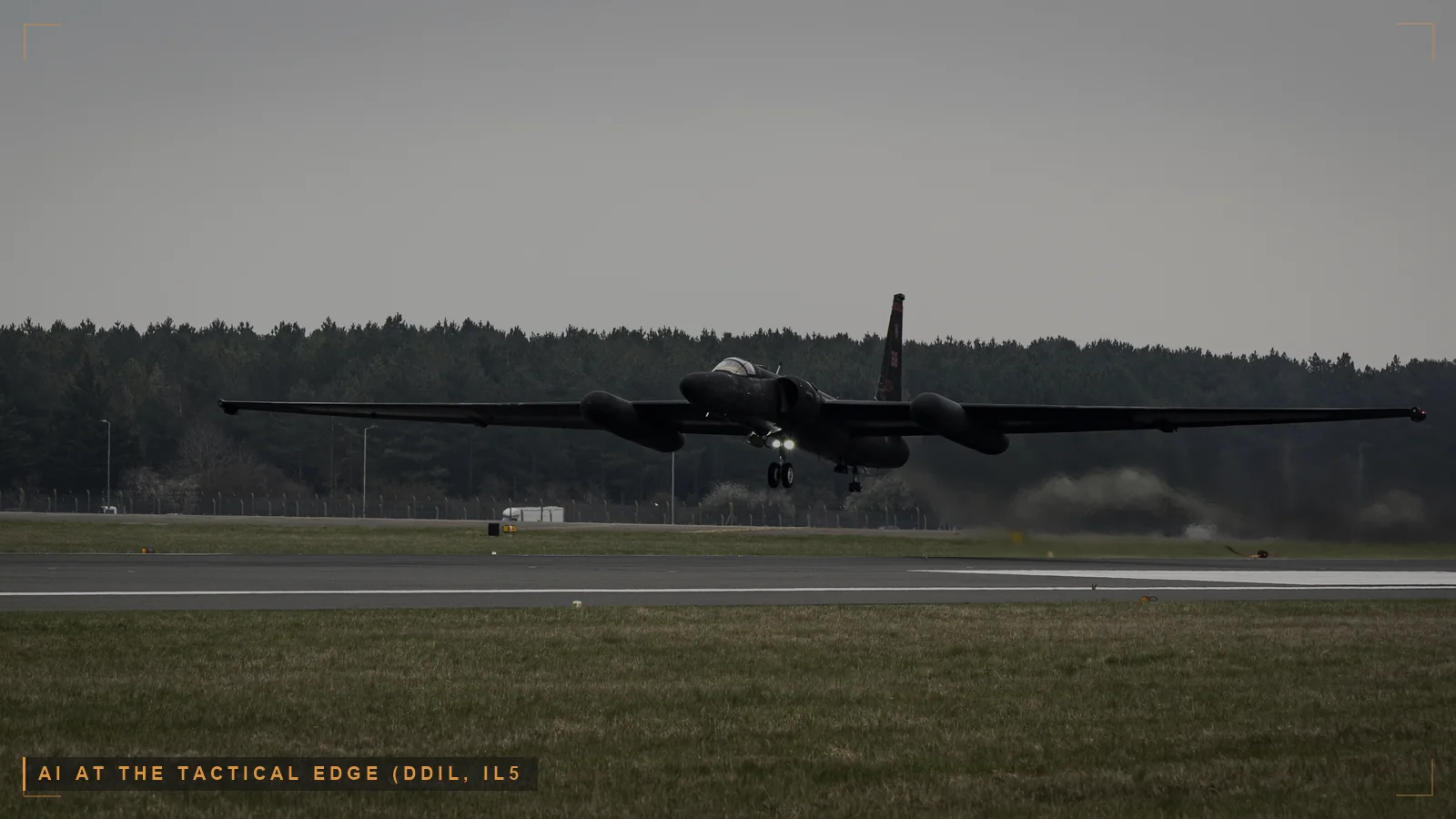
AI at the tactical edge is the deployment of artificial intelligence and data-reasoning capabilities forward, on or near the mission, so they keep working in denied, degraded, intermittent, and limited (DDIL) network conditions disconnected from the enterprise cloud, often at classified cloud impact levels such as IL5 and IL6.
Why it matters to your mission. The decisions that matter most are often made where the network is worst, and cloud-only AI is not there when it counts. Running at the tactical edge keeps the capability working through disconnection and degradation. The outcome is decision support that holds up in the field, so operators act on current understanding without waiting for reachback.
Also called edge AI for defense, tactical-edge AI, or AI for DDIL (denied, degraded, intermittent, and limited) environments.
A capability that only works with a fat pipe back to a cloud region is not a tactical capability. At the forward edge the link is the first thing an adversary attacks and the first thing terrain takes away, so the reasoning has to run locally, degrade gracefully, and reconcile with the enterprise when the connection returns rather than waiting for it.
That makes the edge the hardest deployment case for everything else in this hub: entity resolution, fusion, and the common picture that CJADC2 calls for all have to hold up with no reachback, under classification, on constrained hardware.
Key takeaways
The reason tactical-edge AI exists is that the operating environment the Department plans for is a contested one. Its command-and-control strategy requires the force to sense, make sense, and act "at all levels and phases of war, across all domains, and with partners" (DoD, Summary of the JADC2 Strategy, 2022). "All phases" includes the phase where the adversary has denied or degraded the network, which is exactly when a cloud-dependent tool goes dark.
That is the DDIL problem, and it is increasingly treated not as an exception but as the baseline assumption of near-peer conflict. If the link back to the enterprise is the first casualty, then any reasoning that only runs in the cloud is unavailable at the moment it matters most. The engineering consequence is direct: the data has to be processed, and the decision supported, where the mission is, not where the data center is.
The other half of the problem is classification. Forward systems do not get to relax security to gain reach. DISA's Cloud Computing Security Requirements Guide defines the impact levels these systems must meet: IL5 for the most sensitive unclassified and national-security-system data, and IL6 for classified information up to SECRET, which must run on dedicated, isolated infrastructure rather than a commercial cloud (DISA, DoD Cloud Computing Security Requirements Guide, via the DoD Cyber Exchange). Edge AI has to satisfy those constraints in environments with no reliable connection to the accreditation boundary it depends on.
For the mission the payoff is the difference between a capability that works in the briefing and one that works in the field: reasoning that holds up with no reachback, degrades gracefully when the link is thin, and reconciles cleanly with the enterprise picture when connectivity returns.
DDIL is the doctrinal shorthand for the ways a network fails under contest. The letters name four distinct conditions, and a capability has to survive all of them, not just the easy one:
The wording varies across services, the first "D" is sometimes "disconnected" or "disrupted," and the "L" is sometimes "low-bandwidth," but the planning point is constant: at the edge the network is a variable, not a given. A design that assumes a healthy connection has already failed the DDIL test.
Bottom line: IL5 covers the DoD's most sensitive unclassified and national-security-system data; IL6 covers classified data up to SECRET and must run on dedicated, isolated infrastructure, which commercial clouds are not authorized to host. Edge AI for classified missions is an IL6 problem, and IL6 is why ownership and on-premise operation are not optional.
| Dimension | IL5 | IL6 |
|---|---|---|
| Data it covers | Higher-sensitivity CUI, mission-critical, unclassified national security systems | Classified information up to SECRET |
| Where it can run | DoD-authorized cloud with dedicated resources and U.S.-citizen administration | Dedicated, isolated enclave connected to the classified (SECRET) network |
| Commercial cloud hosting | Permitted under DoD provisional authorization | Not authorized; requires dedicated DoD-controlled infrastructure |
| Authorizing framework | DISA CC SRG provisional authorization | DISA CC SRG provisional authorization, strictest controls |
| Implication for edge AI | Can ride authorized infrastructure, but still must survive DDIL | Must run government-owned on isolated infrastructure, disconnected |
The takeaway for an evaluator is that classification decides the deployment. A tool that can only exist in a commercial cloud region cannot serve an IL6 mission at all, and at the edge even IL5 work has to keep running when the authorized cloud is unreachable. Both push toward the same answer: a capability the government can own and run on its own infrastructure, forward.
Moving AI forward is not the same model with a worse connection; it changes what the system has to do. The pattern that works in DDIL looks like this:
The load-bearing idea is reconciliation. An edge that makes local decisions is necessary; an edge whose decisions cannot be reconciled with the enterprise, with provenance intact, just creates a second, conflicting picture. The goal is one coherent picture that spans the enterprise and the edge, not an island.
These terms are often used loosely together. They describe different things. The table separates them.
The edge is where the commercial-cloud model runs out of road. IL6 work cannot run in a commercial cloud at all, and DDIL means even authorized cloud can be unreachable, so a capability the government cannot run on its own infrastructure is a capability it cannot count on forward. The table contrasts the two models against what the edge actually demands.
| Consideration | Typical commercial cloud model | Government-owned reasoning infrastructure |
|---|---|---|
| Operation without connectivity | Degrades or fails when the link to the cloud drops | Runs fully local in denied and disconnected conditions |
| Classified (IL6) missions | Not authorized to host | Runs on government-owned, isolated infrastructure |
| Control of the reasoning and data | Held in the vendor's environment | Customer keeps control, forward and in the rear |
| Hardware footprint | Assumes data-center resources | Operates on constrained forward hardware |
| Reconciliation with the enterprise | Often tied to the vendor's cloud model | Reconciles through owned resolution and fusion, edge to enterprise |
| Provenance in DDIL | Varies; often depends on the connection | Preserved locally and merged on reconnect |
Government-owned does not mean the government builds everything itself or owns a vendor's underlying intellectual property. It means the customer can run the capability on its own infrastructure, forward and disconnected, and keeps control of the reasoning and the data rather than depending on a vendor's cloud to be reachable. Whether a specific deployment is government-owned (GOTS) or commercial (COTS) depends on the system the customer installs and purchases; at the classified edge, the government-owned, on-premise model is frequently the only one that can run at all.
The comparison explains why ownership and disconnected operation matter; the checklist is what to require in an evaluation.
Evaluating a capability? The seven requirements above are the backbone of a tactical-edge AI evaluation you can score vendors against. Bring them to a scoping call and we will walk each one against your environment: request a technical walkthrough.
For the customer, the outcome is availability where it counts: the capability keeps working through disconnection, so edge decisions do not wait on reachback. Here is how Torch.AI delivers it.
Torch.AI builds reasoning infrastructure the customer can own and govern, offered as a government-owned (GOTS) deployment that runs forward and disconnected when a mission requires it. The same reasoning layer that runs in the enterprise, ORCUS ingesting and normalizing fragmented sources, NEXUS reading unstructured reporting, and HALO resolving and fusing records into a common picture, runs on forward hardware in DDIL conditions without a live link to the cloud. It carries the scoped slice of resolved entities a mission needs, degrades gracefully as bandwidth drops, and reconciles back into the enterprise picture when connectivity returns, with provenance preserved throughout. You can see how this is packaged as a capability on the Torch.AI software page.
Because it is government-owned and runs on the customer's own infrastructure, it can operate at the classified impact levels the edge demands, including isolated IL6 environments a commercial cloud cannot host. This is the systems of record versus systems of reason distinction at the center of Torch.AI's approach, carried all the way to the edge: the reasoning layer acts as a system of reason on top of the force's systems of record, forward and in the rear, so the edge and the enterprise stay one coherent picture rather than two.
Torch.AI's approach is built for the conditions this page describes: denied and degraded networks, classified impact levels, constrained forward hardware, and reconciliation back to the enterprise, with every result traceable to its sources.
For evaluators scoping a capability, see how Torch.AI delivers resolution, fusion, and reasoning that runs government-owned at the disconnected edge on the software page, or request a technical walkthrough and we will run it against a representative edge scenario, with provenance traced end to end.
What does DDIL stand for? Denied, degraded, intermittent, and limited, the four ways a network fails under contest. Some services render the first "D" as disconnected or disrupted and the "L" as low-bandwidth, but the planning point is the same: at the edge the connection cannot be assumed. See DDIL in the terms table.
What is the difference between IL5 and IL6? IL5 covers the DoD's most sensitive unclassified and national-security-system data; IL6 covers classified information up to SECRET and must run on dedicated, isolated infrastructure that commercial clouds are not authorized to host. See the IL5 vs. IL6 table.
Can AI run fully disconnected from the cloud? It has to for the tactical edge. Mission-grade edge AI runs inference locally, carries a scoped picture, degrades gracefully, and reconciles with the enterprise when the link returns, rather than depending on a live connection to a data center.
Is edge AI the same as federated learning? No. Federated learning is one technique for improving models across distributed nodes without centralizing raw data; tactical-edge AI is the broader capability of running the whole reasoning pipeline forward under DDIL and classification constraints.
How does edge AI stay accountable without a connection? By preserving provenance locally. Every resolved entity and answer keeps its link back to source even when the source is only reachable later, so results produced at the edge can still be inspected, reconciled, and defended once connectivity returns.
Why does the tactical edge force a government-owned model? Because IL6 work cannot run in a commercial cloud, and DDIL means even authorized cloud can be unreachable. A capability the government can own and run on its own infrastructure, forward and disconnected, is often the only one that can operate at all. The same capability can also be delivered commercially (COTS) where that fits; which applies depends on the system the customer installs and purchases.


Describe the problem.
Define the constraints. We will structure the session.
No demo.
No slide deck.
Real work.
Describe the problem.
Define the constraints. We will structure the session.
No demo.
No slide deck.
Real work.