

Learn
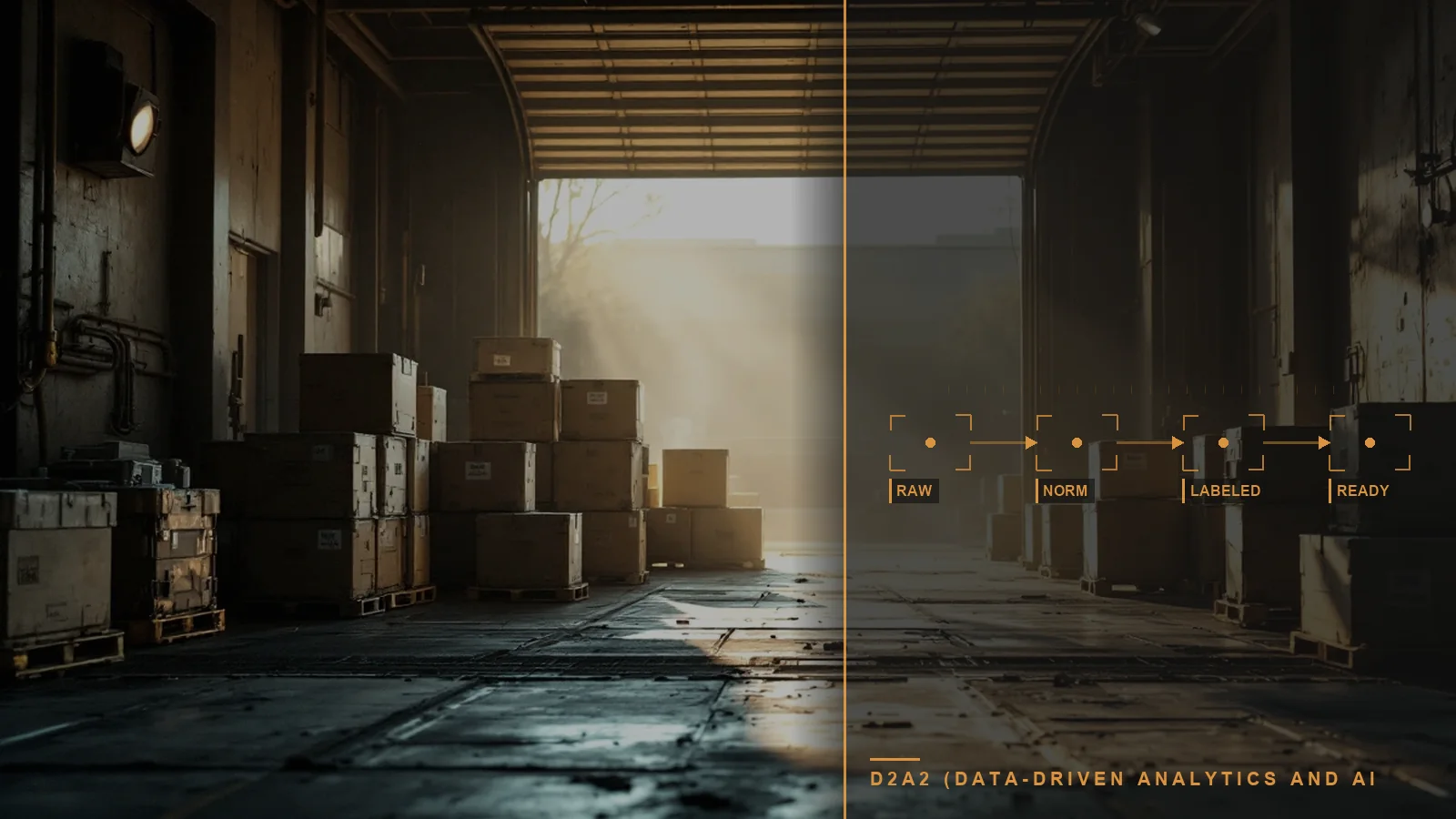
D2A2 (Data-Driven Analytics and AI) is a MITRE framing for the data analytics and AI processes that turn raw surveillance data into deducible, actionable intelligence, distinct from the collection that produced it.
Last updated: October 26, 2026
Why it matters to your mission. Sensors now see almost everything. The harder problem is no longer collecting data, it is turning what was collected into something a decision-maker can act on and defend. D2A2 is the name MITRE gives to that second half of the problem: the analytics and AI that convert raw surveillance data into deducible, actionable intelligence. A program that funds collection but not the reasoning behind it ends up data-rich and insight-poor. The outcome a mission needs is the opposite: observations resolved into understanding, at machine speed, with every conclusion traceable back to the data behind it.
D2A2 (Data-Driven Analytics and AI) is a MITRE framing for the data analytics and AI processes that turn raw surveillance data into deducible, actionable intelligence, distinct from the collection that produced it.
The term comes from the MITRE Corporation. In the Intelligence After Next paper Deciphering Ubiquitous Technical Surveillance (UTS) with Data-Driven Analytics and Artificial Intelligence (D2A2) (Shawn Benson, 2024), MITRE calls D2A2 the "beating heart" that makes surveillance data usable and argues that "without D2A2, the data produced by UTS would be nearly unintelligible and unactionable." D2A2 is a deliberate differentiation: it separates the surveillance that collects data from the processing and exploitation that turns data into intelligence.
A note on fidelity: the paper's title expands D2A2 as "Data-Driven Analytics and Artificial Intelligence," while one line in the body writes "Data-Driven Analysis and Artificial Intelligence." Both appear in the same MITRE document; this page uses the title form and treats D2A2 as a framing, not a standardized doctrinal acronym.
Key takeaways
D2A2 stands for Data-Driven Analytics and AI (Data-Driven Analytics and Artificial Intelligence in the paper's title). The two D's and two A's compress "Data-Driven" and "Analytics and AI" into a single label.
MITRE's point in coining it is that data analytics and AI, historically treated as separate fields, are now "increasingly inseparable" in practice. The paper merges them deliberately so the term captures both today's analytics and tomorrow's AI-augmented versions of the same work, what it calls future-proofing the terminology. In plain terms, D2A2 is the processing-and-reasoning answer to a collection-heavy world: it names the step where data becomes deducible intelligence.
Because D2A2 is a relatively new coinage from a single think-tank paper rather than a term defined in joint doctrine, it is best used as a framing concept. The underlying idea, that collection and exploitation are distinct and both must be resourced, is long-established in intelligence practice.
D2A2 originates in MITRE's Intelligence After Next series, a set of papers MITRE publishes to stimulate thinking among intelligence and national-security leaders. The specific paper is Shawn Benson's 2024 Deciphering Ubiquitous Technical Surveillance (UTS) with Data-Driven Analytics and Artificial Intelligence (D2A2), later reissued in a 2025 Presidential Transition Special Edition.
The paper's argument runs as follows. Ubiquitous technical surveillance (UTS) describes a world of "nearly inescapable data collection," where the internet of things and state-level surveillance merge into a pervasive sensor network. But UTS only describes collection. It says nothing about what anyone can actually deduce from the data. MITRE's central warning is that the DoW and Intelligence Community cannot "presume that detection equals deduction" or "assume observation equals compromise." The paper names D2A2 to force that distinction: collection is one discipline, and turning collected data into intelligence is another.
MITRE maps both onto the established intelligence cycle, Tasking, Collection, Processing, Exploitation, and Dissemination (TCPED). In that mapping, UTS covers the "TC" (tasking and collection) and D2A2 covers the "PED" (processing, exploitation, and dissemination). The paper also leans on the Data, Information, Knowledge, Wisdom (DIKW) model to explain why the distinction matters: data does not become intelligence on its own, and assuming it does is exactly the error D2A2 is meant to correct.
Two caveats worth stating plainly. First, the views in the paper are the author's and, as MITRE notes, do not imply endorsement by the Office of the Director of National Intelligence or any other U.S. government agency. Second, D2A2 is one think-tank's coinage; it is a useful framing, not a mandated standard.
The distinction most people blur is between the data a mission collects and the intelligence it can deduce. D2A2 is a label for the deduction side specifically, and it is narrower than "analytics" and broader than "MLOps."
Plain analytics usually means dashboards, business intelligence, and reporting over already-structured data. D2A2 is about turning raw, fragmented, mostly unstructured surveillance data into intelligence, which requires semantic representation and reasoning long before anything reaches a dashboard. MLOps for defense is the engineering discipline for deploying and maintaining machine-learning models in production. D2A2 is the mission-level outcome those models serve: it treats AI as one tool inside a larger reasoning process, not the end in itself.
| Term | What it names | Primary concern | Relationship to D2A2 |
|---|---|---|---|
| D2A2 | The analytics and AI that turn collected data into deducible intelligence | Deduction: what can be understood from the data | The framing itself |
| Plain analytics / BI | Reporting and dashboards over structured data | Visualizing known quantities | A downstream consumer; D2A2 produces the understanding analytics then displays |
| MLOps | Deploying, serving, and maintaining ML models | Reliable model operations in production | A capability inside D2A2; necessary but not sufficient on its own |
| UTS (collection) | The pervasive sensor network that gathers data | Detection: what can be observed | D2A2's counterpart; UTS collects, D2A2 deduces |
The practical lesson from MITRE is that funding sensors (collection) without funding reasoning (D2A2) leaves a program able to see but not to understand. That gap is where decision risk lives.
Operationalizing D2A2 means building the reasoning path from raw data to a decision a commander can defend. In mission terms, that path has four stages, and each one has a failure mode a program should design against.
Two properties run through all four stages. The first is provenance: a deduction you cannot trace is one you cannot defend when it is challenged. The second is ownership: if the semantic model that turns your data into meaning belongs to a vendor, your deductions are only as portable and inspectable as that vendor allows. Both are design decisions, not afterthoughts.

Four stages from raw data to a decision you can defend
Each stage has a failure mode to design against: a lake that tracks nothing, keyword search dressed up as analysis, records with no structure, and a confident answer no one can audit.
MITRE maps collection to tasking and collection, and D2A2 to processing, exploitation, and dissemination. Funding sensors without funding reasoning leaves a program able to see but not to understand.
The demand D2A2 names is one the U.S. government has documented in its own terms. Independent oversight has described the exact gap D2A2 addresses: the distance between collecting data and turning it into a decision.
The U.S. Government Accountability Office, in Defense Command and Control: Further Progress Hinges on Establishing a Comprehensive Framework, GAO-25-106454 (2025), describes the shift the Department of War is trying to make away from manual, "swivel-chair" movement of data between systems toward integrated flows that let warfighters turn vast amounts of data into actionable information. That is the D2A2 problem stated in acquisition language: collection is not the bottleneck, deduction is. MITRE's paper frames the same gap from the intelligence side, warning the DoW and IC to resource "what is deducible," not just "what is detectable." Read together, the think-tank framing and the oversight finding point at one requirement: the processing and reasoning that turn data into decisions is where the investment case now sits.
Torch.AI builds government-owned reasoning infrastructure that turns fragmented, multi-source data into coherent understanding at machine speed, while keeping every element traceable to its source. That is the D2A2 problem by another name: the data foundation, the semantic representation, and the graph reasoning that turn collected data into analytics and then into AI-supported decisions. You can see how this is packaged as a capability on the Torch.AI software page.
Three public products carry the roles the four-stage path describes. ORCUS is the data-availability layer: it connects to the systems and feeds where mission data lives, processes high-volume unstructured material, and preserves provenance end to end. NEXUS gives the data meaning, applying semantic representation and vectorization, and organizing that meaning into reusable Knowledge Domains so a type of problem becomes a durable analytical asset rather than a one-off query. HALO fuses the resolved entities into a graph an analyst can reason over, trust, and trace. Because this reasoning layer runs as a system of reason on top of existing systems of record, the authoritative sources stay intact and interoperable, and in a government-owned deployment the program keeps control of the layer where data becomes intelligence, able to inspect, govern, and evolve it. Government ownership is an available model to require where the mission calls for it, varying by deployment, not a blanket claim about every install.
This is built for the conditions this page describes: machine-speed processing of unstructured data, semantic meaning that survives across systems, graph reasoning over the relationships that matter, and every deduction traceable back to the data behind it. For evaluators, see the software page or request a technical walkthrough and we will run it against a sample of your data, with provenance traced end to end.
Use this as the backbone of an evaluation you can score against:
Evaluating a capability? Bring these seven requirements to a scoping call and we will walk each one against your environment: request a technical walkthrough.
D2A2 stands for Data-Driven Analytics and AI (Data-Driven Analytics and Artificial Intelligence in the source paper's title). It names the analytics and AI that turn collected data into deducible, actionable intelligence.
The MITRE Corporation coined it, in Shawn Benson's 2024 Intelligence After Next paper on ubiquitous technical surveillance. It is a think-tank framing, not a joint-doctrine standard, and the views are the author's, not an official U.S. government position.
Plain analytics usually means dashboards and reporting over already-structured data. D2A2 covers the earlier, harder step of turning raw, unstructured surveillance data into intelligence through semantic representation and reasoning, which is what analytics then displays.
MLOps is the engineering discipline for deploying and maintaining machine-learning models in production. D2A2 is the mission outcome those models serve; it treats AI as one capability inside a larger reasoning process rather than the end goal.
Build the path from data to decision in four stages: make data available and governed, give it semantic meaning, reason over the relationships in a graph, and deliver decisions into workflows with provenance preserved at every step.
No. D2A2 is MITRE's coinage for an established idea, the separation of collection from exploitation. It is a useful framing, and the underlying distinction is long-standing in intelligence practice, but it is not a mandated doctrinal acronym.


Describe the problem.
Define the constraints. We will structure the session.
No demo.
No slide deck.
Real work.
Describe the data you collect and the decision it should support. We will scope data-driven analytics and AI with you. No dashboard demo. Your mission data. Real work.