

Learn
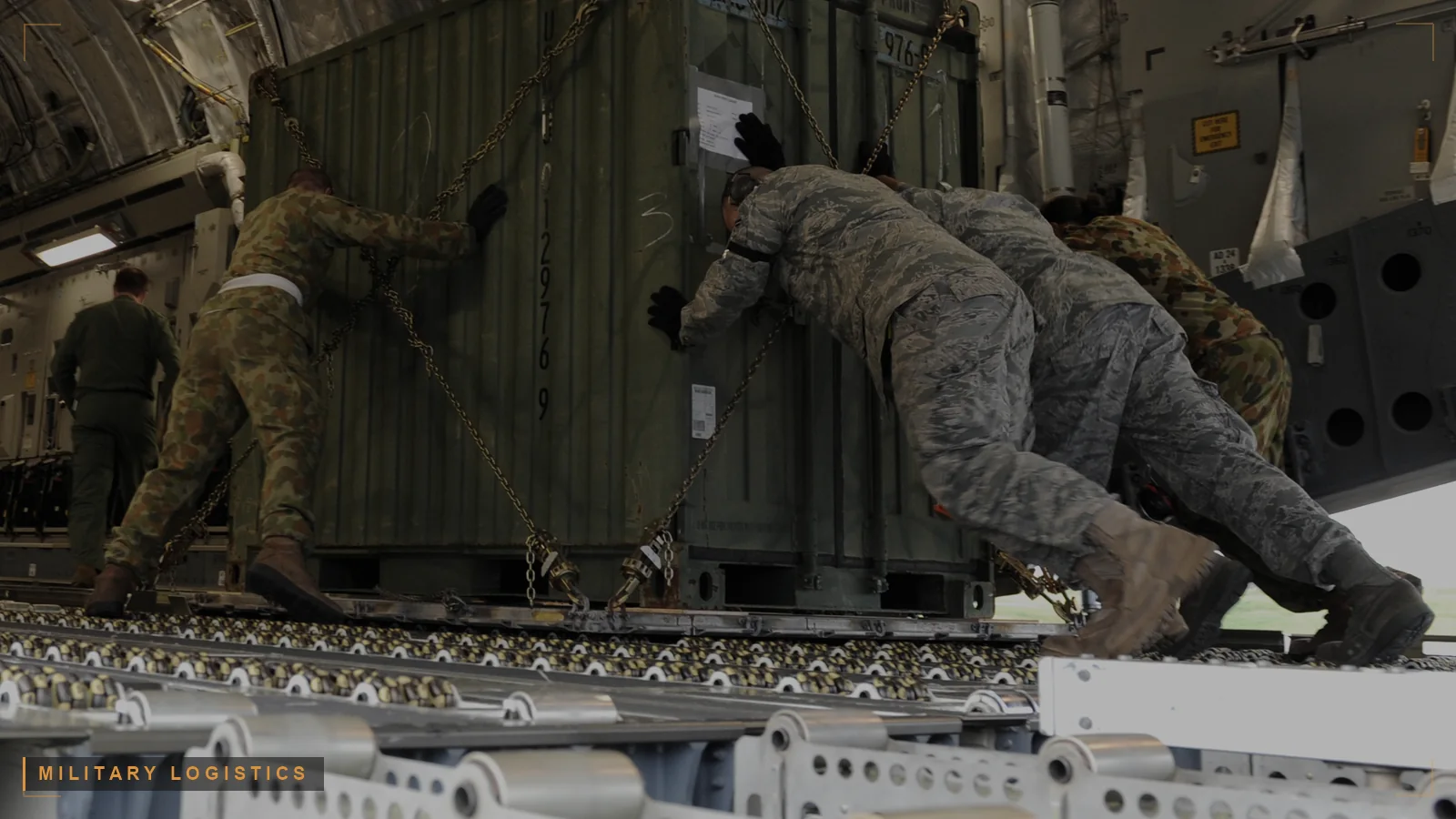
AI in military logistics is the use of machine learning and reasoning systems to forecast demand, predict maintenance, plan distribution, and assess readiness across fragmented supply, maintenance, and transportation data so forces stay sustained, including in contested environments.
AI in military logistics is the use of machine learning and reasoning systems to forecast demand, predict maintenance, plan distribution, and assess readiness across fragmented supply, maintenance, and transportation data so forces stay sustained, including in contested environments. It is also called AI for defense logistics, AI-enabled sustainment, or predictive logistics.
Last updated: November 22, 2026
Why it matters to your mission. A force can only fight as long as it can be supplied, fueled, repaired, and moved. Today that answer is spread across requisition systems, maintenance records, transportation status, and readiness reports that rarely agree with each other. AI earns its place in logistics when it closes that gap: turning the scattered records a logistician reconciles by hand into a forecast a commander can act on before the shortfall arrives.
The gap today. The Army and the Air Force did not meet their mission capable rate goals for fiscal year 2024 for 25 of the 27 aircraft that support military-related missions, and GAO's preliminary analysis tied many of them to supply support, maintenance constraints, and aircraft age. Source: U.S. Government Accountability Office, GAO-26-108888, Military Readiness (March 2026).
Key takeaways
Military logistics is the discipline of moving and supporting a force. Joint doctrine defines logistics in one line: "Planning and executing the movement and support of forces" (Joint Publication 4-0, Joint Logistics, as carried in the DoD Dictionary of Military and Associated Terms). Sustainment is the broader outcome that logistics serves, defined as "the provision of logistics and personnel services required to maintain and prolong operations until successful mission accomplishment" (JP 3-0).
In practice, logistics in the military covers getting materiel from a factory to a fighting position and keeping equipment in the fight once it is there. That spans supply (ordering, storing, and issuing parts, fuel, munitions, and food), maintenance (keeping aircraft, ships, and vehicles mission capable), deployment and distribution (moving forces and materiel to where they are needed), and the services and engineering that support them. Doctrine calls the network of providers that does this work the joint logistics enterprise: "a multitiered matrix of key global logistics providers structured to achieve unity of effort during joint missions."
Defense logistics differs from commercial logistics in one decisive way. A commercial supply chain optimizes cost and delivery time under normal conditions. A military supply chain has to keep working when an adversary is deliberately trying to break it.
AI is used in military logistics to anticipate need instead of reacting to shortage. Each logistics function has a forecasting or planning question at its core, and each answer depends on joining data that sits in different systems. The table below maps the main use cases to the data they need and the decision they support.
| Logistics function | What AI does | Data it depends on | Decision it supports |
|---|---|---|---|
| Supply and demand forecasting | Projects consumption of parts, fuel, munitions, and medical materiel by unit, location, and operation | Requisition history, consumption rates, operational plans, inventory levels | What to order, preposition, or reallocate before the shortfall |
| Predictive maintenance | Forecasts component failure from condition and usage data so work happens before breakdown | Sensor and usage data, maintenance narratives, parts records, failure history | Which platforms to repair first and which parts to stage |
| Distribution and route planning | Generates and compares movement plans across modes and routes, including under disruption | Transportation status, lift capacity, route and threat conditions, delivery priorities | How to get materiel to the point of need when the planned route fails |
| Inventory positioning | Recommends where to hold stock across depots, ships, and forward sites | Stock levels, demand forecasts, lead times, storage constraints | How much to hold forward versus in reserve |
| Readiness assessment | Rolls equipment, parts, and personnel status up into mission capability | Maintenance status, supply availability, readiness reports | Which units can execute which missions, and what is holding the others back |
Worked through a hypothetical case: a maintenance unit's free-text notes start describing the same hydraulic fault across several vehicles. Supply records show the replacement part on back order. Transportation data shows the next resupply convoy routed through an area flagged as contested. Each fact is visible to someone. None of them, alone, says that a company will lose a third of its vehicles to the same fault before the part arrives. AI that can read the maintenance narrative, connect it to the requisition and the route, and flag the convergence gives a logistician days of warning instead of a surprise.
That example also shows the limit. The model does not create the insight; the joined data does. If the maintenance notes, the supply records, and the movement plan cannot be connected and traced to their sources, the forecast is a guess. For depth on the maintenance piece, see predictive maintenance for defense; for the roll-up to mission capability, see readiness assessment with AI.
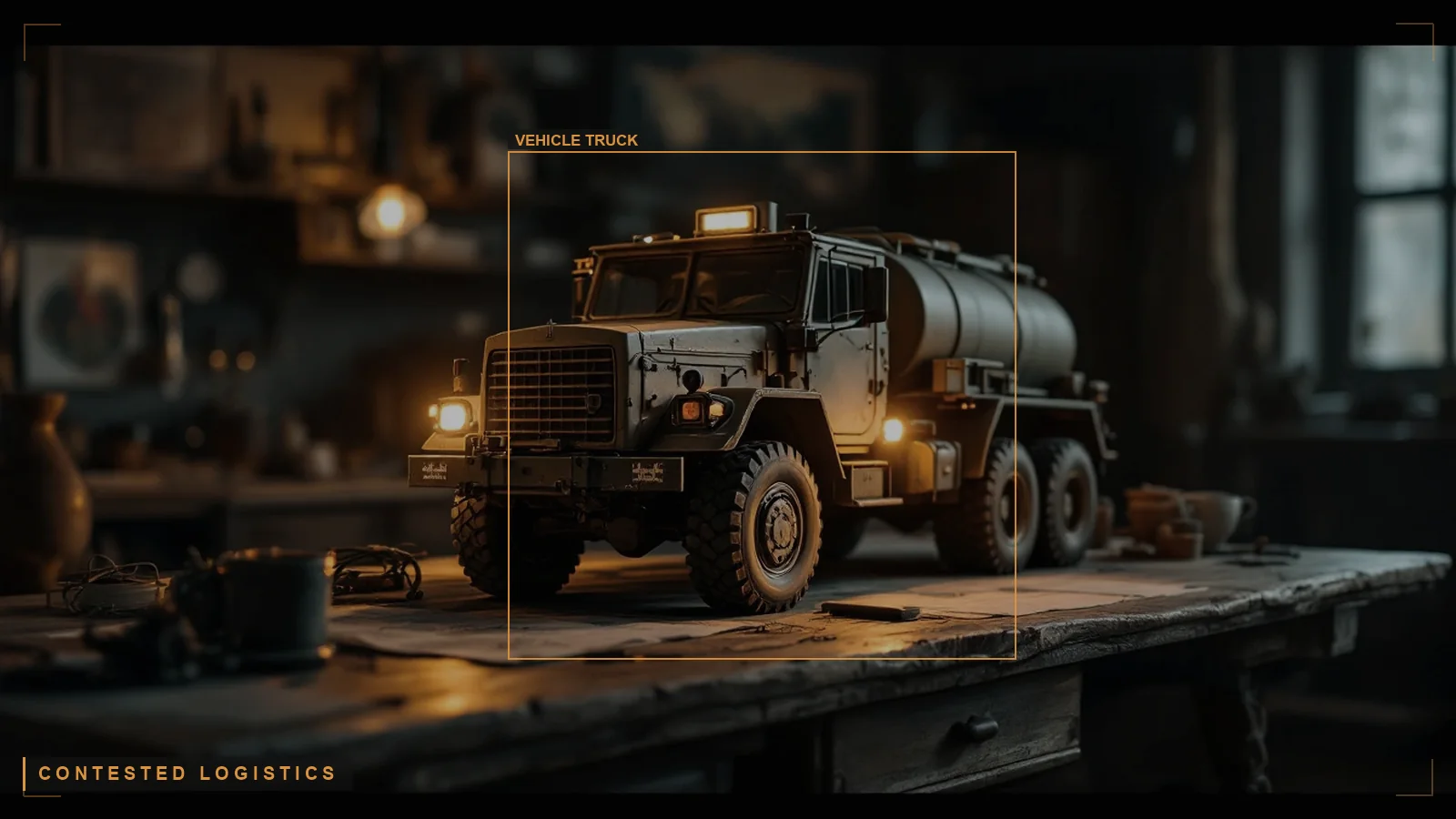
Contested logistics is the problem of sustaining forces when an adversary can attack, disrupt, or deny the supply lines, networks, and bases that logistics depends on. Army sustainment writing describes the threat directly: adversaries "use long-range precision weapons, electronic warfare, and cyber attacks to disrupt supply lines" (Army Sustainment, "Battlefield Algorithm," January 2025).
Independent oversight treats this as a current gap, not a future one. In March 2026 testimony, the U.S. Government Accountability Office stated that DoD "has been unable to sustain its weapon systems to meet its goals across all domains and faces challenges providing logistical support to U.S. forces, especially in contested environments" (GAO-26-108888[1]). The same testimony notes GAO's classified reporting on fuel supply, prepositioned assets, and weapon system maintenance and repair in a contested Indo-Pacific environment.
Contested logistics changes what AI has to do. In a permissive environment, the job is optimization: the cheapest, fastest plan. In a contested one, the job is resilience: recognizing early that a route, a depot, or a data link is compromised, generating alternatives quickly, and continuing to work when connectivity drops. That last requirement is where many enterprise logistics systems fall short. When GAO reviewed the Army's enterprise logistics system in 2021, a system expected to manage $216 billion in assets annually, it found the system "does not function in situations where network connectivity is an issue," with a disconnected capability still planned for later fielding (GAO-21-313[3], April 2021). Logistics AI that works only with a reachback connection fails exactly when it is needed most. For the connectivity side of this problem, see what is DDIL and AI at the tactical edge.
Predictive logistics is the practice of anticipating sustainment requirements and risks far enough in advance to act on them, rather than responding after a shortage, failure, or disruption occurs. It is the operational goal that most military logistics AI serves.
The Department of War has stated this goal in plain terms. Announcing awards under its Joint Sustainment Decision Tool program in 2026, the Defense Innovation Unit wrote that "to maintain operational tempo and freedom of action in contested environments, the Joint Logistics Enterprise (JLEnt) must shift from reactive processes to a predictive and proactive posture" (Defense Innovation Unit, July 9, 2026[2]). DIU, working with USINDOPACOM, USNORTHCOM, the Defense Logistics Agency, and U.S. Army Europe and Africa, described a program that aims to anticipate logistics requirements and manage distribution weeks in advance, and to monitor and forecast critical materiel needs: munitions, fuel, medical materiel, and spare parts.
The same announcement names what logisticians lack today. DIU's AI/ML deputy portfolio director said existing planning processes are "complex and time-consuming" and that logisticians "do not have the resources they need to generate and analyze multiple courses of action to meet sustainment requirements." The capabilities DIU sought include generating courses of action for "dynamic, contested, and degraded environments," identifying risks before they become shortfalls, and letting users run what-if analysis. That is a clear statement of expressed government demand: predictive, explainable sustainment planning that holds up under disruption. For the planning side, see AI course of action generation.
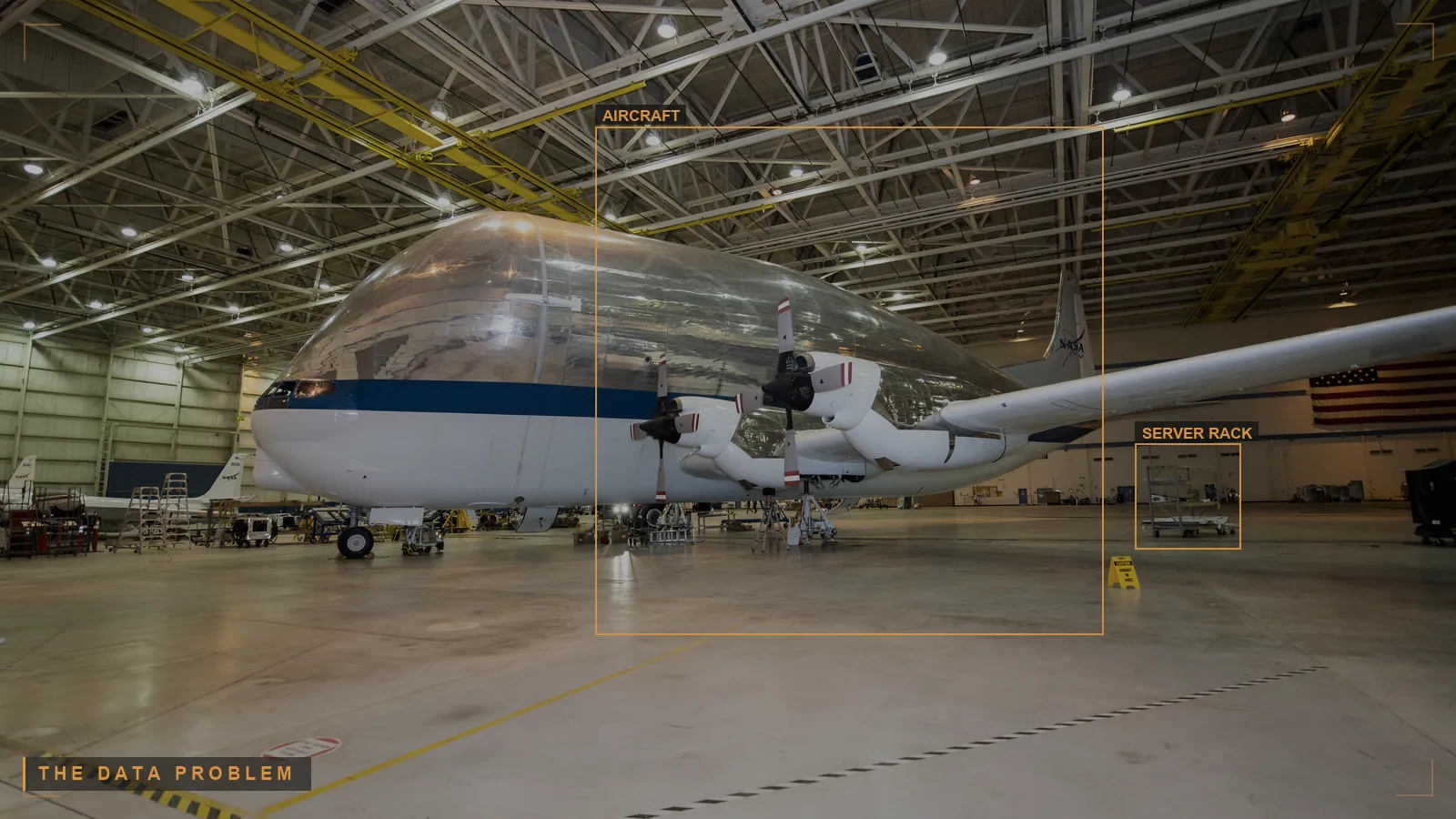
AI in military logistics is a data problem first because the signals a forecast needs are scattered across systems with different owners, formats, and identifiers, and many of them are incomplete. GAO's oversight record shows the pattern repeatedly.
More numbers behind the data problem
Three data properties make logistics hard for AI.
First, the records are fragmented. Supply, maintenance, transportation, and readiness each run on their own systems of record, often different ones in each service. The same part, platform, or unit carries different identifiers in each. A demand forecast that cannot reconcile a part number across a maintenance record and a requisition is forecasting from half the evidence.
Second, the most telling data is unstructured. Maintainers describe faults in free text. Readiness comments explain why a platform is down. These narratives often carry the earliest signal of a fleet-wide problem, and they are the data least likely to be in a form a model can use without first being made meaningful.
Third, visibility is the stated gap. In the same March 2026 testimony, GAO reported that F-35 program officials "recognize that the warfighter wants visibility into the supply chain to determine how to allocate resources," while the related initiatives were still in early stages. When the people closest to the problem name visibility as the need, the bottleneck is clear: getting connected, trustworthy data in front of the decision, not inventing a better algorithm. For the data-preparation discipline underneath this, see making mission data AI-ready and data readiness levels.
These terms overlap and are often used loosely. Each names a different scope.
| Term | What it covers | Relationship to AI in military logistics |
|---|---|---|
| AI in logistics (commercial) | Forecasting, routing, and warehouse optimization for commercial supply chains under normal conditions | Shares the techniques, but assumes stable networks, cooperative partners, and cost as the main objective; military logistics adds adversary disruption, classification, and readiness as the objective |
| Supply chain management | The end-to-end management of materiel from source to end user | The process AI supports; doctrine defines a supply chain as "the linked activities associated with providing materiel from a raw materiel stage to an end user as a finished product" (JP 4-09) |
| Predictive maintenance | Forecasting equipment failure from condition data so maintenance happens before breakdown | One use case within military logistics AI, focused on the maintenance function. See predictive maintenance for defense |
| Readiness assessment | Judging whether units can execute assigned missions | A consumer of logistics AI outputs; parts, maintenance, and supply status roll up into readiness. See readiness assessment with AI |
| Digital twin | A synchronized virtual representation of a platform, system, or force | A modeling approach that logistics AI can feed and draw on, for example to test a sustainment plan. See digital twin for defense |
Bottom line: commercial logistics AI optimizes a cooperative network for cost and speed; military logistics AI has to sustain a force through a network an adversary is trying to break, on data that is fragmented, sensitive, and often disconnected.
| Dimension | Commercial logistics AI | Military logistics AI |
|---|---|---|
| Primary objective | Lower cost, faster delivery | Sustained readiness and operational endurance |
| Operating environment | Stable networks and predictable disruption | Contested: attacked routes, denied bases, degraded links |
| Connectivity | Assumes cloud access | Must keep working when disconnected, intermittent, or limited |
| Data | Owned, mostly structured, shared with partners by contract | Fragmented across service systems, partly unstructured, governed by classification and releasability |
| Demand pattern | Driven by markets and seasonality | Driven by operations plans and enemy action, with surges no history predicts |
| Acceptable output | An optimized plan | A forecast and alternatives a logistician can trace, challenge, and override |
| Ownership | Vendor-hosted platforms are the norm | Government control of the reasoning layer is often a requirement |
The techniques transfer: time-series forecasting, optimization, and anomaly detection work in both settings. What does not transfer is the set of assumptions underneath them. A military capability has to add resilience to disruption, operation without reachback, classification awareness, and a traceable line from every forecast back to its source data.

Same techniques, different assumptions under attack
Time-series forecasting, optimization, and anomaly detection work in both settings. What changes is the environment they run in: commercial AI optimizes a cooperative network; military AI has to sustain a force through one an adversary is trying to break.
A military capability has to add resilience to disruption, operation without reachback, classification awareness, and a traceable line from every forecast back to its source data.
The demand is documented and the techniques are mature. The gap is the data foundation and the operating conditions. If you are evaluating AI for military logistics and sustainment, require:
Evaluating a capability? Bring these seven requirements to a scoping call and we will walk each one against your logistics environment: request a technical walkthrough.
Torch.AI does not run supply chains or replace logistics systems of record, and this page is not a claim to a fielded logistics program. What Torch.AI builds is the reasoning infrastructure that predictive logistics depends on: the layer that connects fragmented supply, maintenance, transportation, and readiness data, makes it meaningful, and keeps every output traceable to its source.
Three public products carry that work. ORCUS is the data-availability layer: it reaches into existing logistics, readiness, and enterprise management systems without forcing a migration, ingests and normalizes multi-source records into a usable form, and keeps provenance attached, whether it runs in the enterprise or at the tactical edge. NEXUS makes that data meaningful, turning maintenance narratives, readiness comments, and reports into semantic representations an analytical model can use, organized as reusable knowledge domains rather than one-off pipelines. HALO makes the relationships understandable, linking platform, component, part, supplier, unit, and route so a logistician can see how one back-ordered part connects to a fleet's readiness.
Because this runs as a system of reason on top of existing systems of record, the authoritative logistics systems stay intact and interoperable. Ownership is an option, not a blanket property: a deployment can be government-owned (GOTS) or commercial (COTS) depending on what the customer installs and purchases, and the government-owned model is available when control of the reasoning layer matters to the mission. See how the products are packaged on the Torch.AI software page.
For evaluators, the fit is specific. If your sustainment challenge is that the signals of a coming shortfall are spread across systems faster than anyone can reconcile them, that is a data and reasoning problem, and it is the one this infrastructure is built for. For how traceability works in practice, see data provenance for AI.
Military logistics is the planning and executing of the movement and support of forces, as joint doctrine (JP 4-0) defines it. It covers supply, maintenance, deployment and distribution, and the services and engineering that keep a force equipped, fueled, repaired, and positioned to fight.
AI is used to forecast demand for parts, fuel, munitions, and medical materiel; predict equipment failures before they happen; plan and re-plan distribution routes under disruption; recommend where to position inventory; and roll equipment and supply status up into readiness. In each case it shifts logistics from reacting to shortages toward anticipating them.
Contested logistics is sustaining forces when an adversary can attack, disrupt, or deny supply lines, networks, and bases, using long-range precision weapons, electronic warfare, and cyber attacks. GAO testified in March 2026 that DoD faces challenges providing logistical support to U.S. forces, especially in contested environments.
Predictive logistics is anticipating sustainment requirements and risks early enough to act on them, rather than responding after a shortage or failure. The Defense Innovation Unit stated in 2026 that the Joint Logistics Enterprise must shift from reactive processes to a predictive and proactive posture to operate in contested environments.
Because the signals a forecast needs sit in separate supply, maintenance, transportation, and readiness systems with different identifiers, and much of the earliest evidence is in unstructured maintenance narratives. Without connecting and tracing that data, an AI forecast works from partial evidence, which is why supply chain visibility, not the model, is usually the binding constraint.
Commercial logistics AI optimizes a cooperative network for cost and speed under normal conditions. Military logistics AI has to sustain readiness through a network an adversary is trying to break, keep working when disconnected, respect classification, and produce forecasts a logistician can trace and override.
No. AI generates forecasts, risk flags, and alternative courses of action faster than people can reconcile the underlying records, but logisticians and commanders still decide. The Defense Innovation Unit's Joint Sustainment Decision Tool program explicitly calls for tools that users can direct, including what-if analysis and branch planning.


Describe the problem.
Define the constraints. We will structure the session.
No demo.
No slide deck.
Real work.
AI in military logistics should anticipate shortfalls and leave the call to logisticians. Describe your sustainment problem. Logisticians decide. Your systems of record. Real work.