

Learn
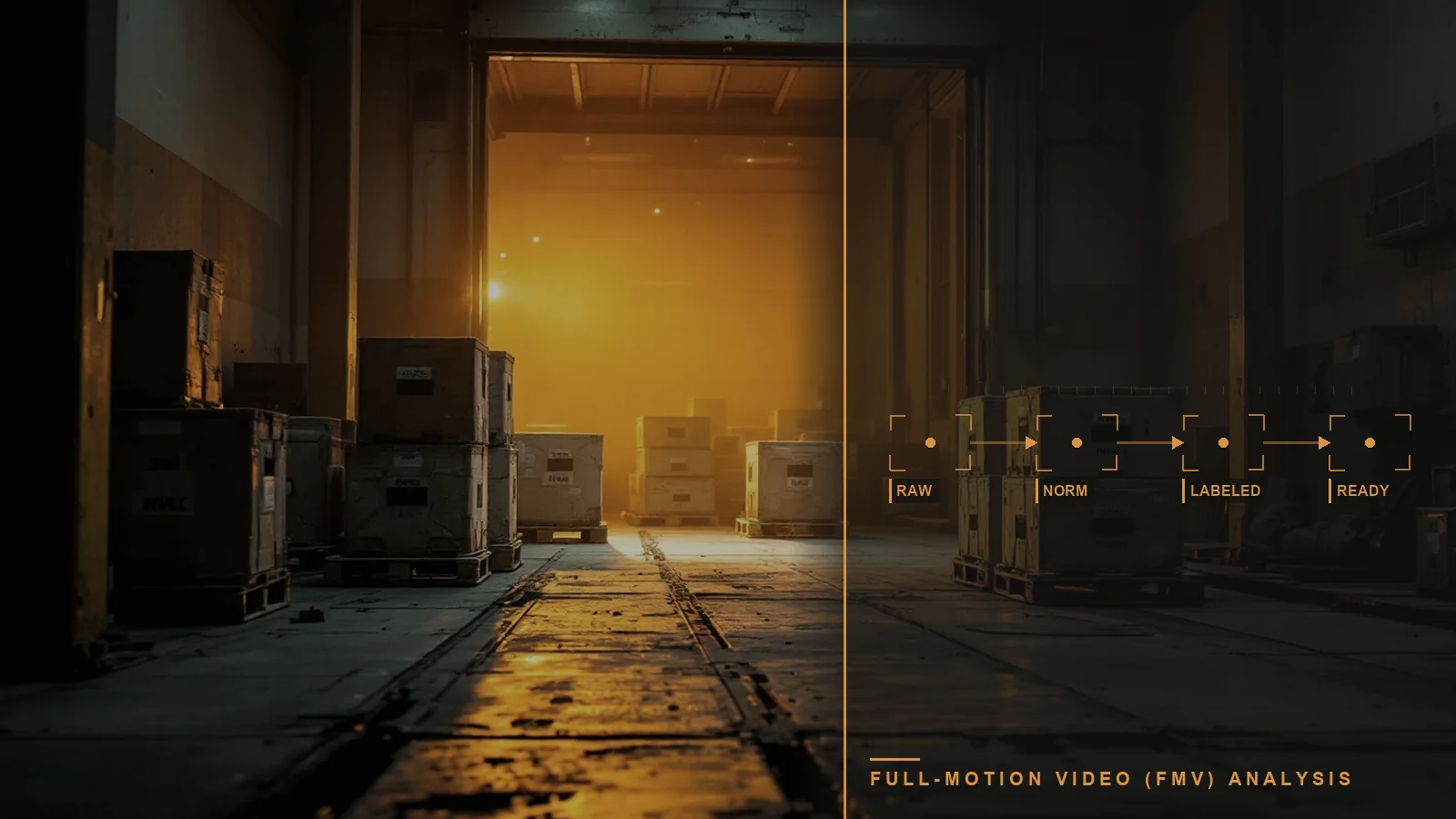
Full-motion video (FMV) analysis is the processing and exploitation of streaming video from drones and aircraft to detect, track, and characterize activity on the ground, turning hours of raw footage into decision-grade intelligence.
Last updated: October 23, 2026
Why it matters to your mission. A drone can watch a road for twelve hours. Someone still has to watch the drone. Full-motion video is one of the most demanded intelligence sources in modern operations, and it is also one of the easiest to drown in: the sensors now collect far more video than analysts can review, so much of it is never looked at. FMV analysis is the discipline of turning that streaming footage into something a commander can act on - a tracked vehicle, a confirmed pattern of activity, a cued alert - fast enough to matter. In the AI era the hard part is no longer collecting the video. It is exploiting it at the speed it arrives.
Full-motion video (FMV) analysis is the processing and exploitation of streaming video from drones and aircraft to detect, track, and characterize activity on the ground, turning hours of raw footage into decision-grade intelligence. It is the exploitation half of a collection pipeline: the sensor produces the video, and FMV analysis produces the intelligence.
FMV sits inside the broader family of geospatial intelligence (GEOINT) known as motion imagery. The National Geospatial-Intelligence Agency's Motion Imagery Standards Board (MISB) defines motion imagery as "a sequence of Images, that when viewed (e.g., with a media player) must have the potential for providing informational or intelligence value," with each image generated from sensed data and related to the next in time and space. FMV is the television-rate, metadata-rich subset of that family: full-motion video is motion imagery transmitted at video-like frame rates with embedded geospatial metadata - the platform's position, the sensor's pointing angle, and a timestamp - encoded into the stream so every frame is geographically located. NGA treats FMV as one of several motion GEOINT data types alongside moving-target-indicator (MTI) data and wide-area motion imagery (WAMI).
Key takeaways
In intelligence, surveillance, and reconnaissance (ISR), full-motion video is the continuous video feed collected by an aircraft or unmanned aerial system and exploited for intelligence. It is what lets an analyst watch a location unfold over time rather than inspect a single frozen moment. That temporal dimension is what makes FMV valuable: it reveals behavior, movement, and change, not just presence.
FMV is collected by platforms across the ISR fleet, from small tactical systems to medium-altitude and high-altitude aircraft. The video streams from the platform to a ground station, where it enters the exploitation chain. In U.S. practice much of that exploitation happens through the Distributed Common Ground System (DCGS), the family of systems the GAO describes as the interoperable architecture through which "analysts process, exploit, and then disseminate intelligence to users." FMV is one input among many that flows through this processing, exploitation, and dissemination pipeline.
What separates ISR-grade FMV from an ordinary video file is the metadata. Because each frame carries the platform's location and the sensor's pointing geometry, an analyst can place what the camera sees on a map, measure it, and hand off coordinates. That geospatial awareness is what connects FMV to the rest of GEOINT and makes a video track usable as targeting or reporting data rather than just a picture of something happening somewhere.
AI is used in FMV analysis mainly to detect, classify, track, and cue objects in the video automatically, so that human analysts review a filtered feed of flagged events instead of watching raw footage in real time. The canonical example is the U.S. Department of War's Project Maven. The April 26, 2017 memorandum establishing the Algorithmic Warfare Cross-Functional Team, signed by then-Deputy Secretary of Defense Robert O. Work, set the team's objective "to turn the enormous volume of data available to DoD into actionable intelligence and insights at speed," and made its first task to "field technology to augment or automate Processing, Exploitation, and Dissemination (PED) for tactical Unmanned Aerial System (UAS) and Mid-Altitude Full-Motion Video (FMV)." The memo is explicit about the goal: "This will help to reduce the human factors burden of FMV analysis." The initial capability was "computer vision algorithms for object detection, classification, and alerts for FMV PED."
That describes the honest scope of AI in FMV today. Computer vision is good at the mechanical, high-volume parts of exploitation:
What AI does not do is decide what the activity means. Determining whether a tracked vehicle represents a threat, a pattern of life, or nothing at all is analytical judgment, and the programs that assumed software would absorb that judgment have generally had to keep the analysts. The realistic value of AI-enabled ISR and PED is that it collapses the volume a human has to look at, not that it removes the human. AI makes the analyst faster; it does not make the analyst optional.
The FMV PED bottleneck is the gap between how much video ISR sensors collect and how many analyst-hours exist to process, exploit, and disseminate it. Collection has outrun exploitation. The constraint in modern ISR is rarely the sensor; it is the human capacity to turn what the sensor captured into intelligence before it goes stale.
This is not a new or contested observation. In March 2010 testimony to Congress, the GAO found that "shortages of analytical staff with the required skill sets hamper the services' and defense agencies' abilities to exploit all ISR information being collected, thus raising the risk that important information may not be available to commanders in a timely manner." The same testimony cited a November 2008 Joint Defense Science Board/Intelligence Science Board task force that "concluded that the rapid increase in collected information overwhelms current ISR capabilities and much of the collected data is never analyzed." Video is the most labor-intensive case: a single feed can demand an analyst's continuous attention for the length of a mission, and a wide-area sensor multiplies that burden further.
The bottleneck is why Project Maven existed in the first place. The problem was not a shortage of video. It was that analysts were overwhelmed by the volume of collected FMV, much of which was never reviewed, and computer vision was introduced to pre-screen the footage so analysts could operate on a filtered feed rather than a raw one. FMV analysis, done well, is the practice of attacking this bottleneck: using automation for triage and preserving scarce analyst judgment for the exploitation that actually requires it.
| Exploitation task | Manual FMV analysis | AI-assisted FMV analysis |
|---|---|---|
| Detect and classify objects | Analyst watches the full feed frame by frame | Computer vision flags vehicles, people, and structures; analyst confirms |
| Track an object over time | Analyst follows it visually, loses it on handoff | Algorithm maintains the track across frames and gaps |
| Find the moment that matters | Analyst scrubs hours of footage | Change and motion indexing jumps the analyst to the relevant segment |
| Watch for an event | Analyst maintains continuous watch | System cues and alerts on objects or patterns of interest |
| Decide what it means | Analyst judgment | Analyst judgment (unchanged) |
| Correlate with other sources | Manual, across separate systems | Automated correlation, then analyst judgment |

AI takes the triage; the analyst keeps the judgment
Sensors collect more video than analysts can process, exploit, and disseminate. Computer vision attacks that PED bottleneck by detecting, tracking, indexing, and cueing, so analysts work a filtered feed instead of raw footage.
Deciding what the activity means stays human judgment. Project Maven's first task was to augment or automate PED for tactical UAS and mid-altitude FMV, to reduce the human factors burden of FMV analysis.
The difference between full-motion video and still imagery is time. Still imagery - a satellite or reconnaissance photograph - captures a single moment with high spatial detail. FMV captures a sequence over time at a lower resolution, revealing movement, behavior, and change that a single frame cannot show. Both are GEOINT; they answer different questions.
Still imagery is strongest for what is there: the precise count, dimensions, and disposition of objects at an instant. FMV is strongest for what is happening: who arrived, where they went, what moved, and when. An image can tell you a vehicle is parked at a facility. Only video can tell you it arrived at 0200, idled for twenty minutes, and departed toward a second location. That temporal signature is why FMV underpins activity-based intelligence, which derives meaning from patterns of activity observed over time rather than from a static snapshot.
| Dimension | Still imagery (GEOINT) | Full-motion video (FMV) |
|---|---|---|
| Captures | A single instant | A sequence over time |
| Answers | What is there | What is happening |
| Spatial detail | High resolution | Lower resolution per frame |
| Temporal detail | None (one moment) | Continuous (motion, change, timing) |
| Exploitation cost | Per image | Per minute of feed - far higher |
| Best for | Order of battle, measurement, mapping | Tracking, pattern of life, timing of activity |
The two are complementary, not competing. A strong GEOINT picture uses still imagery for precise measurement and FMV for behavior, and fuses both with other sources so the moving track in the video is anchored to everything else known about that place and time.
FMV needs fusion because a video track, on its own, is ambiguous. The camera shows a vehicle moving down a road. It does not show who owns it, what it carries, whether it was seen yesterday, or whether a signals or human intelligence report already describes it. A track becomes decision-grade intelligence only when it is correlated with the other sources that give it identity, history, and intent.
This is the core argument for multi-INT fusion: the intelligence value is often not in any single source but in the correlation across sources. FMV supplies the geolocated, time-stamped observation. Signals intelligence, human intelligence, open-source data, and prior reporting supply the context that turns an observation into a conclusion. Doing that correlation by hand, across systems that do not share a format or a key, is slow - and FMV arrives too fast for slow. The fusion has to happen at machine speed or the decision window closes.
Two properties make fused FMV defensible rather than merely fast:
First, the correlation has to preserve provenance. An analyst who cues a strike or writes a report on the strength of a fused picture has to be able to show which frame, which track, and which corroborating source supported the call. Fusion that loses the trail back to the source produces assertions that cannot be defended.
Second, the underlying data has to be governed. FMV exploitation increasingly reasons over sensitive, multi-source data, and correlating it cannot mean pooling it in ways that classification, compartment, or releasability forbid. The fusion layer has to respect those controls while it reasons. This is a data and reasoning infrastructure problem before it is a tradecraft problem - and it is the specific problem of correlating fragmented, fast-moving, multi-source data into a coherent picture you can trust.
Torch.AI does not build sensors, and it does not sell a computer-vision model that watches video frames. This page is not a claim to either. What Torch.AI builds is the government-owned reasoning infrastructure that the exploitation side of FMV depends on: the ability to take the outputs of FMV - detections, tracks, geolocations, timestamps - and fuse them with every other relevant source into a coherent, traceable picture at machine speed.
The relevant capability is correlation you can trust and govern. A detection pulled from a video feed means little until it is resolved against prior reporting, other INTs, and context, and until the analyst can trace the conclusion back to the frame and the corroborating sources that support it. ORCUS provides the data-availability layer that connects to sources and preserves provenance. NEXUS applies semantic representation so unstructured records and reports become something a system can correlate against a video track. HALO fuses resolved entities and relationships into a graph an analyst can inspect, so a vehicle seen in FMV is linked to everything else known about it. Because this runs as a system of reason on top of existing systems of record - including the FMV exploitation systems already in place - the authoritative sources stay intact, and in a government-owned deployment the customer keeps control of the layer where fragmented observations become understanding. You can see how this is packaged on the Torch.AI software page.
For evaluators, the fit is specific: if your FMV challenge is that exploited video produces more tracks and detections than analysts can correlate against everything else they know, that is a data and reasoning problem, and it is the one this infrastructure is built for. Request a technical walkthrough and we will run it against a representative slice of your own multi-source data, with provenance traced end to end.
FMV collection and computer-vision detection are maturing fast. The gap is the exploitation layer that turns detections into decision-grade intelligence. If you are evaluating infrastructure to support FMV exploitation and multi-source fusion, require:
Evaluating a capability? Bring these six requirements to a scoping call and we will walk each one against your environment: request a technical walkthrough.
In ISR, full-motion video is the continuous video feed collected by an aircraft or unmanned aerial system and exploited for intelligence. It is distinguished from an ordinary video by embedded geospatial metadata - the platform position, sensor pointing angle, and timestamp - that geolocates every frame, making it a subset of motion imagery within GEOINT and usable as mapped, measurable intelligence.
AI is used mainly to detect, classify, track, and cue objects in the video automatically, so analysts review a filtered feed of flagged events instead of raw footage. This was the founding mission of Project Maven, whose first task was to automate processing, exploitation, and dissemination of UAS and mid-altitude FMV. AI handles high-volume triage; deciding what the activity means remains human judgment.
The FMV PED bottleneck is the gap between how much video sensors collect and how many analyst-hours exist to process, exploit, and disseminate it. GAO has reported that shortages of analysts hamper the ability to exploit all ISR information collected, and that much of the collected data is never analyzed. The constraint is analyst capacity, not sensors, which is why AI triage matters.
The difference is time. Still imagery captures a single instant at high spatial resolution and answers what is there; full-motion video captures a sequence over time at lower resolution and answers what is happening. Both are GEOINT. FMV reveals movement, timing, and pattern of activity that a single frame cannot, which is why it underpins activity-based intelligence.
Because a video track alone is ambiguous - it shows movement but not identity, history, or intent. FMV becomes decision-grade only when correlated with signals, human, open-source, and prior reporting that supply context. Because FMV arrives fast, that multi-INT fusion has to happen at machine speed while preserving provenance and respecting access controls, which is a data and reasoning infrastructure problem.


Describe the problem.
Define the constraints. We will structure the session.
No demo.
No slide deck.
Real work.
Describe your FMV analysis bottleneck. We will scope the session around your feeds and multi-source data. No canned footage. Your mission data. Real work.