


.svg)
Learn
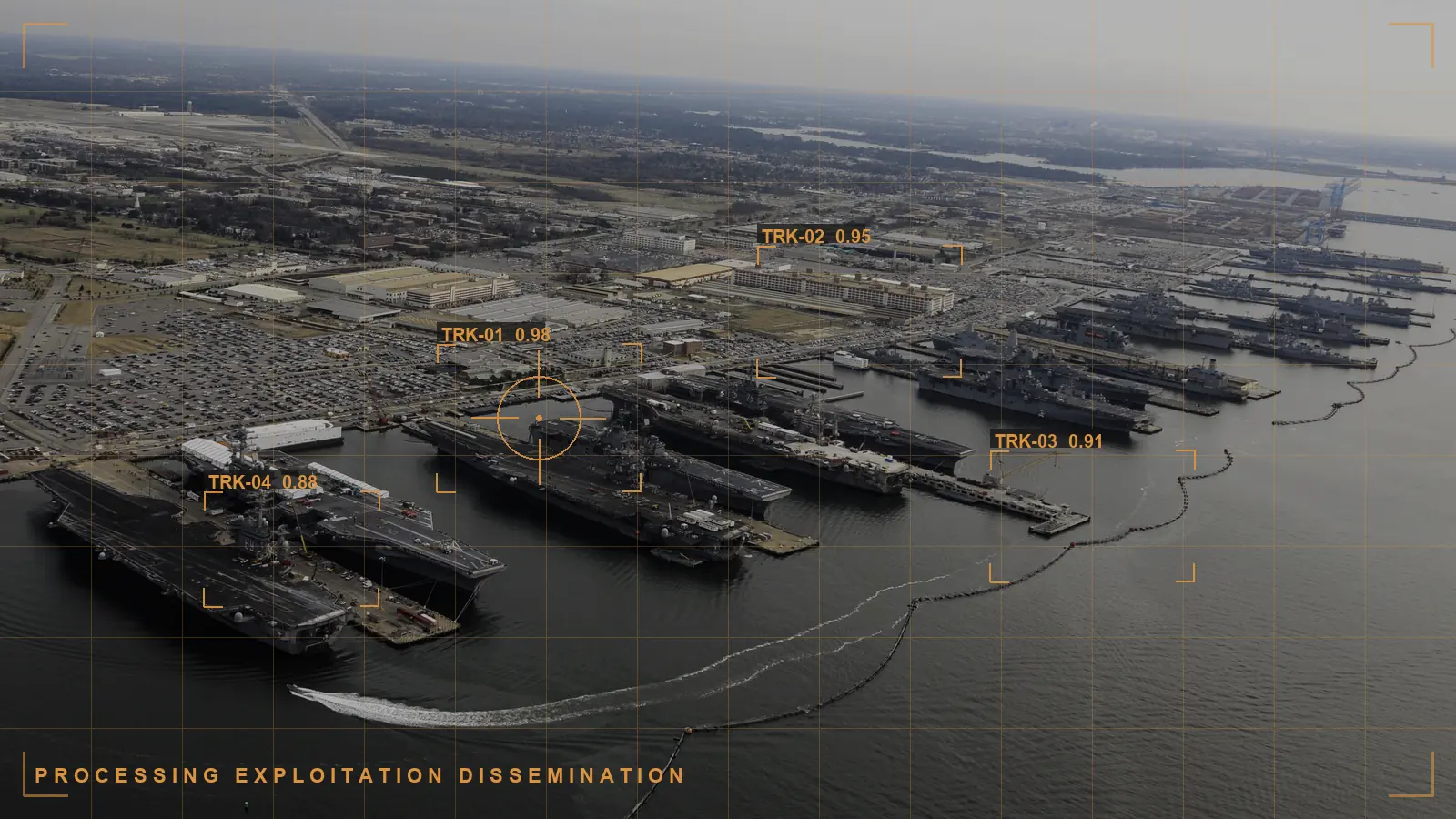
Processing, exploitation, and dissemination (PED) is the work of turning collected ISR data into usable intelligence and getting it to the people who need it: processing raw feeds into a readable form, exploiting them to extract meaning, and disseminating the result to decision-makers.
Processing, exploitation, and dissemination (PED) is the work of turning collected ISR data into usable intelligence and getting it to the people who need it: processing raw feeds into a readable form, exploiting them to extract meaning, and disseminating the result to decision-makers.
Collection gets the data. PED is what makes it matter. A sensor that captures an image, intercept, or signal has produced nothing a commander can act on until that material is processed, exploited by an analyst, and delivered in time. PED is where most of the delay, and most of the backlog, actually lives.
PED is the set of functions that convert collected data into intelligence products. It sits inside the joint intelligence process, which moves from planning and direction, through collection, processing and exploitation, and analysis and production, to dissemination and integration. See JP 2-0 Joint Intelligence. In the ISR community, "PED" names the processing, exploitation, and dissemination of what sensors collect, often run by a dedicated PED cell.
The three words are distinct jobs:
A gap at any stage breaks the chain. Processed data no one exploits is wasted collection; exploited intelligence no one receives in time is a missed decision.
TCPED (tasking, collection, processing, exploitation, dissemination) is the ISR cycle that frames PED with the two steps that precede it: tasking the sensor and collecting the data. The broader joint intelligence process in JP 2-0 adds analysis and production and an evaluation loop around it. PED is the shared middle: the conversion of collection into product. The terms overlap because they describe the same work at different scopes.
Because collection has outrun the capacity to exploit it. Joint doctrine notes that collection requirements routinely exceed available collection and PED capacity, so teams cannot exploit everything they gather. See JP 2-01. The constraint is rarely the sensor; it is the analyst-hours to process and exploit what the sensor already captured. The GAO has found that acquiring and curating usable data is a central challenge in fielding AI for defense, which is the same problem one layer down. See GAO-22-104765.
AI moves the routine conversion work off the analyst so judgment goes where it matters. It detects and labels objects, correlates reports across sources, and formats output for dissemination, with the analyst accepting, correcting, or rejecting each result. The analyst stays accountable for the call, and every step keeps a traceable record.
Torch.AI supports this as government-owned reasoning infrastructure that complements existing collection systems rather than replacing them. NEXUS makes multi-source ISR output meaningful through semantic representation and Knowledge Domains. HALO makes the relationships among entities, events, and sources understandable through graph-based fusion and reasoning. Both run on ORCUS, the government-owned data-availability layer, so the infrastructure stays owned by the mission. The companion piece AI-Enabled ISR and PED Automation covers how that automation works in practice.
| Stage | What it does | AI decision-support | Human authority |
|---|---|---|---|
| Processing | Raw feeds to readable form | Decode, format, georeference, transcribe, translate at scale | Confirms fidelity |
| Exploitation | Extract meaning | Detect, label, and correlate objects and activities | Accepts, corrects, or rejects each call |
| Dissemination | Deliver to decision-makers | Format and route products by need and classification | Owns the release decision |
PED is the set of functions that convert collected data into intelligence products, sitting inside the joint intelligence process between collection and analysis. In the ISR community it names the processing, exploitation, and dissemination of what sensors collect, often run by a dedicated PED cell.
Processing converts raw collected data into a workable form (decoding, formatting, georeferencing, transcribing, translating); exploitation is the analytic step that extracts meaning and identifies objects, activities, and entities; dissemination delivers the result to the people who need it, in a usable form and classification, in time to act.
TCPED (tasking, collection, processing, exploitation, dissemination) frames PED with the tasking and collection steps that precede it, and the broader joint intelligence process adds analysis and production and an evaluation loop. PED is the shared middle: the conversion of collection into product.
Collection has outrun the capacity to exploit it. Doctrine notes that collection requirements routinely exceed available collection and PED capacity, so teams cannot exploit everything they gather. The constraint is usually analyst-hours to process and exploit what was already captured, not the sensor.
AI moves routine conversion work off the analyst: detecting and labeling objects, correlating reports across sources, and formatting output for dissemination, while the analyst accepts, corrects, or rejects each result and stays accountable. Torch.AI supports this as government-owned reasoning infrastructure, with NEXUS making ISR output meaningful, HALO making relationships understandable, and both running on ORCUS.


SHARE