

Learn
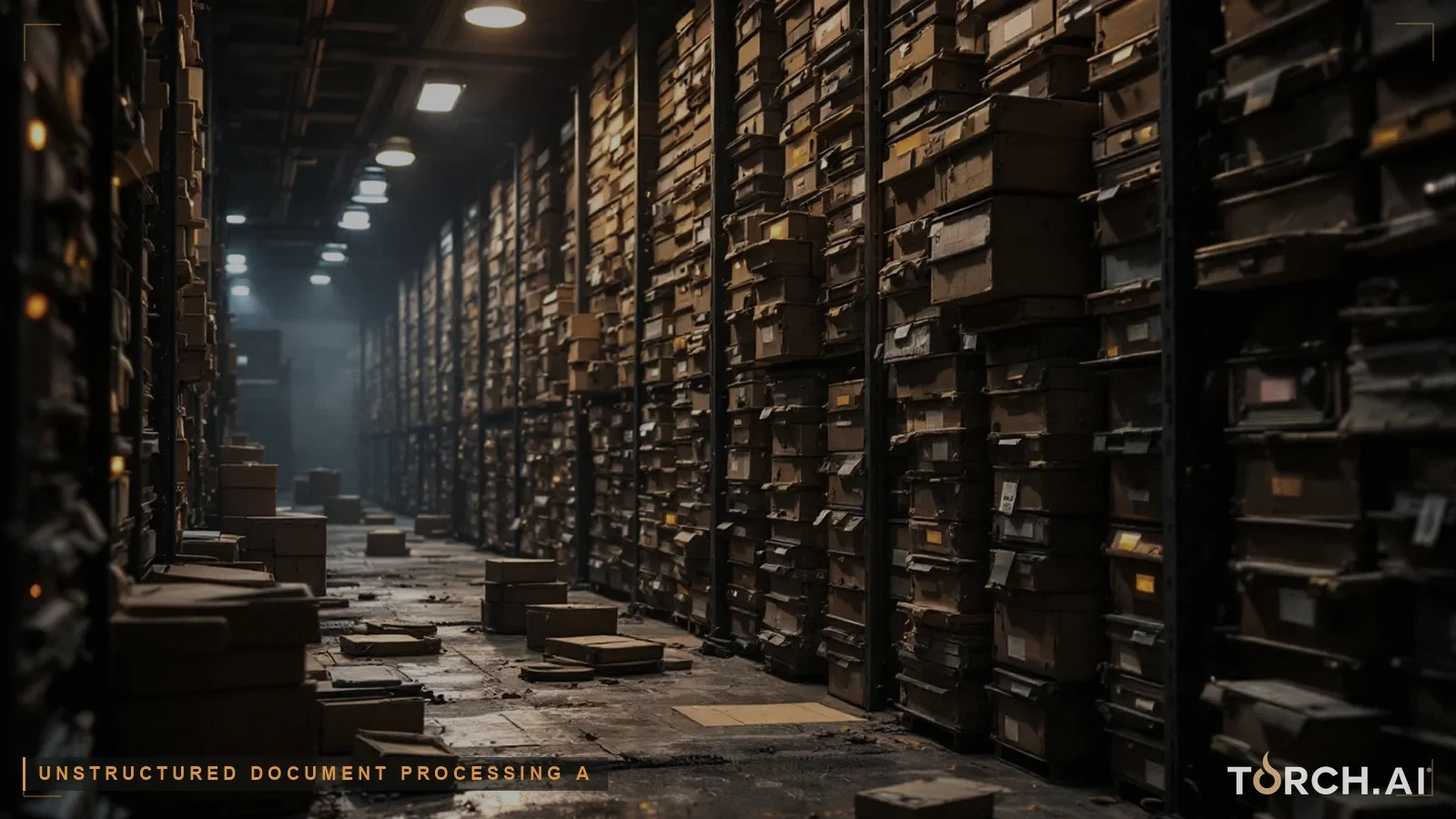
Unstructured document processing is the practice of turning raw material - PDFs, email, scanned documents, and captured media - into normalized, analyzable, AI-ready data that analysts and models can reason over.
Why it matters to your mission. The material that holds the answer, the PDFs, email, scans, and captured media, is exactly the data most models and analysts cannot use. Turning that raw material into normalized, AI-ready data unlocks it. The outcome is more of the mission's hardest data made analyzable, so decisions draw on everything collected, not just what was already structured.
Unstructured document processing is the practice of turning raw material - PDFs, email, scanned documents, and captured media - into normalized, analyzable, AI-ready data that analysts and models can reason over.
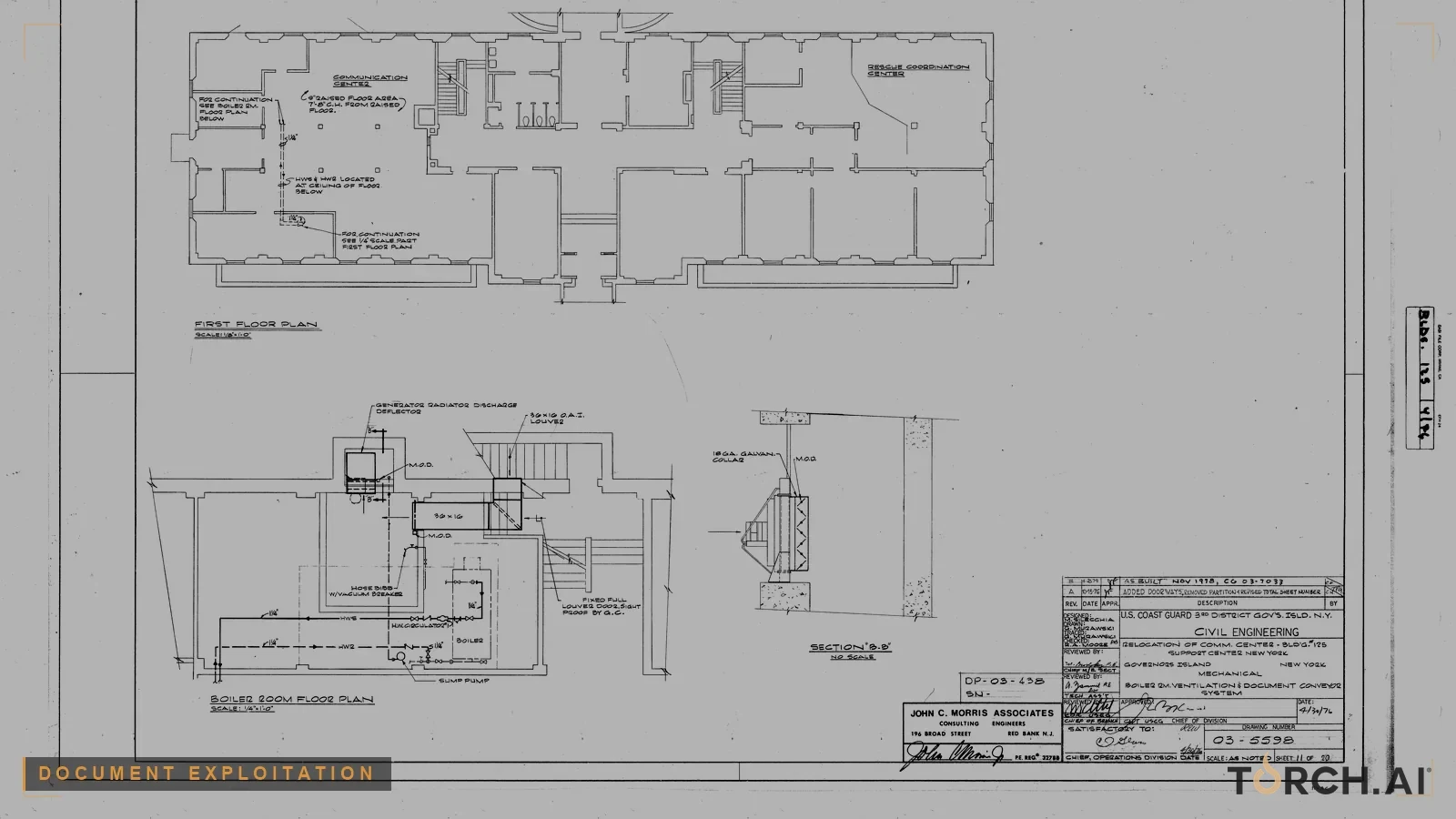
In defense, this work is called document and media exploitation (DOMEX): an intelligence discipline focused on extracting mission value from captured documents and media. The hard part is rarely the model. It is producing usable, normalized, labeled data. The U.S. Government Accountability Office found that having usable data available to train AI is a central obstacle to fielding AI capabilities, not the algorithms themselves (see GAO-22-104765, Artificial Intelligence: Status of Developing and Acquiring Capabilities for Weapon Systems, 2022). Torch.AI builds government-owned reasoning infrastructure that makes this content meaningful and connected across the systems you already run, without rip-and-replace, and with provenance preserved end to end.
Key takeaways
DOMEX is an intelligence discipline: captured documents and media are triaged, exploited, and translated into reporting that supports a mission. Generic commercial intelligent document processing optimizes for business forms - invoices, contracts, claims - under predictable templates where the sender wants to be understood. DOMEX inverts those assumptions. It handles heterogeneous, adversarial, multi-language material where provenance, chain of custody, and classification matter as much as the extracted text, and where the output must be auditable and tied back to its source.
The practical consequence is that a tool tuned for clean, cooperative business forms underperforms the moment it is pointed at captured media. There is no template to lean on, the language and script vary, the quality is poor, and every extracted fact has to carry a line back to the document it came from so an analyst can defend it.
| Dimension | Commercial document processing | DOMEX / mission document exploitation |
|---|---|---|
| Typical input | Invoices, contracts, claims on known templates | PDFs, email, scans, captured media, mixed and degraded |
| Language and script | Usually one language, stable formatting | Multi-language, multi-script, transliteration, poor quality |
| The source | Cooperative; wants to be understood | Captured or adversarial; no cooperation, no template |
| What matters most | Throughput and field accuracy | Provenance, chain of custody, classification, auditability |
| Acceptable output | Extracted fields into a business system | Normalized, source-linked data an analyst can brief and defend |
| Ownership of the result | Often held in a vendor platform | Government-owned, portable to downstream reasoning |
Models can only reason over data they can read. Most mission content arrives as documents, email, and media that carry no consistent schema, so it never reaches the analyst or the model in usable form. Independent oversight has made the same point at the program level: the GAO identified usable, labeled data as the obstacle to fielding AI, not the algorithms (see GAO-22-104765). Normalization, not a bigger model, is what closes that gap.
The Department of War's own data goals describe the properties unstructured material lacks. The DoD Data Strategy sets the VAULTIS goals - data that is visible, accessible, understandable, linked, trustworthy, interoperable, and secure - and the follow-on DoD Data, Analytics, and AI Adoption Strategy carries that forward into guidance for adopting and scaling AI capabilities (both referenced in the GAO's AI acquisition review, GAO-23-105850, 2024). Raw PDFs, email, and captured media meet none of those seven properties until they are processed. Unstructured document processing is the step that makes them visible, understandable, and linked.
Document exploitation is a pipeline, not a single model. In a mission setting the stages are:
The load-bearing distinction is that extraction is not the end state. Pulling text out of a PDF is the easy first step. The value comes from normalizing that text into data an analyst or a model can reason over, with provenance that survives all the way to the decision.

From captured documents to a linked, analyzable graph
Mission documents arrive as mixed, multi-language PDFs, email, scans, and captured media from sources that never meant to be understood. Each stage turns them into data an analyst can brief and defend.
Provenance and classification are captured at ingest and carried through every stage, so the output stays source-linked and ready for semantic search, entity resolution, and graph-based fusion.
Torch.AI builds government-owned reasoning infrastructure that processes heterogeneous feeds into a common representation and keeps the result under mission control. It complements the systems you already operate rather than replacing them.
The same pipeline ingests open-source and publicly available information alongside mission feeds. Provenance travels with every item, which supports the measurable, accountable practices the NIST AI Risk Management Framework (AI RMF 1.0) describes for building trustworthy AI into the design, development, use, and evaluation of AI systems. You can see how this is packaged as a capability on the Torch.AI software page.
Because the normalized result is government-owned, the customer keeps control of the layer where documents become data, and can inspect, govern, and evolve it rather than renting it inside a vendor's proprietary model.
No. This reasoning infrastructure complements existing systems of record. It reads from and writes back to the repositories you already operate, so there is no rip-and-replace. The normalized, AI-ready representation sits alongside the source systems, with links back to the original material for audit. This is the systems of record versus systems of reason distinction: the processing and normalization layer acts as a system of reason on top of the authoritative documents, never a replacement for them.
| Stage | Input | What happens | AI-ready output |
|---|---|---|---|
| Ingest | PDFs, email, scanned documents, captured media | Capture with provenance and classification | Source-linked items |
| Extract | Mixed, multi-language text and media | Text, entity, and media extraction | Structured fields |
| Normalize | Heterogeneous feeds | Map to a common representation | Consistent records |
| Represent | Normalized records | Semantic representation and vectorization (NEXUS) | Meaningful, searchable data |
| Connect | Represented data | Relationship resolution (HALO) | Linked, analyzable graph |
The points above explain why normalization, provenance, and ownership matter; the checklist below is what to actually require in an evaluation.
Evaluating a capability? The seven requirements above are the backbone of a document exploitation evaluation you can score against. Request a technical walkthrough and we will walk each one against your environment.
DOMEX is an intelligence discipline in which captured documents and media are triaged, exploited, and translated into mission reporting, handling heterogeneous, adversarial, multi-language material where provenance, chain of custody, and classification matter. Generic commercial intelligent document processing optimizes for predictable business forms where the sender wants to be understood.
Models can only reason over data they can read. Most mission content arrives as documents, email, and media with no consistent schema, so it never reaches the analyst or the model in usable form. Normalization, not a bigger model, closes that gap, and the GAO has identified usable data as the obstacle to fielding AI.
Through a pipeline: ingest the material with provenance and classification, extract text and entities across formats and languages, normalize the output into a common representation, represent it semantically for search, connect it by resolving relationships, and preserve a line back to each source document throughout.
Torch.AI processes heterogeneous feeds into a common representation and keeps the result government-owned. NEXUS provides semantic representation, vectorization, and Knowledge Domains; HALO makes relationships understandable through graph-based fusion; ORCUS is the government-owned data-availability layer. Provenance travels with every item.
No. This reasoning infrastructure complements existing systems of record, reading from and writing back to repositories you already operate, so there is no rip-and-replace. The AI-ready representation sits alongside source systems with links back to the original material for audit.


Describe the problem.
Define the constraints. We will structure the session.
No demo.
No slide deck.
Real work.
Bring a sample of your PDFs, email, or captured media. We will scope unstructured document processing around it. No rip-and-replace. Your documents. Real work.