Learn
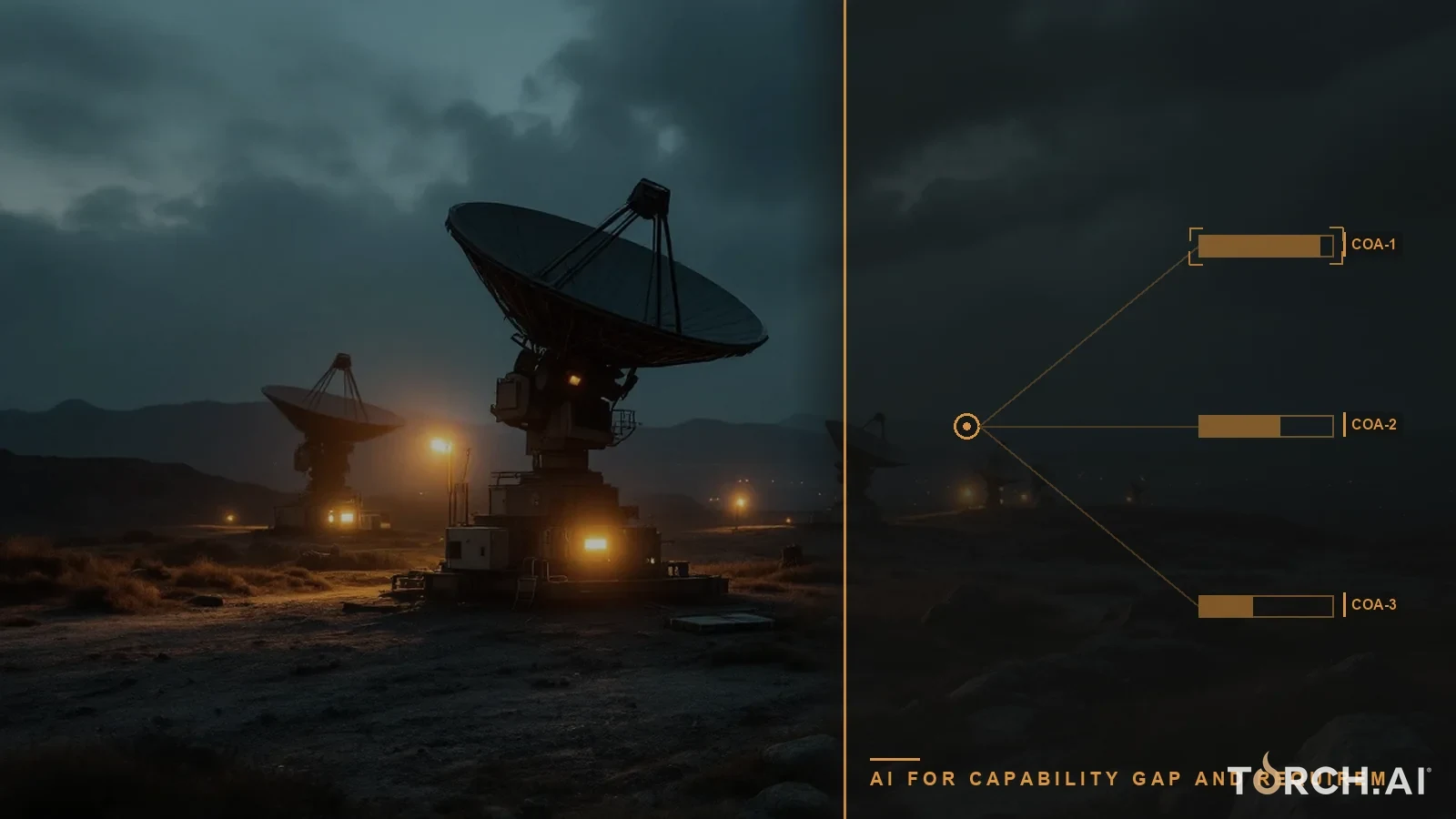
AI for capability gap and requirements analysis is decision-support software that makes doctrine, lessons, and program data usable in context so analysts can identify capability gaps across DOTMLPF-P and tie each gap to evidence.
Why it matters to your mission. Capability gaps hide across doctrine, lessons learned, and program data that no team can read fast enough, so requirements lag the threat. Making that corpus usable in context lets analysts tie each gap to evidence across DOTMLPF-P. The outcome is faster, defensible requirements and investment decisions grounded in evidence rather than the loudest voice in the room.
AI for capability gap and requirements analysis is decision-support software that makes doctrine, lessons, and program data usable in context so analysts can identify capability gaps across DOTMLPF-P and tie each gap to evidence.
Requirements analysis is evidence work under deadline. A capabilities-based assessment has to reconcile doctrine, force structure, training records, materiel status, and lessons from recent operations, and those sources live in different systems, formats, and classification enclaves. When the data is fragmented, analysts spend their time finding and reconciling it instead of reasoning about the gap, and the decision risk shifts from "did we assess correctly" to "did we even see the relevant evidence." AI does not decide the requirement. It makes the relevant material legible and traceable so the human assessment rests on the full record, with a citation back to each source.
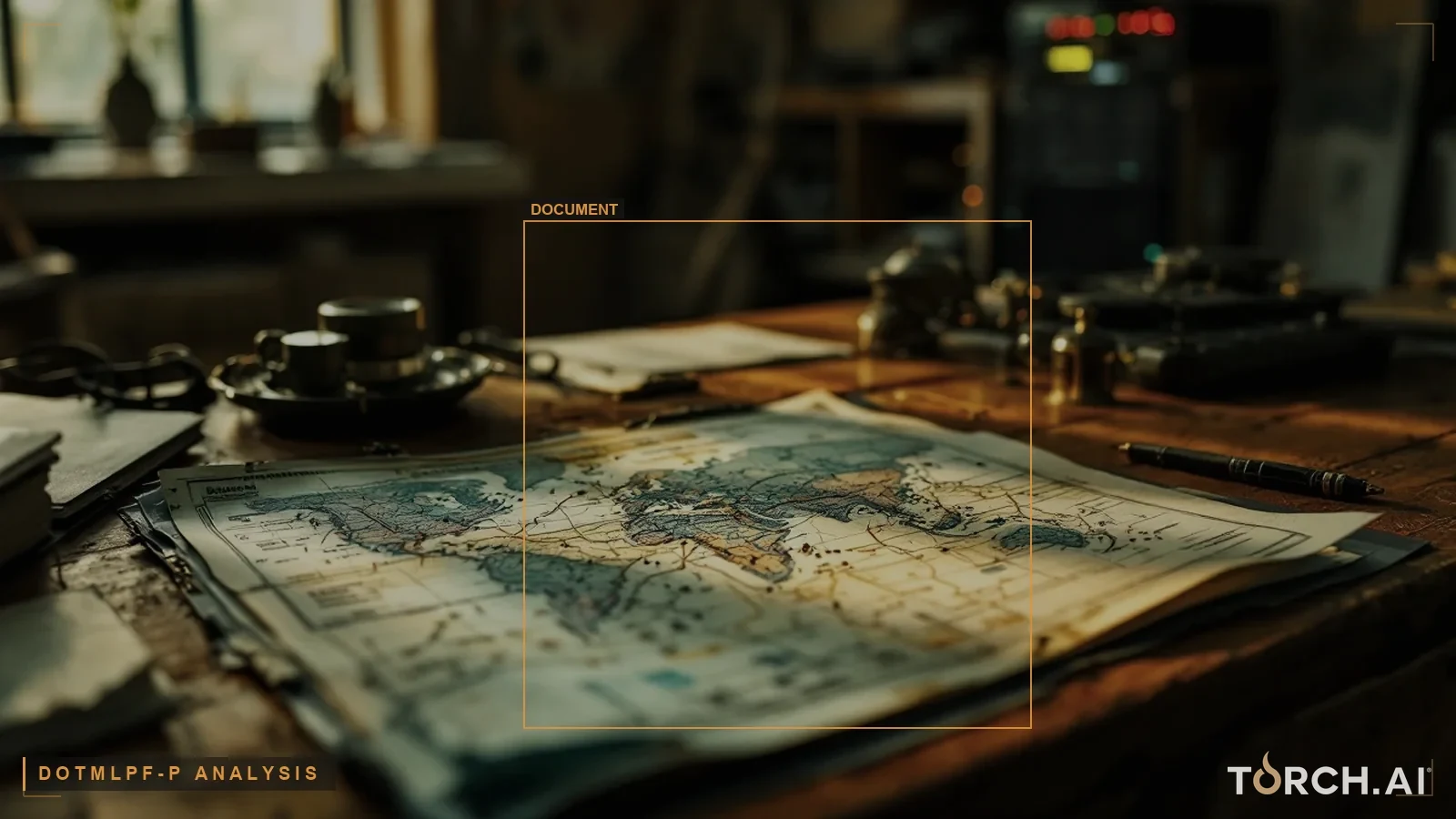
DOTMLPF-P is the framework used to analyze a capability gap across eight areas: Doctrine, Organization, Training, Materiel, Leadership and Education, Personnel, Facilities, and Policy. The point of the framework is that a gap is not automatically a new program. A shortfall in a unit's ability to accomplish its mission might be closed by a change in doctrine, a change in how a force is organized, a training fix, or a policy change, not by buying new materiel. The Chairman of the Joint Chiefs of Staff Instruction that chartered the Joint Requirements Oversight Council, CJCSI 5123.01, built the capabilities-based assessment around exactly this distinction: a non-materiel solution produces a DOTMLPF-P Change Recommendation, while a materiel need moves toward an Initial Capabilities Document. For a plain-language breakdown of all eight categories and the materiel-versus-non-materiel distinction, see What Is DOTMLPF-P?.
AI support reads the relevant doctrine, directives, and program records for each of the eight areas and surfaces them next to the gap, so the analyst can weigh a materiel answer against a non-materiel one on a complete record instead of defaulting to a procurement because the doctrine and training evidence was too scattered to assemble in time.
Functional needs analysis is the step inside a capabilities-based assessment that compares the capabilities a mission requires to the capabilities a force actually has, and names the shortfalls. It is slow for a mundane reason: the "required" side lives in doctrine, concepts, and mission-essential task lists, while the "current" side lives in readiness systems, program records, test reports, and after-action reporting, and no one system holds both.
AI decision support closes that distance in two ways. First, it makes institutional knowledge usable in context, pulling the relevant doctrine, directives, and lessons learned next to the specific gap under assessment rather than leaving the analyst to search eight repositories by hand. Second, it connects each identified gap to the underlying program, training, and readiness evidence across the source systems, so the shortfall is shown against the record instead of asserted from memory. The analyst still writes the finding. The software makes sure the finding is grounded and that every claim in it points back to a primary source an action officer can open.
No. The requirements process is a governed staffing and validation process owned by the Joint Staff, not a piece of software, and it is in the middle of a formal change. In August 2025 the Joint Capabilities Integration and Development System (JCIDS) was directed to be disestablished, and it was replaced by the Joint Force Requirements Process (JFRP), documented in the updated Chairman of the Joint Chiefs of Staff Manual 5123.01 dated January 2026. The DOTMLPF-P framework and the capabilities-based assessment carry forward under the new name; one of the oversight council's standing principles is still to address all eight DOTMLPF-P elements together when it delivers a solution to the warfighter.
Torch.AI reasoning infrastructure is government-owned decision support that complements whichever requirements process is in force. It does not replace the governance, the review boards, or the human sign-off, and it does not replace the systems of record the assessment draws on. What it changes is the part that is purely mechanical: the time analysts spend assembling and reconciling the evidence a capabilities-based assessment depends on, under a process that is itself being rewritten.
Capability and readiness shortfalls persist in part because the evidence is scattered and hard to assemble into one defensible picture. The U.S. Government Accountability Office reported in Military Readiness: Actions Needed for DOD to Address Challenges across the Air, Sea, Ground, and Space Domains (GAO-24-107463) that U.S. military readiness has degraded over two decades and that DOD had more than 100 open GAO recommendations on readiness still unaddressed. A gap that cannot be assembled on the record is a gap that keeps recurring in the next assessment.
Readiness itself is assessed on a capability basis. The Department of War Readiness Reporting System, established by DoD Directive 7730.65, reports readiness against mission-essential tasks (METs): what a unit can actually do against its assigned missions, not just whether it is manned and equipped. That is the same capability language a requirements gap analysis uses, which is why the two connect. Making the readiness and program evidence usable in context lets an analyst see a shortfall against the full record, trace every claim to its source, and hand the requirements owner a finding that holds up when it is challenged.
The division of labor is the whole point: the software handles assembly and traceability, the human handles judgment and accountability. Keeping that line sharp is what makes the output defensible in a staffing process.
| Step | Human analyst owns | AI decision support provides |
|---|---|---|
| Define required capability | Mission framing and the standard to be met | Relevant doctrine, concepts, and directives surfaced in context |
| Assess current capability | Judgment on whether current capability is sufficient | Program, training, and readiness data connected to the gap |
| Identify the gap | The finding and its significance | Evidence and relationships linking the gap to its sources |
| DOTMLPF-P change recommendation | The materiel vs. non-materiel call | All eight areas surfaced with cited source material |
| Document and staff | Authorship, validation, sign-off | An audit trail: every claim traced to its primary source |
The software assembles and cites; the analyst decides
The division of labor is the whole point: the software handles assembly and traceability, the human handles judgment and accountability. Keeping that line sharp is what makes the output defensible in a staffing process.
The analyst still writes the finding and makes the materiel versus non-materiel call. The software makes sure every claim in it points back to a primary source an action officer can open.
Torch.AI builds government-owned reasoning infrastructure that connects to mission data where it already lives, so a requirements team does not have to migrate its doctrine, program, and readiness records onto a vendor platform to reason over them. Three capabilities map directly onto the gap-analysis problem. NEXUS organizes mission knowledge into governed Knowledge Domains so doctrine, directives, and lessons learned become usable in context next to the gap under assessment. HALO fuses the relationships across those sources into a graph, so an analyst can trace a shortfall to the specific program, unit, or policy evidence behind it. ORCUS provides the ingestion and reasoning layer underneath, reading structured program and readiness records alongside the unstructured text of reports and after-action reviews.
The through-line is ownership and traceability. Because the reasoning layer complements the systems of record rather than replacing them, the authoritative sources stay intact, and because every surfaced claim carries a link back to its source, the resulting finding is one an action officer can brief, challenge, and defend inside a governed requirements process. You can see how this is packaged as a capability on the Torch.AI software page.
DOTMLPF-P is the framework used to analyze a capability gap across eight areas: Doctrine, Organization, Training, Materiel, Leadership and Education, Personnel, Facilities, and Policy. A gap may be closed by a non-materiel change rather than a new program. AI support surfaces the relevant doctrine, directives, and program records for each area next to the gap.
Functional needs analysis compares required capabilities to current ones and identifies shortfalls. AI support makes institutional knowledge usable in context and connects each identified gap to the underlying program, training, and readiness evidence across source systems. The analyst writes the finding; the software makes sure it is grounded and cited.
No. The requirements process is a governed staffing and validation process owned by the Joint Staff, now carried out under the Joint Force Requirements Process that replaced JCIDS in 2025-2026. Torch.AI reasoning infrastructure is government-owned decision support that complements that process and the systems of record; it does not replace governance, the review boards, or human sign-off.
Capability and readiness shortfalls persist in part because the evidence is scattered and hard to assemble. Readiness is assessed on a capability basis against mission-essential tasks, and making that evidence usable in context lets analysts see the shortfall against the full record and trace every claim to its source.


Describe the problem.
Define the constraints. We will structure the session.
No demo.
No slide deck.
Real work.
Describe the assessment. We will scope a DOTMLPF-P analysis session around your doctrine, program, and readiness data. No slide deck. Your program data. Real work.