


.svg)
Learn
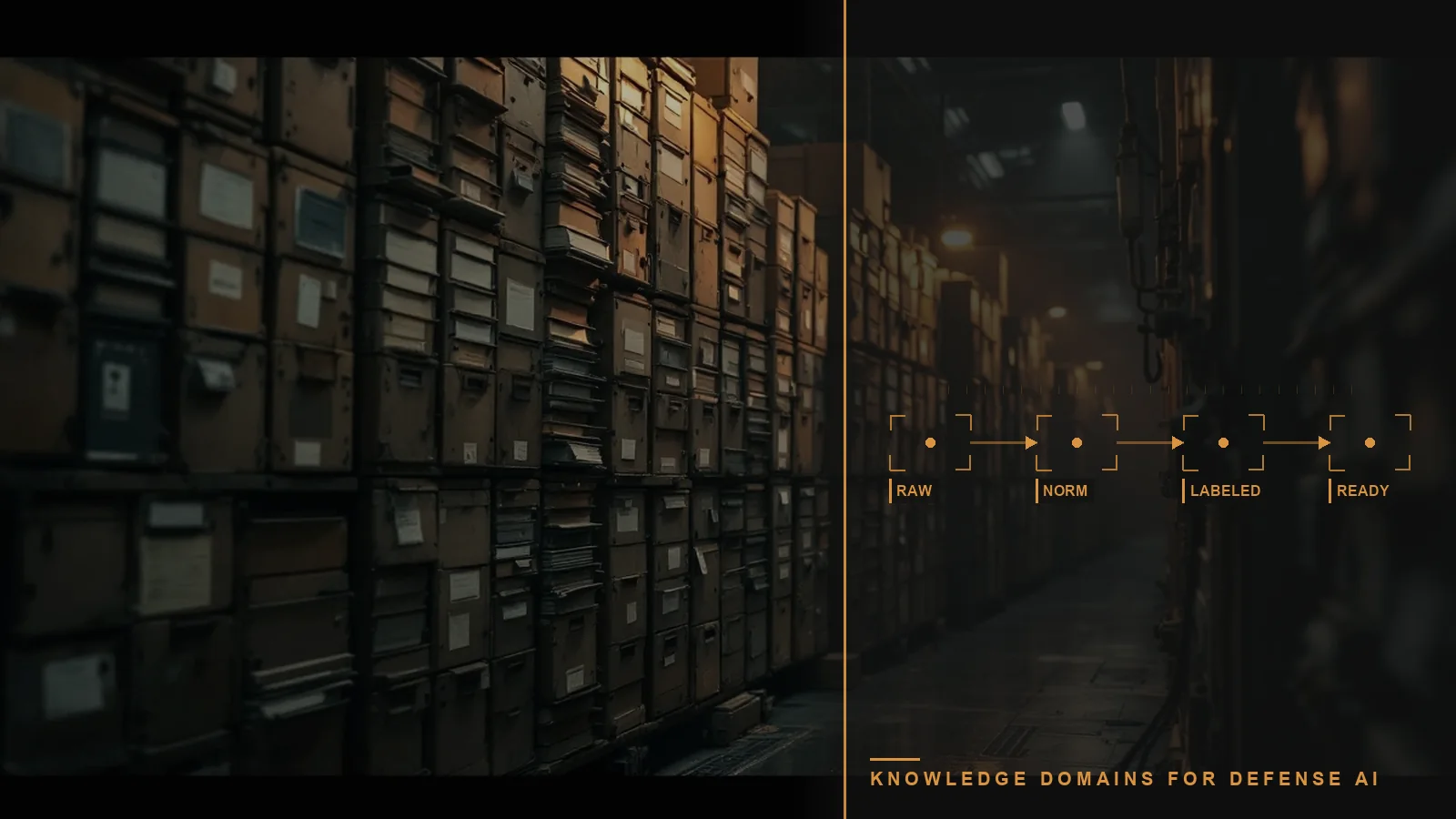
A knowledge domain is the unit of reusable analytical value in a reasoning platform: a durable, domain-specific pipeline and enriched data representation that turns a type of data or problem space into a reusable analytical object, packaging authoritative sources, semantic enrichment, concepts, relationships, and retrieval so AI and analysts can reason over it and reuse it across problems.
Why it matters to your mission. Every new problem usually means rebuilding the data work from scratch, so analytical value is spent once and lost. A knowledge domain packages that work into a reusable analytical object. The outcome is speed and compounding return: new missions stand up faster because the hard analytical work is reused, not rebuilt.
Also called mission knowledge domains or reusable knowledge domains.
The idea answers a specific failure. Understanding in a headquarters is usually assembled per task and then lost: the sources, the vocabulary, the relationships that made an analysis work leave with the person who did it. A knowledge domain captures that structure, which authoritative sources count, what the key concepts and entities are, and how they relate, so the next question starts from accumulated knowledge instead of a blank page.
That makes a knowledge domain the organizing layer the rest of this hub plugs into: resolved entities and fused relationships populate it, GraphRAG reasons over it, and deterministic doctrine governs it. A knowledge domain is what turns one-off analysis into a reusable, governable asset.
Key takeaways
Knowledge domains exist because knowledge in a military organization is notoriously hard to move and keep. Army doctrine makes knowledge management a formal discipline precisely for this reason, defining it as the process of enabling knowledge flow to enhance shared understanding, learning, and decision-making (U.S. Army, ATP 6-01.1, Knowledge Management, 2024). The problem it addresses is that understanding tends to live in people and slides, not in a reusable form, so it is rebuilt every rotation and lost every reassignment.
The demand for a better answer is visible in what the services are fielding. The Army's Combined Arms Command put an AI-powered knowledge platform into use to make doctrine, lessons learned, training, and planning content navigable and answerable rather than merely stored (U.S. Army, CAC advances AI-powered knowledge platform, 2026). That is the knowledge-domain idea in practice: take a bounded body of mission knowledge and make it something a person or an AI can reason over, not a shelf of documents.
The reason a loose document store is not enough is that reasoning needs structure. Answering a real question requires knowing which sources are authoritative, what the concepts and entities mean, and how they relate, not just retrieving the nearest paragraph. A knowledge domain supplies that structure deliberately, so the knowledge is not only findable but usable, and usable the same way every time rather than depending on who is asking.
For the mission the payoff is institutional memory that actually compounds: each hard-won analysis adds to a governed body of knowledge the next team inherits, so the force gets faster and more consistent over time instead of relearning the same ground.
A knowledge domain is more than a folder; it is a structured, governed thing. Its parts are:
The load-bearing parts are authoritative sources and reuse. Designating what counts as authoritative is what makes a domain trustworthy; packaging it for reuse is what makes it worth building. A body of knowledge that is neither governed nor reusable is just a data store with extra steps.
These terms sit close to knowledge domains and are easy to conflate. The table separates them.
Knowledge domains are useful because mission knowledge already divides into recognizable areas. A force reasons across the warfighting functions, intelligence, fires, sustainment, command and control, movement and maneuver, and protection, and across the enduring areas captured in the DOTMLPF-P construct: doctrine, organization, training, materiel, leadership and education, personnel, facilities, and policy. Each of those is a natural knowledge domain: a bounded body of authoritative sources, concepts, and relationships that recurs across missions.
That is the practical power of the idea, and it describes the shape of the whole approach: raw mission data, grouped by category, is organized into reusable knowledge domains, and those domains in turn power the expert systems and mission use cases built on top of them. Instead of treating every engagement as unique, a program can build a knowledge domain for a recurring area, intelligence collection, readiness, targeting, doctrine, and reuse it, adapting at the edges rather than starting over. The domains are stable even when the specific mission is not, which is exactly what makes the knowledge worth capturing once and governing well.
The difference between a knowledge domain and a well-organized project folder is reuse, and reuse is where the return lives. Building the authoritative sources, concepts, and relationships for a subject is expensive; doing it once and applying it across every problem that touches that subject is what makes the expense worth it. A knowledge domain built for a functional area serves the next mission in that area, the next analyst, and the next AI workflow, each inheriting vetted knowledge instead of rebuilding it. Reuse is also what makes governance tractable: a domain curated once, with its authoritative sources maintained, stays trustworthy across all the places it is used, whereas knowledge rebuilt per task is inconsistent by construction. The goal is not a bigger document store; it is a body of knowledge that is built once, governed deliberately, and applied everywhere it is relevant.
A knowledge domain is a force's accumulated understanding, among the most valuable things it builds. If the domain, its authoritative sources, and the logic that reasons over it live in a vendor's proprietary environment, the government has put its institutional memory somewhere it cannot fully control, govern, or move. The table contrasts the models against what a knowledge domain requires.
| Consideration | Typical commercial platform | Government-owned reasoning infrastructure |
|---|---|---|
| Control of the knowledge | Held in the vendor's proprietary model | Customer owns and governs the domain |
| Authoritative-source designation | Vendor-defined or opaque | The customer designates and maintains what is authoritative |
| Provenance | Varies | Every conclusion traces to a source in the domain |
| Portability and reuse | Locked to the vendor's model | Portable across problems, missions, and workflows |
| Keeping it current | On the vendor's cadence | The customer curates and governs change |
| Where it can run | Frequently cloud-only | Enterprise to classified and disconnected environments |
Government-owned does not mean the government builds everything itself or owns a vendor's underlying intellectual property. It means the knowledge domain, its authoritative sources, and the reasoning over it stay under the customer's control and governance rather than inside a proprietary model. Whether a specific deployment is government-owned (GOTS) or commercial (COTS) depends on the system the customer installs and purchases; for a force's own institutional knowledge, the government-owned model is the one to evaluate.
A knowledge domain encodes what the force treats as true, so a human has to own that authority. The machine does the assembly and the reasoning: ingesting sources, structuring concepts and relationships, and answering over the domain at scale. But designating which sources are authoritative, resolving what the domain should treat as correct, and governing how it changes are judgments a knowledge manager or subject authority owns, not an automated default. Two properties make that possible: every answer carries provenance back to the authoritative source it rests on, so it can be checked; and the domain surfaces where knowledge is thin or contested rather than papering over it. This is the same auditable discipline the rest of this hub requires, applied to institutional knowledge: the AI reasons over the domain; the human governs what the domain holds as true.
The sections above explain why authority, structure, and reuse matter; the checklist is what to require in an evaluation.
Evaluating a capability? The seven requirements above are the backbone of a knowledge-domain evaluation you can score vendors against. Bring them to a scoping call and we will walk each one against your environment: request a technical walkthrough.
For the customer, the outcome is reuse and speed: analytical work becomes a durable asset that stands up the next mission faster instead of starting over. Here is how Torch.AI delivers it.
Torch.AI builds reasoning infrastructure the customer can own and govern, offered as a government-owned (GOTS) deployment when a mission requires it, with knowledge domains as a first-class concept. ORCUS readies the underlying data; NEXUS, the analytical layer above it, builds and serves knowledge domains as its primary unit of reuse, packaging a bounded problem space into semantically enriched representations that encode meaning, time, and location, with its designated authoritative sources, concepts, relationships, and retrieval, so it becomes a reusable analytical object rather than a document store; HALO resolves and fuses the entities and relationships that populate a domain; and a deterministic doctrine layer applies the governing rules within a domain where they must be evaluated consistently. Those governed domains in turn power the expert systems and mission use cases built on them, each owned and portable rather than locked in a proprietary model, with every answer traced to the authoritative source it rests on. You can see how this is packaged as a capability on the Torch.AI software page.
Because the domain is governed with provenance preserved, it is built for the knowledge manager and the analyst rather than around them: a human designates what is authoritative and governs change, and the reasoning over the domain stays inspectable. This is the systems of record versus systems of reason distinction at the center of Torch.AI's approach: a knowledge domain is a reusable system of reason built on top of the authoritative sources, which stay intact, so the force's institutional knowledge compounds instead of evaporating.
Torch.AI's approach is built for the conditions this page describes: bounded bodies of mission knowledge; designated, governed authoritative sources; concepts and relationships that support reasoning; reuse across problems and missions; and auditable, government-owned operation from the enterprise to the disconnected edge.
For evaluators scoping a capability, see how Torch.AI builds and governs reusable knowledge domains on the software page, or request a technical walkthrough and we will build one against a sample of your own mission knowledge, with provenance traced end to end.
What is a knowledge domain in simple terms? It is a reusable analytical package: a durable, domain-specific pipeline and enriched data representation that turns a type of data or problem space into a reusable analytical object. It packages authoritative sources, key concepts, relationships, semantic enrichment, and retrieval, so AI and analysts can reason over it and reuse it across problems instead of rebuilding the same understanding every time.
How is a knowledge domain different from a knowledge base or RAG corpus? A knowledge base or RAG corpus is a collection of documents retrieved to ground answers. A knowledge domain adds designated authoritative sources, defined concepts, and explicit relationships, so it supports reasoning and reuse, not just retrieval of the nearest passage.
Why are knowledge domains reusable? Because the expensive part, building the authoritative sources, concepts, and relationships for a subject, is done once and then applied across every problem that touches that subject. A domain built for a functional area serves the next mission, analyst, and workflow in that area, each inheriting vetted knowledge.
How do knowledge domains relate to knowledge management? Knowledge management is the discipline of enabling knowledge to flow for decision-making; a knowledge domain is a structured, reusable, governed unit that knowledge management produces, so the knowledge is captured in a form AI and analysts can actually reason over.
Who decides what a knowledge domain treats as authoritative? A human does. Designating authoritative sources and governing what the domain holds as true are judgments a knowledge manager or subject authority owns. The AI reasons over the domain and traces answers to sources; it does not decide what is authoritative, consistent with auditable AI principles.
Why should knowledge domains be government-owned? Because a knowledge domain is a force's accumulated institutional knowledge. A government-owned (GOTS) deployment keeps the domain, its authoritative sources, and the reasoning over it under the customer's control, portable and governable rather than locked in a vendor's model. The same capability can also be delivered commercially (COTS); which applies depends on the system the customer installs and purchases.


Describe the problem.
Define the constraints. We will structure the session.
No demo.
No slide deck.
Real work.
Describe the problem.
Define the constraints. We will structure the session.
No demo.
No slide deck.
Real work.