

Learn
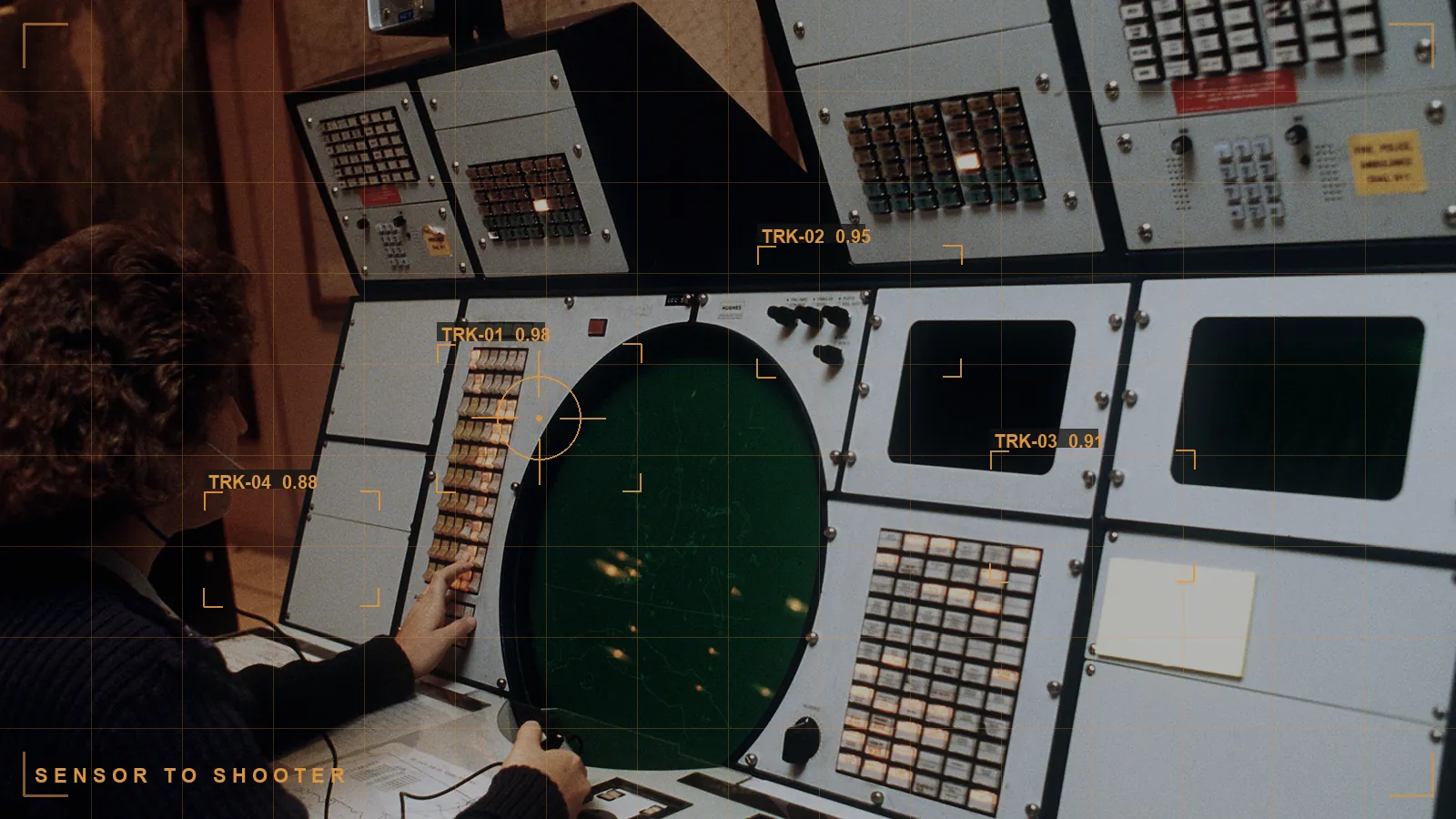
Sensor-to-shooter is the time and data path from a sensor detecting a potential target to a shooter being cleared and able to act on it, spanning the detection, identification, decision, and tasking steps that connect the two.
Last updated: October 23, 2026
Why it matters to your mission. In a fight, the side that closes the gap between seeing a target and acting on it wins the exchange. That gap is the sensor-to-shooter timeline, and most of it is not flight time or trigger time. It is data time: the minutes spent moving a detection between systems, correlating it with other sources, confirming the target, and getting a decision to the right shooter. In contested operations that data path runs across many sensors, networks, and services that were never built to talk to each other. Compressing sensor-to-shooter is therefore less a weapons problem than a problem of fusing and routing data fast and reliably across systems. That is the heart of the modern decision-speed story.
Sensor-to-shooter is the time and data path from a sensor detecting a potential target to a shooter being cleared and able to act on it, spanning the detection, identification, decision, and tasking steps that connect the two. The phrase names both a timeline to be measured and a chain of data-handoffs to be engineered, which is why reducing it is as much about data movement as about the sensor or the weapon at either end.
The concept sits at the center of the Defense Department's command-and-control modernization. The Congressional Research Service describes Joint All-Domain Command and Control (JADC2) as a concept that "connects the data sensors, shooters, and related communications devices of all U.S. military services" into a single network, adopting "a network-centric approach (connecting every sensor with every shooter) in an attempt to move data at machine speed." Sensor-to-shooter is the specific path that runs through that network for a single engagement, and the time it takes is the metric the whole effort is trying to drive down.
Key takeaways
The sensor-to-shooter timeline is the total elapsed time from the moment a sensor first detects a candidate target to the moment a shooter is cleared and able to engage it. It is a measured interval, and it is the number that command-and-control modernization is built to reduce. The timeline is not a single transaction; it is the sum of every handoff along the way, and each handoff is a place where time is lost.
The steps in the path are consistent across doctrine and vendor descriptions, even when the labels differ. Each one adds time.
| Stage | What happens | Where time is lost |
|---|---|---|
| Detect | A sensor registers a candidate target | Getting the detection off the sensor and onto a shared network |
| Locate and identify | The track is positioned and classified as friend, foe, or unknown | Correlating one sensor's data with others to confirm what it is |
| Decide | A human authority weighs the target against rules of engagement and intent | Assembling a trustworthy picture fast enough to decide with confidence |
| Task | The engagement is assigned to the best available shooter | Matching the right shooter across services and routing the order |
| Engage and assess | The shooter acts and the effect is evaluated | Feeding the result back so the next decision is informed |
The point of laying the path out this way is that the sensor and the shooter at the two ends are rarely the slow part. The middle, where a detection becomes a confirmed, decidable, assignable target, is where a timeline measured in minutes or hours is made or lost. That middle is a data problem.
Sensor-to-shooter and the kill chain describe the same engagement from two angles. The kill chain is the sequence of functional steps, find, fix, track, target, engage, and assess, that an organization performs to prosecute a target. Sensor-to-shooter is the timeline and data path that runs through those steps, with emphasis on connecting the sensor at the front to the shooter at the end. The kill chain tells you what has to happen; sensor-to-shooter tells you how long it takes and where the data moves.
The two terms are often used together because the modern goal is to break the chain's rigidity. The Congressional Research Service frames JADC2's purpose as enabling commanders to "understand the battlespace," "direct forces," and "deliver synchronized combat effects" faster than an adversary can. Achieving that means any sensor in any domain should be able to cue any available shooter in any other domain, which turns a single linear chain into a flexible web of possible sensor-shooter pairings.
| Term | What it names | Primary emphasis |
|---|---|---|
| Kill chain | The ordered functional steps from finding a target to assessing the effect | The process: what must be done, in what order |
| Sensor-to-shooter | The timeline and data path connecting the detecting sensor to the engaging shooter | The speed and the data handoffs between systems |
| Kill web | Many sensors and shooters interconnected so any can pair with any other | Flexibility and resilience across domains and services |
The distinction matters for buyers because the kill chain can be doctrinally sound while the sensor-to-shooter timeline is still too slow. The steps are right; the data cannot move between them fast enough. That is the gap infrastructure has to close.

The delay builds in the middle, not at the ends
The sensor and the weapon are fast. The delay accumulates in the middle, where a detection has to be correlated, confirmed, decided on, and routed across systems that were never built to interoperate.
Compressing the timeline rarely means re-engineering sensors or shooters. It means removing the manual data handoffs between them, while the decision stays with a human authority. Segment widths are illustrative, not measured.
Sensor-to-shooter is slow today primarily because the data path crosses fragmented systems that were never designed to interoperate, so the time is consumed in manual correlation, format translation, and relaying information between stovepipes rather than in the sensing or the shooting. The individual sensors are fast and the weapons are fast. The seams between them are not.
The Government Accountability Office is direct about the organizational root of this. In its 2025 review, GAO found that "military services are pursuing projects largely in isolation and without clear goals," and warned that "in the absence of clear direction, warfighting entities will continue to pursue their command and control projects largely in isolation, which will likely result in achieving CJADC2 much more slowly and inefficiently, if at all." Projects built in isolation produce data that does not readily combine, and non-combining data is exactly what forces the slow, manual handoffs in the middle of the path.
There are three recurring sources of delay, and all three are data problems:
None of these are solved by a faster missile or a better sensor. They are solved by making fragmented, multi-source data combine quickly and reliably, which is an infrastructure problem.
Sensor-to-shooter time is reduced by removing the manual data handoffs in the middle of the path, so detections from many sensors are automatically correlated, identified, and routed to the right shooter at machine speed instead of being relayed by hand between systems. The weapons and sensors are rarely re-engineered. The data layer between them is.
In practice this means four things have to happen to the data as it crosses the path:
This is why decision speed is fundamentally a data-and-reasoning problem. The hard part of shortening sensor-to-shooter is turning fragmented, multi-source detections into a single trustworthy picture fast enough to act on, which is the same cross-source correlation that multi-INT fusion and a shared common operating picture depend on. The outcome the whole path is engineered for is decision advantage: acting on a confirmed target before the adversary can react.
Combined Joint All-Domain Command and Control (CJADC2) shortens sensor-to-shooter by treating the connection between sensors and shooters as a data-integration problem rather than a collection of separate systems, using shared data and analytics to move a detection to a decision and a shooter faster than any single service could alone. It is explicitly not a new weapon or a single platform.
The Defense Department was precise about this when it delivered the first working version. In announcing the CJADC2 minimum viable capability, Deputy Secretary of Defense Kathleen Hicks said, as reported by DOD News, that "CJADC2 isn't a platform, or a single system. It's a fusion of concepts, technologies, policies, tools, and talent that's advancing how we command and control forces." DOD News described the capability as "combining software applications, data integration and cross-domain operational concepts designed to provide decision advantage to warfighters." The operative words are data integration and decision advantage: the capability compresses the path by integrating data, not by replacing the shooters.
The GAO frames the concept the same way, stating plainly that "CJADC2 is not itself a system but is a way to use data and analytics to make and communicate better decisions in battle." This is the key point for anyone evaluating how to shorten their own sensor-to-shooter path: the lever is the data and reasoning layer, and it has to connect existing systems rather than rip them out. For a deeper treatment of how AI fits into this, see CJADC2 and AI and the broader CJADC2 overview. The same compression logic applies at the forward edge, where tactical edge AI processes detections close to the sensor to cut the time before data even enters the network.
A related data-ownership point matters here. The government-owned data integration direction behind CJADC2 is reflected in the Open Data and Applications Government-owned Interoperable Repositories (Open DAGIR) approach, which lets the Defense Department integrate multiple vendors' applications while retaining ownership and control of its own data. Shortening sensor-to-shooter should not come at the cost of handing the integrated picture to a single vendor.
Torch.AI does not build weapons or sensors, and this page is not a claim to a fire-control system. What Torch.AI builds is the government-owned reasoning infrastructure that the data-heavy middle of the sensor-to-shooter path depends on: the ability to connect fragmented, multi-source detections into one coherent, trustworthy picture at machine speed, while keeping every element traceable to its source.
The relevant capability is correlation you can trust and govern. Compressing the path means pulling detections and corroborating data out of many systems, resolving when separate records describe the same object, and presenting a confirmed track a commander can decide on and defend, all without trapping that picture in a proprietary model. ORCUS provides the data-availability layer that connects to sources and preserves provenance. NEXUS applies semantic representation so unstructured and mismatched records become something a system can correlate. HALO fuses resolved entities and relationships into a graph an analyst can inspect and trace. Because this runs as a system of reason on top of existing systems of record, the sensors, networks, and command systems stay intact, and in a government-owned deployment the customer keeps control of the layer where fragmented detections become a decidable target. You can see how this is packaged on the Torch.AI software page.
For evaluators, the fit is specific: if your sensor-to-shooter timeline is slow because detections are scattered across systems faster than anyone can correlate and confirm them, that is a data and reasoning problem, and it is the one this infrastructure is built for. Request a technical walkthrough and we will run it against a representative slice of your own multi-source data, with provenance traced end to end.
The weapons and sensors are mature. The modern gap is the data capability that connects them. If you are evaluating infrastructure to compress a sensor-to-shooter path, require:
Evaluating a capability? Bring these six requirements to a scoping call and we will walk each one against your environment: request a technical walkthrough.
The sensor-to-shooter timeline is the total elapsed time from a sensor first detecting a candidate target to a shooter being cleared and able to engage it. It is the sum of every step in between, detect, identify, decide, and task, and most of the time is spent moving and confirming data between systems rather than in the sensor or the weapon.
The kill chain is the ordered sequence of functional steps from finding a target to assessing the effect. Sensor-to-shooter is the timeline and data path that runs through those steps, emphasizing how fast and how reliably data moves from the detecting sensor to the engaging shooter. The kill chain names what must happen; sensor-to-shooter measures how long it takes.
It is slow mainly because the data path crosses fragmented systems that were never built to interoperate, so time is lost to manual correlation, format translation, and relaying information between stovepipes. GAO has found that services pursue command-and-control projects largely in isolation, which produces data that does not readily combine and forces the slow handoffs in the middle of the path.
It is reduced by removing the manual data handoffs in the middle of the path, so detections from many sensors are automatically correlated, identified, and routed to the right shooter at machine speed. The sensors and weapons are rarely re-engineered; the data and reasoning layer between them is, so a confirmed, decidable target reaches a shooter faster.
CJADC2 treats the connection between sensors and shooters as a data-integration problem rather than a set of separate systems. The Defense Department describes its CJADC2 capability as combining software applications, data integration, and cross-domain concepts to provide decision advantage, and GAO calls CJADC2 a way to use data and analytics to make better decisions in battle. The compression comes from integrating data, not replacing shooters.
It is mostly a data problem. The sensors and weapons at the two ends are fast; the delay accumulates in the middle, where a detection has to be correlated across sources, confirmed, decided on, and routed to the right shooter. Compressing the timeline therefore depends on fusing and moving fragmented, multi-source data quickly and reliably, which is a reasoning-infrastructure capability.


Describe the problem.
Define the constraints. We will structure the session.
No demo.
No slide deck.
Real work.
Describe the problem.
Define the constraints. We will structure the session.
No demo.
No slide deck.
Real work.