Learn
Command and control (C2) is the exercise of authority and direction by a properly designated commander over assigned and attached forces in the accomplishment of the mission, carried out through people, processes, data, networks, and C2 nodes.
Command and control (C2) is the exercise of authority and direction by a properly designated commander over assigned and attached forces in the accomplishment of the mission, carried out through people, processes, data, networks, and C2 nodes.
Last updated: November 17, 2026
Why it matters to your mission. Intelligence, fires, maneuver, and logistics each do something; command and control points them at the same objective at the same time. When the commander's picture is late, partial, or assembled by hand from a dozen screens, the force works hard on the wrong problem, or on the right problem too slowly. The modern C2 question is less about who holds authority, which doctrine settles, and more about whether the information under that authority arrives fast, complete, and trustworthy enough to decide on.
The first half of that definition is joint doctrine word for word: command and control is "the exercise of authority and direction by a properly designated commander over assigned and attached forces in the accomplishment of the mission," from Joint Publication 1, Volume 2, as carried in the DoD Dictionary of Military and Associated Terms. The second half comes from the U.S. Army's ADP 6-0, Command and Control (July 2026), which defines the C2 system as "the arrangement of people, processes, data and networks, and command and control nodes that enable commanders to conduct operations."
ADP 6-0 states the stakes plainly: C2 by itself will not secure an objective, destroy a target, or deliver supplies, but none of those activities can be coordinated or synchronized without it. Authority is the constant. What changes from one era to the next is the system that turns authority into coordinated action, and today that system runs on data.
Key takeaways
Command and control by the numbers
In the military, command and control means the commander's lawful authority over assigned forces and the means by which that authority produces coordinated action. It is not a piece of equipment or a single office. ADP 6-0 calls C2 "fundamental to the art and science of warfare" and places the commander at its focal point: commanders "assess situations, make decisions, and direct action."
C2 also covers mission activities that sound like separate disciplines. GAO notes that targeting, "the process of selecting and prioritizing targets and matching the appropriate response to them," is a command and control activity, and that battle management is a subset of C2 rather than a synonym for it (GAO-25-106454). Read that way, the kill chain and the sensor-to-shooter timeline are C2 applied to a single target, which is why delays anywhere in the C2 system show up as delays in engagement.
Command is authority; control is regulation. Command is the commander's right and responsibility to decide and direct. Control, in ADP 6-0's words, "is the regulation of forces and warfighting functions to accomplish the mission in accordance with the commander's intent." The Army describes command as more art than science and control as "more science than art because it relies on objectivity, empirical methods, and data driven analysis."
| Dimension | Command | Control |
|---|---|---|
| Core meaning | The authority a commander lawfully exercises over subordinates | The regulation of forces and warfighting functions to accomplish the mission |
| Nature | More art than science: judgment, intuition, leadership | More science than art: measurement, data, analysis |
| Elements (ADP 6-0, 2026) | Authority, responsibility, decision making, leadership | Information, communication, organization |
| Typical failure | A decision that is late, unclear, or not owned | A sound decision built on stale, partial, or untraceable information |
| Where technology helps | Supports judgment; does not replace it | Directly: processing data, sharing information, synchronizing action |
The table shows where modern investment concentrates. Nobody is trying to automate command authority. ADP 6-0 is explicit that "the C2 system begins with people" and that "no amount of technology can reduce the importance of the human dimension." What technology changes is control. The 2026 edition notes that "computing and communication technologies such as artificial intelligence, machine learning, and mesh networks significantly contribute to effective C2." Information is the first element of control, and it is where oversight finds the sharpest problems.

Command is authority; control is regulation
Command is the commander's right and responsibility to decide and direct. Control is the regulation of forces to accomplish the mission in line with the commander's intent.
Nobody is trying to automate command authority. Modern investment concentrates on control, where information is the first element and data is now part of the C2 system.
A command and control system is everything a commander uses to exercise C2, not only the hardware. Joint doctrine (JP 6-0, as defined in the DoD Dictionary) calls it "the personnel, facilities, equipment, communications, and procedures essential for a commander to plan, direct, and control operations of forces pursuant to the missions assigned." The Army's 2026 ADP 6-0 reframes the components as people, processes, data and networks, and C2 nodes, adding the role of technology and data to the 2019 edition.
Army doctrine now names data as a component, not a by-product of networks. ADP 6-0 assigns the C2 system three basic functions:
For example, A brigade staff receives a report of a hostile drone launch site. The sensor report lands in one system, the status of available fires assets sits in another, and the airspace picture lives in a third. The people are the commander and staff, the processes are the battle rhythm and targeting cycle, the data and networks are those three feeds, and the C2 node is the command post. If the feeds do not reconcile on their own, a staff officer re-keys one screen into another and the decision waits on the slowest manual step. Every component can be sound while the system as a whole is slow.
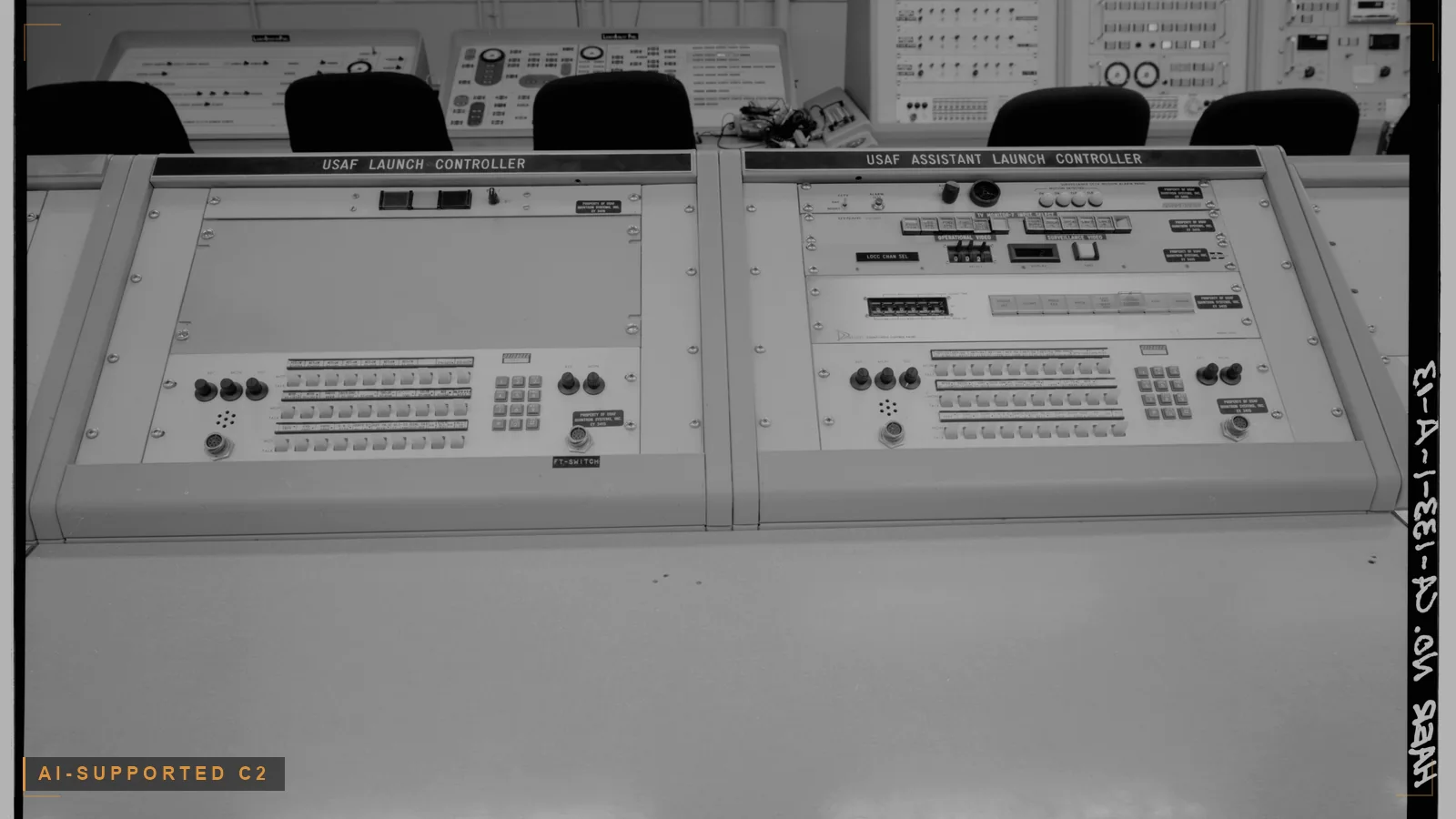
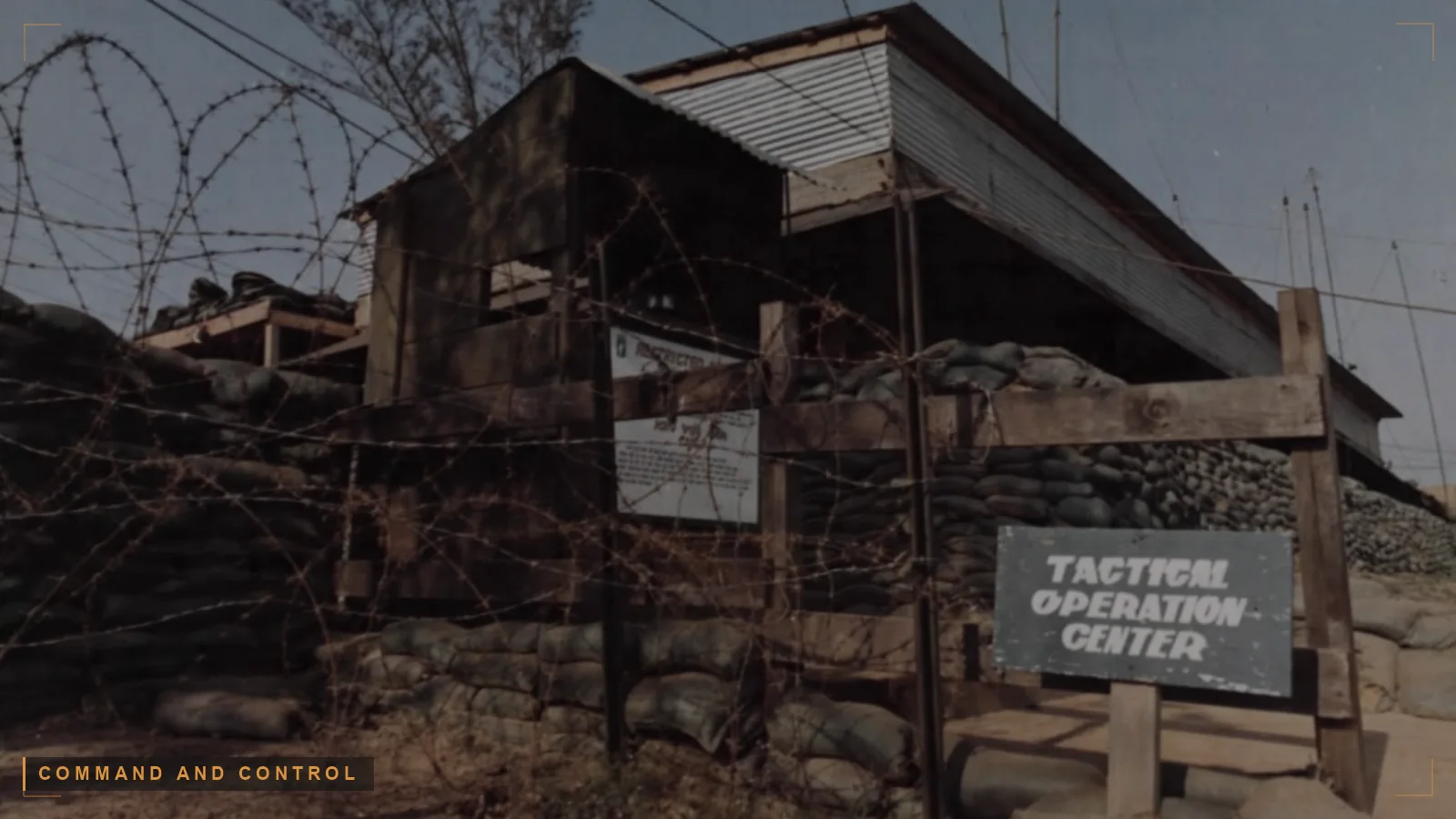
A command and control center is the physical or virtual facility where a commander and staff build understanding, plan, and direct operations. In joint doctrine the headquarters version is a joint operations center: "a jointly manned facility of a joint force commander's headquarters established to plan, monitor, and guide the execution of the commander's decisions" (JP 3-33, DoD Dictionary). The Army's 2026 doctrine uses the broader term C2 node, a physical or virtual location where people, processes, and networks come together to support the commander. The shift is deliberate: because large, static headquarters are vulnerable, ADP 6-0 says "command posts are no longer the singular center point of command and control," and commanders now operate the C2 system through a series of dispersed nodes.
ADP 6-0 judges every C2 node by its core tasks, including situational understanding, planning, controlling operations, and data orchestration, which it defines as "the process of synchronizing, integrating, and prioritizing data to enhance shared understanding and decision making." Data integration is now a doctrinal C2 task, not an IT afterthought.
Oversight explains why that task is hard. GAO found that DoD builds large operations centers that "largely rely on inefficient 'swivel chair' data collection and assessment processes": analysts re-enter data from multiple displays into yet another system, in part because it sits at different classification levels and in different formats. GAO concluded this makes it harder for warfighters to decide at the scale and tempo missions need (GAO-25-106454). The shared display those centers produce is the common operating picture.
The center is also a target. ADP 6-0 warns that "the enemy prioritizes friendly C2 nodes as high-value targets," so nodes must keep working in disrupted, degraded, intermittent, and low-bandwidth conditions and favor dispersion and redundancy over one large site. Dispersal raises the data problem further: many smaller nodes have to share one picture over thin links. That is the DDIL environment, and it is where tactical edge AI has to operate.
Command and control is shifting from service-specific networks and hand-built pictures toward one connected, data-centric C2 environment across all domains and partners. The Department of Defense, now also styled the Department of War, pursues this through Combined Joint All-Domain Command and Control (CJADC2). GAO describes CJADC2 as "DOD's long-term concept to connect and modernize command and control capabilities from various military departments and organizations," intended to move from swivel-chair analysis to a model where all data is integrated (GAO-25-106454). GAO reports that DoD's modernization strategy also aims for more automated, scalable decision-making tools.
GAO also identified what stands in the way. Systems were built in stovepipes, often around "proprietary contractor designs and architectures," and proprietary application programming interfaces "can restrict the government's ability to connect software applications and make updates." Classification and releasability markings limit what can be shared with partners.
This page is the hub for that topic. Each spoke covers one part of modern C2 in depth:
AI supports command and control on the control side of the equation: processing more data than a staff can read, correlating reports across systems, and generating options faster, while the commander keeps authority and accountability. ADP 6-0 draws the same line. Technology such as artificial intelligence and machine learning can enhance the C2 system, but the system "begins with people," and commanders "base their exercise of C2 on human characteristics more than on processes, data and networks, and C2 nodes."
In the Air Force's first Decision Advantage Sprint, initial analysis found that software responded to more than twice as many dilemmas as humans alone and that machine error rates were "on par with human error," alongside the seven-fold decision-time reduction noted above. It was a single experiment, not a fielded capability.
The useful question for an evaluator is how the AI earns trust inside a C2 process: whether every recommendation traces back to its sources, whether it respects classification, and whether a human stays in or on the loop at the right points. Those questions are covered in human-machine teaming, human-in-the-loop vs human-on-the-loop, and decision advantage.
"Command and control" overlaps with several terms, and one of them means something entirely different.
| Term | What it means | Relationship to command and control |
|---|---|---|
| Mission command | Joint doctrine: "the conduct of military operations through decentralized execution based upon mission-type orders" (JP 3-31). Army: its "approach to command and control" | A philosophy for exercising C2, not a substitute for it. It decides how much decision authority is pushed down |
| Battle management | "The management of activities within the operational environment based on the commands, direction, and guidance given by appropriate authority" (JP 3-01) | A subset of C2, per GAO. It executes within the direction C2 provides |
| Common operational picture (COP) | "A single, identical display of relevant information shared by more than one command" (JP 3-0) | A product of the C2 system that supports shared understanding |
| CJADC2 | DoD's concept to connect C2 capabilities across services, domains, and partners | The current modernization effort for C2 itself. See What is CJADC2? |
| Command and control (cybersecurity) | In MITRE ATT&CK, the adversary tactic of communicating "with compromised systems to control them" (TA0011) | Same words, different field. A "C2 server" in a malware report is attacker infrastructure, not military command |
The cybersecurity row explains much of the search confusion around "C2." Malware, beacons, and "C2 channels" are the cyber meaning; commanders, forces, and operations are the military meaning this page covers.
Doctrine settles authority. The open problem is the data underneath control. If you are evaluating a capability to support command and control, require:
Evaluating a capability? Bring these nine requirements to a scoping call and we will walk each one against your C2 environment: request a technical walkthrough.
Torch.AI does not provide command authority. What Torch.AI builds is the reasoning infrastructure under the control side of C2: the layer that turns fragmented, multi-source data into coherent understanding at machine speed, so the people who exercise command decide on a complete, traceable picture.
Two products map to the C2 tasks doctrine now names. ORCUS is the data-availability layer. It connects to data where it already lives, automates ingestion and normalization, synchronizes multi-source data, enforces identity and access controls, and captures metadata and provenance before routing data to downstream workflows. That maps to the data orchestration task ADP 6-0 assigns to a C2 node. NEXUS is the analytical layer above it. It builds a consistent semantic representation across systems that describe the same unit, track, or event in different formats, and packages that analysis into reusable knowledge domains, which supports the data analytics a C2 node runs to produce actionable insight. Where a mission needs relationships made explicit, HALO adds graph-based fusion on top.
Because this layer reasons on top of existing systems of record rather than replacing them, the authoritative C2, intelligence, and logistics systems keep doing their jobs, and every element in the commander's picture keeps a line back to its source with its classification intact. That is the distinction between systems of record and a system of reason. The infrastructure is available as a government-owned deployment when the mission requires the customer to control the integration and reasoning logic; whether a given installation is government-owned (GOTS) or commercial (COTS) depends on how it is deployed and purchased. You can see how this is packaged on the Torch.AI software page.
Command and control is the exercise of authority and direction by a properly designated commander over assigned and attached forces in the accomplishment of the mission, the joint definition from JP 1, Volume 2. In practice it is both the commander's authority and the system of people, processes, data, networks, and C2 nodes that turns that authority into coordinated action.
Command is authority: the commander's lawful right and responsibility to decide and direct. Control is regulation: directing and synchronizing forces in line with the commander's intent. Army doctrine (ADP 6-0) treats command as more art and control as more science.
A command and control system is everything a commander uses to exercise C2. Joint doctrine lists the personnel, facilities, equipment, communications, and procedures needed to plan, direct, and control operations; the Army's 2026 ADP 6-0 describes people, processes, data and networks, and C2 nodes. It exists to build situational understanding, support decisions, and help the force adapt.
A command and control center is the facility where a commander and staff build understanding, plan, and direct operations. In joint doctrine the headquarters version is a joint operations center. Army doctrine calls these C2 nodes, physical or virtual, and expects them to orchestrate and analyze data from many sources.
The Department of Defense is moving from service-specific networks and manually assembled pictures toward one connected, data-centric C2 environment through CJADC2, for which it requested over $1.4 billion in fiscal year 2025. GAO found operations centers still relying on "swivel chair" data handling and identified proprietary interfaces and classification barriers as obstacles to connecting the hundreds of systems involved.
AI supports the control side of C2 by processing large volumes of data, correlating reports across systems, and generating options faster, while the commander keeps authority. In the Air Force's first Decision Advantage Sprint, initial analysis found battle managers' average decision time fell seven-fold with machine support, a single experiment rather than a fielded result.
In cybersecurity, command and control refers to the channels and infrastructure an adversary uses to communicate with compromised systems and control them, catalogued as tactic TA0011 in MITRE ATT&CK. It is a different concept from military command and control: a "C2 server" in a threat report is attacker infrastructure, not a military headquarters.
Command and control is the function: a commander's authority and direction over forces. Mission command is a philosophy for exercising that function through decentralized execution based on mission-type orders. The U.S. Army describes mission command as its approach to command and control.


Describe the problem.
Define the constraints. We will structure the session.
No demo.
No slide deck.
Real work.
Describe your command and control environment. We will scope a session around your systems and data. No demo. Your C2 data. Real work.